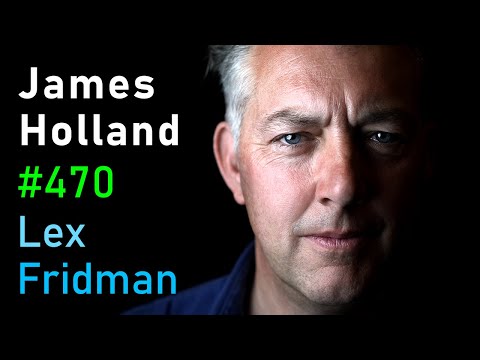
James Holland: World War II, Hitler, Churchill, Stalin & Biggest Battles | Lex Fridman Podcast #470
James Holland (guest), Lex Fridman (host), Narrator, Narrator
In this episode of Lex Fridman Podcast, featuring James Holland and Lex Fridman, James Holland: World War II, Hitler, Churchill, Stalin & Biggest Battles | Lex Fridman Podcast #470 explores james Holland Dissects World War II: Strategy, Ideology, and Catastrophe James Holland and Lex Fridman explore World War II as a uniquely global, industrial, and ideological catastrophe, emphasizing its scale and human drama. Holland challenges myths about German military superiority, highlighting how logistics, production, and coalition warfare defined the conflict more than battlefield heroics alone. They analyze Hitler’s ideology, propaganda, and strategic blunders—especially Barbarossa, Stalingrad, and the failure to understand operational logistics. The conversation culminates in the Normandy landings, the Holocaust’s mechanics, and lessons about how fragile democracy and peace are in the face of economic crisis, propaganda, and extremist leaders.
James Holland Dissects World War II: Strategy, Ideology, and Catastrophe
James Holland and Lex Fridman explore World War II as a uniquely global, industrial, and ideological catastrophe, emphasizing its scale and human drama. Holland challenges myths about German military superiority, highlighting how logistics, production, and coalition warfare defined the conflict more than battlefield heroics alone. They analyze Hitler’s ideology, propaganda, and strategic blunders—especially Barbarossa, Stalingrad, and the failure to understand operational logistics. The conversation culminates in the Normandy landings, the Holocaust’s mechanics, and lessons about how fragile democracy and peace are in the face of economic crisis, propaganda, and extremist leaders.
Key Takeaways
World War II was decided by logistics and industry more than tactics.
Holland stresses the ‘operational’ level—factories, shipping, fuel, and standardization—arguing that Allied production capacity and supply-chain management ultimately outweighed German tactical prowess or individual battlefield brilliance.
Get the full analysis with uListen AI
The Nazi ‘war machine’ was far less mechanized than its image suggests.
Only a small fraction of German divisions were fully motorized; most of the army relied on horses and an incoherent mix of vehicles, creating massive maintenance and supply problems, especially in the Soviet Union’s vast terrain.
Get the full analysis with uListen AI
Hitler’s ideological rigidity produced catastrophic strategic errors.
His racial-ideological goals (Lebensraum, destruction of ‘Jewish Bolshevism’) overrode military pragmatism, leading to overreach in Barbarossa, a fixation on symbolic targets like Stalingrad, and refusal to adapt plans even when war-gaming showed they could not work.
Get the full analysis with uListen AI
Propaganda plus new technology can rapidly radicalize a modern society.
Goebbels’ integration of radio, film, and mass rallies created a dense propaganda environment in which simple, black-and-white narratives (‘us vs. ...
Get the full analysis with uListen AI
German military ‘genius’ and hardware are often overrated in hindsight.
Holland argues Hitler was not a military genius, German operations were logistically unsound, and prestige weapons like the Tiger tank were over-engineered, scarce, and hard to maintain—while simpler, reliable Allied equipment such as the Sherman tank and Mustang fighter were war-winning.
Get the full analysis with uListen AI
Stalingrad plus North Africa marked the true strategic turning point.
By late 1942–early 1943, Germany was simultaneously losing 6th Army at Stalingrad and vast material and aircraft in Tunisia; after that, with the US and USSR fully engaged, the numerical and industrial imbalance made eventual German defeat inevitable.
Get the full analysis with uListen AI
Normandy was a masterpiece of coalition planning and air supremacy.
D-Day succeeded not just through bravery on the beaches but through a year-plus of coordinated Anglo-American planning, absolute air superiority, mine-sweeping, deception, and the ability to out-supply and out-reinforce Germany once a bridgehead was established.
Get the full analysis with uListen AI
Notable Quotes
“Where there's war, there is always incredible human drama.”
— James Holland
“The Nazi war machine is a misnomer. The spearhead is mechanized—but the rest is not.”
— James Holland
“It’s a thousand-year Reich or it’s Armageddon. There is no middle ground for Hitler.”
— James Holland
“The Second World War is a war of numbers. At a certain point, the outcome becomes inevitable.”
— James Holland
“Life is fragile and peace is fragile. You take it for granted at your peril.”
— James Holland
Questions Answered in This Episode
How might World War II have unfolded differently if Britain and France had formed a genuine military alliance with the Soviet Union before the Molotov–Ribbentrop Pact?
James Holland and Lex Fridman explore World War II as a uniquely global, industrial, and ideological catastrophe, emphasizing its scale and human drama. ...
Get the full analysis with uListen AI
To what extent did economic trauma and Versailles-style humiliation, rather than inherent cultural factors, enable Hitler’s rise and the radicalization of German society?
Get the full analysis with uListen AI
What are the modern equivalents of Nazi radio and mass rallies, and how can democracies defend themselves against similar propaganda ecosystems today?
Get the full analysis with uListen AI
Was there any realistic point after 1941 at which Germany could have negotiated a peace that avoided total collapse, or did ideology make that impossible?
Get the full analysis with uListen AI
How should we morally evaluate Allied strategic bombing and civilian destruction when weighed against the alternative of a longer war and potentially greater Axis atrocities?
Get the full analysis with uListen AI
Transcript Preview
And you see that manifest itself on D-Day, where you've got 6,939 vessels of which there are 1,213 warships, (inhales deeply) 4,127 assault craft, 12 and a half thousand aircraft. You know, 155,000 men landed and dropped from the air in 24-hour period. It is phenomenal. It is absolutely phenomenal.
The following is a conversation with James Holland, a historian specializing in World War II, who has written a lot of amazing books on the subject, especially covering the Western front, often providing fascinating details at multiple levels of analysis, including strategic, operational, tactical, technological, and of course, the human side, the personal accounts from the war. He also co-hosts a great podcast on World War II, called We Have Ways of Making You Talk. This is a Lex Fridman podcast. To support it, please check out our sponsors in the description or at lexfridman.com/sponsors. And now, dear friends, here's James Holland. In volume one of The War in the West, your book series on World War II, you write, "The Second World War witnessed the deaths of more than 60 million people from over 60 different countries. Entire cities were laid waste. National borders were redrawn, and many millions more people found themselves displaced. Over the past couple of decades, many of those living in the Middle East or parts of Africa, the Balkans, Afghanistan, and even the United States may feel, justifiably, that these troubled times have already proved the most traumatic in their recent past. Yet, globally, the Second World War was, and remains, the single biggest catastrophe of modern history. In terms of human drama, it is unrivaled. No other war has affected so many lives in such a large number of countries." So, what to you makes World War II the biggest catastrophe and human drama in modern history? And maybe from a historian perspective, the most fascinating subject to study?
The thing about World War II is it really is truly global. You know, it's fought in deserts, it's fought in, in the Arctic, um, it's fought across oceans, it's fought in the air, um, it's in jungle, it's in the hills. It is on the beaches. (laughs) Um, it's also on the Russian Steppe and it's also in Ukraine. So it's, it's, it's that global nature of it. And I just think, you know, where there's, where there's war, there is always incredible human drama. And I think for most people, and certainly their true in my case, you get drawn to the human drama of it. It's that thought that, you know, "Gosh, if I'd been 20 years old, how would I have dealt with it?" You know, "Would I have been in the Army? Would I have been in the Air Force? Would I have been on a, you know, Royal Navy destroyer? Or, you know, how would I have coped with it? And how would I have dealt with that separation?" I mean, I've interviewed people who were away for four years. I remember talking to a tank man from, uh, from Liverpool in England, called Sam Bradshaw. And he went away for four years, and when he came home, he'd been twice wounded. He'd been very badly wounded in North Africa, and then he was shot in the neck in Italy. Eventually, got home. When he came home, his mother had turned gray. His little s- baby sister who had been, you know, 13 when he left, was now a, a young woman. His old school had been destroyed by Luftwaffe bombs. He didn't recognize the place. And do you know what he did? He joined up again. Went back outta Europe and was one of the first people in Belsen, so you know ...
Install uListen to search the full transcript and get AI-powered insights
Get Full TranscriptGet more from every podcast
AI summaries, searchable transcripts, and fact-checking. Free forever.
Add to Chrome