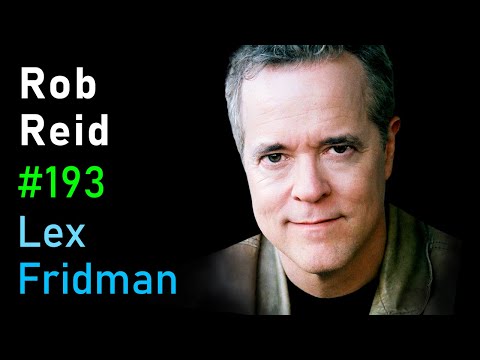
Rob Reid: The Existential Threat of Engineered Viruses and Lab Leaks | Lex Fridman Podcast #193
Lex Fridman (host), Rob Reid (guest), Narrator
In this episode of Lex Fridman Podcast, featuring Lex Fridman and Rob Reid, Rob Reid: The Existential Threat of Engineered Viruses and Lab Leaks | Lex Fridman Podcast #193 explores rob Reid warns: synthetic biology may outpace our defenses, fast Lex Fridman and Rob Reid explore existential risks from engineered pandemics, especially synthetic biology and gain-of-function research, arguing these may be more dangerous in the next few decades than AI or nuclear weapons. They discuss the lab‑leak hypothesis, institutional failures around COVID, and the urgent need for global surveillance, rapid diagnostics, and governance to prevent both accidents and malevolent use. The conversation ranges into simulation theory, memes, AGI and consciousness, space colonization as a civilizational backup, startup founding, and the meaning of life. Throughout, Reid is cautiously optimistic that “the good guys” can win if we act early and honestly about risks instead of censoring or denying them.
Rob Reid warns: synthetic biology may outpace our defenses, fast
Lex Fridman and Rob Reid explore existential risks from engineered pandemics, especially synthetic biology and gain-of-function research, arguing these may be more dangerous in the next few decades than AI or nuclear weapons. They discuss the lab‑leak hypothesis, institutional failures around COVID, and the urgent need for global surveillance, rapid diagnostics, and governance to prevent both accidents and malevolent use. The conversation ranges into simulation theory, memes, AGI and consciousness, space colonization as a civilizational backup, startup founding, and the meaning of life. Throughout, Reid is cautiously optimistic that “the good guys” can win if we act early and honestly about risks instead of censoring or denying them.
Key Takeaways
Synthetic biology is likely the dominant extinction risk in the next 30 years.
Reid argues that engineered pathogens—whether from bad actors or lab accidents—are more plausible near‑term civilization‑ending threats than runaway AI or even nuclear war, because biotech is advancing exponentially and is steadily democratizing.
Get the full analysis with uListen AI
Gain-of-function research on highly lethal viruses should be globally banned.
Using H5N1 experiments as a case study, he contends that deliberately making non‑contagious but ultra‑lethal viruses airborne in leaky BSL‑3/4 labs has enormous expected downside and very dubious upside, and should be prohibited by treaty similar to nuclear and bioweapons conventions.
Get the full analysis with uListen AI
We need layered, global early‑warning systems for outbreaks.
Reid highlights realistic measures: cheap in‑clinic and at‑home diagnostics, national and global lab networks (like the Sentinel project in Nigeria), and monitoring of symptom search queries, which together could spot new pathogens days to weeks earlier and massively reduce damage.
Get the full analysis with uListen AI
Institutional trust depends on openly admitting uncertainty and tradeoffs.
They criticize public‑health communication in COVID—mask reversals, the J&J pause, and Fauci’s style—as overconfident, opaque, and paternalistic, which fueled skepticism; treating the public like adults and clearly framing probabilities would preserve more trust.
Get the full analysis with uListen AI
Defenses must be built before powerful tools fully democratize.
Reid warns that as synbio tools become as easy as ‘hitting print,’ a single incompetent or malevolent actor could cause global catastrophe; only pre‑emptive ecosystem “hardening” (access controls, monitoring, response capacity) lets the numerical and competence advantage of “good guys” matter.
Get the full analysis with uListen AI
Career leverage often lies at the intersection of two decent skills, not one extreme one.
On startups and careers, Reid suggests it’s usually more attainable—and more valuable—to be pretty good at two fields that rarely overlap (e. ...
Get the full analysis with uListen AI
Backup copies of civilization—on Mars and beyond—are worth pursuing.
They see multi‑planetary settlement as both awe‑inspiring and pragmatic: a way to survive Earth‑bound catastrophes, likely achieved via a mix of big NASA/SpaceX‑style “Atlantic” leaps and many small, semi‑renegade “Pacific islander” hops and, eventually, AI‑piloted probes.
Get the full analysis with uListen AI
Notable Quotes
““Any lab can leak. We have proven ourselves incapable of creating a lab that is utterly impervious to leaks.””
— Rob Reid
““Why in the world would we create something where, if God forbid it leaked, it could annihilate us all?””
— Rob Reid
““The good guys will almost inevitably outsmart and definitely outnumber the bad guys… but they need the imagination to think like the worst possible actor before it’s too late.””
— Rob Reid
““If YouTube and other platforms censor conversations about this… we’ll become merely victims of our brief Homo sapiens story, not its heroes.””
— Lex Fridman
““Mortality makes you realize how rare and precious the moments we have are—and how consequential every decision about how we spend our time becomes.””
— Rob Reid
Questions Answered in This Episode
If synthetic biology is such a clear existential risk, what concrete global governance mechanisms—beyond voluntary norms—could realistically be created and enforced in the next decade?
Lex Fridman and Rob Reid explore existential risks from engineered pandemics, especially synthetic biology and gain-of-function research, arguing these may be more dangerous in the next few decades than AI or nuclear weapons. ...
Get the full analysis with uListen AI
Where should the ethical line be drawn between legitimate pathogen research for preparedness and reckless gain-of-function experiments, and who gets to decide?
Get the full analysis with uListen AI
How can we rebuild trust in scientific and public‑health institutions without silencing dissent, especially when rapid crises make certainty impossible?
Get the full analysis with uListen AI
Is it technologically and politically feasible to build a ‘weather map of pathogens’ that respects privacy but still enables real‑time outbreak surveillance?
Get the full analysis with uListen AI
If AGI must be conscious and capable of suffering to integrate into human society, what ethical obligations will we have toward such systems—and could those obligations meaningfully constrain progress?
Get the full analysis with uListen AI
Transcript Preview
The following is a conversation with Rob Reid, entrepreneur, author, and host of the After On podcast. Sam Harris recommended that I absolutely must talk to Rob about his recent work on the future of engineered pandemics. I then listened to the four-hour special episode of Sam's Making Sense podcast with Rob, titled Engineering the Apocalypse, and I was floored and knew I had to talk to him. Quick mention of our sponsors: Athletic Greens, Belcampo, Fundrise, and NetSuite. Check them out in the description to support this podcast. As a side note, let me say a few words about the lab leak hypothesis, which proposes that COVID-19 is a product of gain-of-function research on coronaviruses conducted at the Wuhan Institute of Virology that was then accidentally leaked due to human error. For context, this lab is Biosafety Level 4, BSL-4, and it investigates coronaviruses. BSL-4 is the highest level of safety, but if you look at all the human and the loop pieces required to achieve this level of safety, it becomes clear that even BSL-4 labs are highly susceptible to human error. To me, whether the virus leaked from the lab or not, getting to the bottom of what happened is about much more than this particular catastrophic case. It is a test for our scientific, political, journalistic, and social institutions of how well we can prepare and respond to threats that can cripple or destroy human civilization. If we continue gain-of-function research on viruses, eventually these viruses will leak, and they will be more deadly and more contagious. We can pretend that won't happen, or we can openly and honestly talk about the risks involved. This research can both save and destroy human life on Earth as we know it. It's a powerful double-edged sword. If YouTube and other platforms censor conversations about this, if scientists self-censor conversations about this, we'll become merely victims of our brief homo sapiens story, not its heroes. As I said before, too carelessly labeling ideas as misinformation and dismissing them because of that will eventually destroy our ability to discover the truth. And without truth, we don't have a fighting chance against the Great Filter before us. This is the Lex Fridman Podcast, and here is my conversation with Rob Reid. I have seen evidence on the internet that you have a sense of humor, allegedly, but you also talk and think about the destruction of human civilization. What do you think of the Elon Musk hypothesis that the most entertaining outcome is the most likely? And he, I think, followed on to say as seen (laughs) from a, an external observer, like if somebody was watching us, it seems we come up with creative ways of, uh, progressing our civilization that's fun to watch.
Yeah, so he, he... exactly. He said from the standpoint of the observer, not the participant, I think.
Right.
And so what's interesting about that, those were, I think, just a couple of freestanding tweets and, and delivered without a whole lot of wrapper of context so it's left to the mind of the, the reader of the tweets-
Install uListen to search the full transcript and get AI-powered insights
Get Full TranscriptGet more from every podcast
AI summaries, searchable transcripts, and fact-checking. Free forever.
Add to Chrome