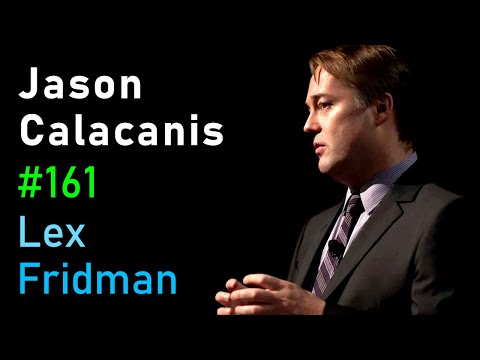
Jason Calacanis: Startups, Angel Investing, Capitalism, and Friendship | Lex Fridman Podcast #161
Lex Fridman (host), Jason Calacanis (guest)
In this episode of Lex Fridman Podcast, featuring Lex Fridman and Jason Calacanis, Jason Calacanis: Startups, Angel Investing, Capitalism, and Friendship | Lex Fridman Podcast #161 explores jason Calacanis on startups, risk, loyalty, and saving capitalism Lex Fridman and Jason Calacanis explore the GameStop/WallStreetBets saga, Robinhood’s role in democratizing finance, and the structural fragility of financial and regulatory systems. Jason explains how he evaluates radical startup ideas, defends Robinhood while critiquing its communication failures, and unpacks why some founders and companies survive existential crises. They discuss capitalism versus authoritarian “state capitalism” in China, how social media algorithms incentivize outrage, and why entrepreneurship is critical to preserving liberal democracy. The conversation ends on friendship, loyalty, founder suffering, and the importance of gratitude and love in sustaining people through extreme, Olympic‑level business journeys.
Jason Calacanis on startups, risk, loyalty, and saving capitalism
Lex Fridman and Jason Calacanis explore the GameStop/WallStreetBets saga, Robinhood’s role in democratizing finance, and the structural fragility of financial and regulatory systems. Jason explains how he evaluates radical startup ideas, defends Robinhood while critiquing its communication failures, and unpacks why some founders and companies survive existential crises. They discuss capitalism versus authoritarian “state capitalism” in China, how social media algorithms incentivize outrage, and why entrepreneurship is critical to preserving liberal democracy. The conversation ends on friendship, loyalty, founder suffering, and the importance of gratitude and love in sustaining people through extreme, Olympic‑level business journeys.
Key Takeaways
Great startup bets come from asking what could go right, not what could go wrong.
Jason backs ideas like Robinhood and Uber by imagining the world if they succeed—mass retail participation in markets or on‑demand transport—rather than fixating on low odds of success.
Get the full analysis with uListen AI
Product quality plus genuinely delighted customers matter more than pitch decks or pedigrees.
He looks for a well‑crafted product and intense engagement (e. ...
Get the full analysis with uListen AI
Finance and tech systems haven’t been stress‑tested for edge cases, creating both chaos and opportunity.
GameStop revealed issues like opaque short interest and fragile clearing/settlement rules; similarly, COVID exposed failures in regulation, testing, and vaccine deployment.
Get the full analysis with uListen AI
Capitalism’s competitive pressure is a powerful force for broad societal progress but can be misdirected.
From Tesla to chess apps, Jason argues competition drives massive consumer value; the real danger is when authoritarian regimes like China “win capitalism” and fuse it with state control.
Get the full analysis with uListen AI
Social media algorithms that optimize for engagement inherently reward outrage and cancel culture.
Shifting from reverse‑chronological feeds to engagement‑ranked feeds created a system where extremity, moral panic, and public shaming reliably rise to the top and shape discourse.
Get the full analysis with uListen AI
Venture capital is jet fuel: founders should take it only if they truly want hyper‑growth and binary outcomes.
VC portfolios assume most startups will die and a few will return the entire fund; that creates pressure to swing for 100x outcomes, which is misaligned for many lifestyle or slower‑growth businesses.
Get the full analysis with uListen AI
Loyalty, love, and gratitude are critical for surviving extreme entrepreneurial journeys.
Jason’s stories—like sending Elon checks during Tesla’s near‑collapse—illustrate how deep personal support sustains founders, and he urges people to actively thank those who helped them as a source of joy and resilience.
Get the full analysis with uListen AI
Notable Quotes
“The way to do really well as an angel investor is not to say what could go wrong but to say what could go right—and then imagine if it does work, what would the world look like?”
— Jason Calacanis
“If America does not win capitalism and China does, it is literally the end of the human species.”
— Jason Calacanis
“If you’re not serious about changing the world, why would you go work for Bezos? Why would you go work for Elon Musk? Don’t do it.”
— Jason Calacanis
“What are we at the end of the day besides a series of memories with the people we love?”
— Jason Calacanis
“The number one reason a startup fails is that the founder gives up.”
— Jason Calacanis (quoted by Lex Fridman at the end)
Questions Answered in This Episode
How should regulators reform short-selling and clearing mechanisms to increase transparency without stifling retail participation?
Lex Fridman and Jason Calacanis explore the GameStop/WallStreetBets saga, Robinhood’s role in democratizing finance, and the structural fragility of financial and regulatory systems. ...
Get the full analysis with uListen AI
When, if ever, is it ethically acceptable for infrastructure providers (like cloud platforms) to deplatform applications or communities?
Get the full analysis with uListen AI
How can social media be redesigned—algorithmically or structurally—to preserve engagement while promoting nuance, empathy, and personal growth instead of outrage?
Get the full analysis with uListen AI
For a first-time founder, how do you decide whether to pursue a VC‑backed hyper‑growth path versus a slower, bootstrapped approach?
Get the full analysis with uListen AI
What concrete cultural or educational shifts would best encourage more young people worldwide to see themselves as potential entrepreneurs and problem‑solvers?
Get the full analysis with uListen AI
Transcript Preview
The following is a conversation with Jason Calacanis, who's an entrepreneur, investor, author of Angel: How to Invest in Technology Startups, and as many people may know, he's a fun, brilliant, long-time podcast host of This Week In Startups and co-host of the All-In Podcast with Chamath Palihapitiya, David Sacks, and David Friedberg, who all happen to be poker buddies and self-proclaimed besties. The result is always a great listen due to both the love and the heated disagreements. Quick mention of our sponsors: Brave Browser, Linode Linux Virtual Machines, Four Sigmatic Mushroom Coffee, and Rev Speech-to-Text Service. Click the sponsor links to get a discount and to support this podcast. As a side note, let me say that I've been learning a lot about real world finance in the past few months. To give you a bit of context, on the side I've studied trading from an algorithmic trading perspective as a machine learning and game theory problem off and on for a few years in undergrad and grad school. I found the distributed complex system aspect of finance and economics in general fascinating. But now, I find even more fascinating the human side of the whole thing, ideas of greed, power, freedom, and truth. WallStreetBets, Robinhood, and the whole beautiful mess around this topic allows us to have great conversations about human nature and the systems that underlie the rise and fall of civilizations. If you enjoy this thing, subscribe on YouTube, review it on Apple Podcasts, follow on Spotify, support on Patreon, connect with me on Twitter @lexfridman. And now, here's my conversation with Jason Calacanis. I have a million things to talk to you about-
Yeah.
... but we do happen to be living through what I would think of as a historic event in, in terms of its impact, in terms of like almost philosophically thinking about the role of people and how they can fight power with this whole WallStreetBets and GameStop situation.
Yeah.
I was wondering, you've covered in your, uh, amazing All-In Podcast, you guys have been having fascinating battles over this whole situation.
(laughs)
I was wondering if you could tell maybe from your perspective, as it's unrolling, uh, the, the saga of WallStreetBets and GameStop, what are some interesting insights-
Yeah.
... uh, that, uh, you have about this whole set of events?
In full disclosure, I was an angel investor in Robinhood before they launched, and when I met the founder Vlad and his partner, you know, they pitched me at a, a, a bar not too far from where we are right now in Palo Alto called Antonio's Nut House.
(laughs)
And my friend Adeo ... It's a (laughs) really good story. My friend Adeo had asked me to speak at his founder's institute, which is kinda like an accelerator for people who are thinking about starting a company.
Yes.
And so I gave a talk and then he said, "Hey, let's go to Antonio's Nut House and, um, we'll meet Elon for a drink." Uh, and so Elon met us for a drink there. And it's the, it's the divest of dive bars.
Install uListen to search the full transcript and get AI-powered insights
Get Full TranscriptGet more from every podcast
AI summaries, searchable transcripts, and fact-checking. Free forever.
Add to Chrome