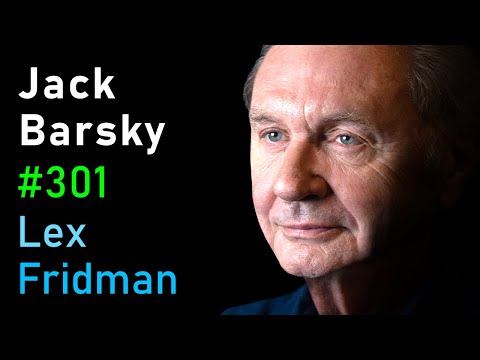
Jack Barsky: KGB Spy | Lex Fridman Podcast #301
Jack Barsky (guest), Lex Fridman (host), Narrator, Narrator, Narrator
In this episode of Lex Fridman Podcast, featuring Jack Barsky and Lex Fridman, Jack Barsky: KGB Spy | Lex Fridman Podcast #301 explores former KGB ‘illegal’ reveals double life, loyalty, and love’s cost Lex Fridman interviews Jack Barsky, a former KGB "illegal" agent who operated undercover in the United States during the Cold War, exploring the inner workings, culture, and ideology of the KGB. Barsky recounts his recruitment in East Germany, intense tradecraft and cultural training in Moscow, and eventual infiltration of American society under a stolen identity. He explains why he ultimately chose to defect and stay in the U.S., driven less by politics than by love for his American daughter, and how the FBI eventually discovered and debriefed him. The conversation ranges from the paranoia and incompetence inside Soviet intelligence to modern geopolitics, disinformation, Putin’s psychology, and Barsky’s late-life embrace of love and faith.
Former KGB ‘illegal’ reveals double life, loyalty, and love’s cost
Lex Fridman interviews Jack Barsky, a former KGB "illegal" agent who operated undercover in the United States during the Cold War, exploring the inner workings, culture, and ideology of the KGB. Barsky recounts his recruitment in East Germany, intense tradecraft and cultural training in Moscow, and eventual infiltration of American society under a stolen identity. He explains why he ultimately chose to defect and stay in the U.S., driven less by politics than by love for his American daughter, and how the FBI eventually discovered and debriefed him. The conversation ranges from the paranoia and incompetence inside Soviet intelligence to modern geopolitics, disinformation, Putin’s psychology, and Barsky’s late-life embrace of love and faith.
Key Takeaways
KGB power was built on paranoia and compartmentalization, which made it both formidable and fragile.
Stalin’s terror, frequent purges of security chiefs, and deep mistrust at all levels created an agency that could be ruthlessly effective yet structurally unstable, with truth rarely reaching the top. ...
Get the full analysis with uListen AI
Recruitment focused less on hardened operatives and more on young, ambitious idealists who could be shaped.
Barsky was targeted in East Germany as a brilliant, ego-driven chemistry student with a taste for adventure and no strong emotional ties holding him back. ...
Get the full analysis with uListen AI
Becoming an effective ‘illegal’ required deep cultural immersion, not just technical tradecraft.
Beyond Morse code, secret writing, microdots, and surveillance detection, Barsky was pushed into opera, museums, books, and TV to pass in elite Western circles. ...
Get the full analysis with uListen AI
Even elite intelligence services can be surprisingly incompetent and constrained by bureaucracy.
Barsky describes clumsy cover stories, badly thought-out logistics (like routing him through Chicago with no backup plan), and crude cryptographic tools that were laborious and error-prone. ...
Get the full analysis with uListen AI
Love, not ideology, ultimately determined Barsky’s defection and survival.
After years of loyal service, the birth of his American daughter anchored him emotionally in the U. ...
Get the full analysis with uListen AI
Conspiracy narratives often overestimate the precision and control of intelligence agencies.
Discussing figures like Yuri Bezmenov and modern disinformation, Barsky stresses that while active measures and online manipulation exist (by Russia, China, and the U. ...
Get the full analysis with uListen AI
Barsky now sees his life’s central lesson as the primacy of love over power or ideology.
From teenage heartbreak to the love for his children and his eventual Christian faith, he frames his journey from fanatic communist spy to American citizen as a story of learning that "love conquers all. ...
Get the full analysis with uListen AI
Notable Quotes
“If they don’t trust me, they don’t send me out. And if I don’t trust them, I’m not going.”
— Jack Barsky
“We were all pretty much strong believers in communism and the future of the world being ours.”
— Jack Barsky
“The Soviet Union was the only dictatorship in history that did not rest its powers on the military. They rested it on the intelligence apparatus—and that thing was unstable.”
— Jack Barsky
“One of the secrets to happiness is the ability to make fun of the worst situations that you’re in.”
— Jack Barsky
“All the things you have done—what’s the number one lesson? Love conquers all.”
— Jack Barsky
Questions Answered in This Episode
How much of Barsky’s account challenges your assumptions about how competent and coordinated major intelligence agencies really are?
Lex Fridman interviews Jack Barsky, a former KGB "illegal" agent who operated undercover in the United States during the Cold War, exploring the inner workings, culture, and ideology of the KGB. ...
Get the full analysis with uListen AI
In Barsky’s story, where do you see the turning point where personal love clearly overpowered ideological commitment—and have you experienced anything similar in your own life?
Get the full analysis with uListen AI
Given his description of KGB compartmentalization and cultural blind spots, how plausible do you think large-scale, long-term ideological subversion campaigns actually are today?
Get the full analysis with uListen AI
What responsibilities, if any, do former spies like Barsky have to the countries and people they once served—and to the countries they later adopt?
Get the full analysis with uListen AI
How should modern democracies balance the need for powerful intelligence agencies with the dangers of secrecy, paranoia, and the military–industrial complex that Barsky and Lex discuss?
Get the full analysis with uListen AI
Transcript Preview
Something happened where they forced my hand. And this is the only time that a, a Soviet agent was anywhere near me on the territory of the United States. So I'm waiting for the A train on, on a dark morning still in Queens, and, uh, there's this, uh, man in a black trench coat comes up to me from my right, and he whispers into my ears, "You gotta come back, or else you're dead."
The following is a conversation with Jack Barsky, a former KGB spy, author of Deep Undercover, and the subject of an excellent podcast series called The Agent. There are very few people who have defected from the KGB and live to tell the story. It is one of the most powerful intelligence organizations in history. And this conversation gives a window into its operation, both from an ideological and psychological perspectives. But also it tells the story of a man who lived one heck of an incredible life. This is the Lex Fridman Podcast. To support it, please check out our sponsors in the description. And now, dear friends, here's Jack Barsky. Let's start with a big basic question. What is the KGB? Komitet Gosudarstvennoy Bezopasnosti.
Right. So that is the Committee of, uh, State Security. Yeah. Bezopasnost, uh, this is a... Opasnost is a, a threat, right?
Threats. So-
Okay. And B-S means? Is-
Without.
Right. (laughs)
So, and I guess that directly translates to security, without threat.
So, and don't, don't exist anymore. It wa- was disbanded when the Soviet Union fell apart, and, uh, the successor, uh, agencies were... are now the SVR and, and the, uh, FSB. FSB supposedly the equivalent to the FBI, and SVR to CIA. But, uh, the SVR is, is relatively weak, and the FSB has, has taken on a lot of espionage and, um, you know, active measures, and th- they're much bigger and stronger. But the most capable intelligence agency in, in Russia is the, is, is the GRU, military intelligence.
That nobody knows very much about.
That's right. I, when I was in the KGB-
(laughs)
... I had no idea that there was military intelligence. Nobody ever mentioned anything like that. And by the way, I recently had a, uh, the pleasure to g- give a talk at the DIA. When they reached out to me, I didn't know they existed either.
Interesting. Yeah. That, that's always the question. If you want to be an intelligence agency, should the world know anything about you? Because in some sense, you want to create the legend in order to attract, uh, great competent individuals to work for you. But at the same time, you want it to be shrouded in complete mystery. If n- if nobody knows you exist, you might be able-
Right.
... to operate well as an, as an intelligence agency. That, that, that is fascinating. But FSB is the thing that carries the flag-
Install uListen to search the full transcript and get AI-powered insights
Get Full TranscriptGet more from every podcast
AI summaries, searchable transcripts, and fact-checking. Free forever.
Add to Chrome