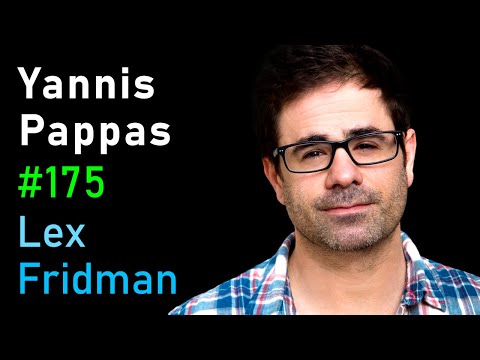
Yannis Pappas: History and Comedy | Lex Fridman Podcast #175
Lex Fridman (host), Yannis Pappas (guest), Narrator
In this episode of Lex Fridman Podcast, featuring Lex Fridman and Yannis Pappas, Yannis Pappas: History and Comedy | Lex Fridman Podcast #175 explores comedy, mortality, power, and history collide in wide-ranging conversation Lex Fridman and comedian Yannis Pappas move between dark comedy and serious reflection on power, death, history, and the human condition.
Comedy, mortality, power, and history collide in wide-ranging conversation
Lex Fridman and comedian Yannis Pappas move between dark comedy and serious reflection on power, death, history, and the human condition.
They debate whether power corrupts or reveals character, the role of fear of death in human motivation, and how much of history is brutality versus progress.
Yannis shares personal stories about his father, Greek heritage, the Battle of Crete, and his career in comedy, while skewering everything from dictators to healthcare and conspiracies.
Throughout, they use humor to explore uncomfortable truths about human nature, morality, charisma, and what it means to live honestly and meaningfully.
Key Takeaways
Power usually reveals character more than it changes it.
Pappas argues that power doesn’t fundamentally transform people; it exposes their darkest drives by removing constraints, which is why psychopaths often rise and seem unchanged while moral people risk being twisted by new indulgences.
Get the full analysis with uListen AI
Accepting life’s impermanence is essential for emotional survival.
Drawing on his father’s advice, Yannis stresses that nothing is permanent—money, health, abilities, even identity—so emotional resilience requires flexibility, humor, and a realistic grasp of mortality rather than clinging to illusions.
Get the full analysis with uListen AI
Fear of death is a central driver of human behavior, but we manage it with stories.
Lex brings in Ernest Becker’s view that the terror of mortality fuels culture and creativity, while Yannis counters that acceptance can be instinctive in near-death moments; together they suggest we oscillate between denial, fear, and periodic acceptance.
Get the full analysis with uListen AI
Dogs are not just pets; they are co‑architects of human civilization.
Pappas emphasizes that dogs’ protection, hunting, and specialization enabled humans to transition from vulnerable hunter‑gatherers to settled societies, making them moral ‘partners’ who deserve special protection compared to other animals.
Get the full analysis with uListen AI
Historical narratives leave out both brutality and randomness.
From the Battle of Crete to Mongol conquests, Yannis notes that textbooks sanitize war leaders, omit panic, accidents, and friendly fire, and over-credit ‘heroic’ figures who likely stayed far from the front while myth and PR filled in the rest.
Get the full analysis with uListen AI
Charisma and flattery can overpower intelligence and ethics.
Using Bernie Madoff and Jeffrey Epstein as examples, they show how confidence, exclusivity, and ego-stroking allow con men to hypnotize even brilliant people, highlighting that emotional vulnerabilities often trump rational analysis.
Get the full analysis with uListen AI
Being “doggedly yourself” is more important than conventional success.
Yannis describes choosing comedy over a prestigious professional track in a high-achieving immigrant family, arguing that the real “currency” of life is doing work you love and building real human connections, not status or wealth.
Get the full analysis with uListen AI
Notable Quotes
“I don’t think power changes anyone; it just reveals your darkest.”
— Yannis Pappas
“You have to survive not only physically, but emotionally.”
— Yannis Pappas (quoting his father)
“The meaning of life is to experience love, and love is not a feeling, it’s an action.”
— Yannis Pappas
“Without dogs, we wouldn’t be here. We would never have evolved from hunter‑gatherers.”
— Yannis Pappas
“If what you believe is based on illusion, you’re going to end up doing destruction.”
— Yannis Pappas
Questions Answered in This Episode
If power primarily reveals rather than corrupts, how should we design institutions and safeguards around leaders who haven’t yet been tested?
Lex Fridman and comedian Yannis Pappas move between dark comedy and serious reflection on power, death, history, and the human condition.
Get the full analysis with uListen AI
Is it healthier, individually and culturally, to strive for acceptance of death or to openly acknowledge that we are terrified of it?
They debate whether power corrupts or reveals character, the role of fear of death in human motivation, and how much of history is brutality versus progress.
Get the full analysis with uListen AI
Where should we draw the moral line on non-human suffering—do animals and future conscious robots deserve similar kinds of rights and protections?
Yannis shares personal stories about his father, Greek heritage, the Battle of Crete, and his career in comedy, while skewering everything from dictators to healthcare and conspiracies.
Get the full analysis with uListen AI
How much of what we call ‘great leadership’ in history is actually effective propaganda, selective storytelling, and survivorship bias?
Throughout, they use humor to explore uncomfortable truths about human nature, morality, charisma, and what it means to live honestly and meaningfully.
Get the full analysis with uListen AI
In an economy that celebrates fame and extreme success, how can someone practically commit to being ‘doggedly themselves’ without being crushed by financial or social pressure?
Get the full analysis with uListen AI
Transcript Preview
The following is a conversation with Yannis Pappas, a comedian who co-hosted the podcast History Hyenas that I came across when I was researching the Battle of Crete from World War II. He and his co-host were hilarious in their rants about history and about life. The chemistry they have is probably the best of any co-hosted comedy podcast or even podcast in general that I've ever heard. As of a few weeks ago, unfortunately, History Hyenas is no more, at least for now, because all good things must come to an end. But Yannis hosts a new podcast called Long Days with Yannis Pappas plus he has a comedy special on YouTube for free. Quick mention of our sponsors: Wine Access, Blinkist, Magic Spoon, and Indeed. Check them out in the description to support this podcast. As a side note, let me say that some of you have noticed that I have not spoken with too many computer scientists, physicists, biologists, or engineers recently. The reason has to do mostly with the risk aversion of many of these folks in the time of COVID, especially as they get closer to taking the vaccine. I'm tested several times a week and still some people are just more willing than others to have an in-person conversation in these times. I only do these podcasts in person because I look for the possibility of a genuine human connection. I'm willing to sacrifice a lot for that. Maybe it's silly, but I look for the magic that, uh, Charles Bukowski writes about in his poem Nirvana, the magic that is somehow in the air on those rare occasions when two people meet, talk, and you notice that while on the surface you may be worlds apart, you're still somehow woven from the same fabric. I've had that with many guests. Jim Keller comes to mind, but many others as well. I'm an AI person. Machine learning, robotics, computer science is my passion. Trust me, I can't wait to be having more technical conversations again, but I will also continue to mix in comedians, musicians, historians, and of course wise, all-seeing sages like Yannis Pappas and Tim Dillon, just to keep it, as Tim likes to say, fun. This is the Lex Fridman Podcast, and here is my conversation with Yannis Pappas. You've co-hosted, until recently, an amazing history comedy podcast called, uh, the History Hyenas. So you're a bit of a student of history?
Yeah. Uh, an F student of history.
F student?
Yeah.
Okay, I thought it was more like a D minus.
D minus, yeah.
Okay.
Still got to repeat the grade if you get all D minuses. I actually had a 0.67 GPA average my freshman year and I had to do it again. This is, this podcast is going to be the spectrum of human intelligence. This- It runs the gamut-
The full spectrum.
... from there to here. Yeah.
Install uListen to search the full transcript and get AI-powered insights
Get Full TranscriptGet more from every podcast
AI summaries, searchable transcripts, and fact-checking. Free forever.
Add to Chrome