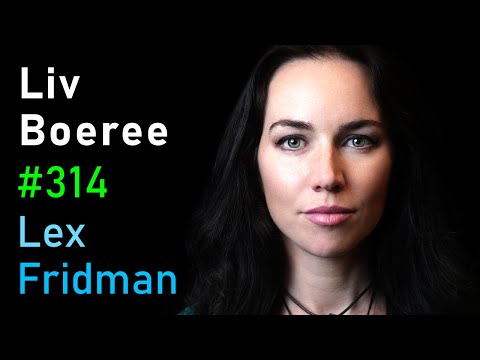
Liv Boeree: Poker, Game Theory, AI, Simulation, Aliens & Existential Risk | Lex Fridman Podcast #314
Liv Boeree (guest), Lex Fridman (host), Narrator, Narrator
In this episode of Lex Fridman Podcast, featuring Liv Boeree and Lex Fridman, Liv Boeree: Poker, Game Theory, AI, Simulation, Aliens & Existential Risk | Lex Fridman Podcast #314 explores poker, Moloch, and Meaning: Game-Theoretic Lens on Life’s Risks Lex Fridman and Liv Boeree use poker and game theory as a lens to explore decision-making, luck vs. skill, and how modern tools like solvers and simulations transformed poker from intuition-driven art into math-heavy science.
Poker, Moloch, and Meaning: Game-Theoretic Lens on Life’s Risks
Lex Fridman and Liv Boeree use poker and game theory as a lens to explore decision-making, luck vs. skill, and how modern tools like solvers and simulations transformed poker from intuition-driven art into math-heavy science.
They extend game-theoretic ideas to real-world systems, discussing Moloch (destructive competitive dynamics), social media’s attention economy, nuclear deterrence, AI races, and biosecurity as generators of existential risk.
Liv contrasts rationalist optimization with intuition, faith, and “useful fictions,” describing personal experiences that softened her strict atheism and shifted her focus from zero‑sum games to “win‑win” / positive-sum thinking.
The conversation ranges from relationships and radical honesty to simulations, alien life, and the meaning of existence, with both arguing we must consciously redesign our games—technological, social, and personal—toward cooperation and long‑term survival.
Key Takeaways
Study the game theory of your domain, not just your intuition.
In poker, top players now rely on game theory optimal (GTO) solvers that simulate billions of self-play hands to converge on near‑unexploitable strategies. ...
Get the full analysis with uListen AI
Calibrate your emotions to the real stakes and sample size.
Liv emphasizes training yourself to dampen fight‑or‑flight in artificial high‑stakes settings (like bluffing for your tournament life) so clear thinking can prevail. ...
Get the full analysis with uListen AI
Recognize Moloch: when individual incentives create collective lose‑lose outcomes.
From Instagram beauty filters to clickbait media and AI races, many systems reward short‑term competitive advantages that make everyone worse off over time. ...
Get the full analysis with uListen AI
Be extremely cautious with powerful technologies, especially in bio and AI.
Liv argues that projects like broadly publishing dangerous pathogen genomes or racing to AGI with weak safety incentives are classic Moloch dynamics. ...
Get the full analysis with uListen AI
Treat social media as a hazardous attention environment, not a neutral tool.
Because engagement algorithms learn to feed off rage, platforms systematically amplify divisive, anger‑inducing content. ...
Get the full analysis with uListen AI
Use “useful fictions” and faith carefully, not dogmatically.
Liv describes experiences (a strong premonition of winning a major poker event, apparent ‘energy healing’) that pushed her from hard atheism toward epistemic humility. ...
Get the full analysis with uListen AI
Seek win‑win structures and redesign your games when everything looks zero‑sum.
Boeree introduces “WinWin” (also called Omnia) as a conceptual opposite to Moloch: a meme for building systems where competition is constrained and cooperation thrives. ...
Get the full analysis with uListen AI
Notable Quotes
“Poker used to be an art of pure intuition; now if you don’t understand game theory optimal play, you get eaten alive in the long run.”
— Liv Boeree
“Moloch is the god of unhealthy competition—everyone chases short‑term advantage and collectively we end up in a lose‑lose.”
— Liv Boeree
“The problem with raging against the machine is that the machine has learned to feed off rage.”
— Liv Boeree
“Technology is not value‑neutral anymore. These are social technologies; they literally dictate how humans form groups and what ideas survive.”
— Liv Boeree
“We need to treat war itself as the real enemy. That’s the thing humanity has to defeat.”
— Liv Boeree
Questions Answered in This Episode
In your own life or industry, where do you see clear examples of Moloch—systems where individual optimization is making everyone worse off?
Lex Fridman and Liv Boeree use poker and game theory as a lens to explore decision-making, luck vs. ...
Get the full analysis with uListen AI
How would you redesign social media algorithms or business models to reward genuinely positive‑sum, ‘WinWin’ content instead of rage and division?
They extend game-theoretic ideas to real-world systems, discussing Moloch (destructive competitive dynamics), social media’s attention economy, nuclear deterrence, AI races, and biosecurity as generators of existential risk.
Get the full analysis with uListen AI
Where is your intuition reliably strong, and where are you fooling yourself by using ‘gut feel’ in domains you rarely experience?
Liv contrasts rationalist optimization with intuition, faith, and “useful fictions,” describing personal experiences that softened her strict atheism and shifted her focus from zero‑sum games to “win‑win” / positive-sum thinking.
Get the full analysis with uListen AI
What “useful fictions” (like overconfidence or faith in a larger purpose) might actually help you act more effectively—and where might they be dangerous?
The conversation ranges from relationships and radical honesty to simulations, alien life, and the meaning of existence, with both arguing we must consciously redesign our games—technological, social, and personal—toward cooperation and long‑term survival.
Get the full analysis with uListen AI
If humanity is in an AI and biosecurity arms race, what concrete coordination mechanisms or norms could realistically slow things down without handing advantage to bad actors?
Get the full analysis with uListen AI
Transcript Preview
Evolutionarily, we, you know, if we see a lion running at us, we didn't have time to sort of calculate the lion's kinetic energy and, you know, is it optimal to go this way or that way, you just reacted. And physically our bodies are well attuned to actually make right decisions. But when you're playing a game like poker, this is not something that you ev- you know, evolved to do, and yet you're in that same flight or fight response. Um, and so that's a really important skill to be able to develop, to basically learn how to, like, meditate in the moment and calm yourself so that you can think clearly.
The following is a conversation with Liv Boeree, formerly one of the best poker players in the world, trained as an astrophysicist, and is now a philanthropist and an educator on topics of game theory, physics, complexity, and life. This is the Lex Fridman Podcast. To support it, please check out our sponsors in the description. And now, dear friends, here's Liv Boeree. What role do you think luck plays in poker and in life? You can pick whichever one you want, poker or life and/or life.
The longer you play, the less influence luck has. You know, like with all things, the bigger your sample size, um, the more the quality of your decisions or your strategies matter. Um, so to answer that question, yeah, in poker it really depends. If you and I sat and played 10 hands right now, I might only win 52% of the time, 53% maybe. Um, but if we played 10,000 hands, then I'll probably win, like, over 98, 99% of the time. So it's a question of sample sizes.
And what are you figuring out over time? The betting strategy that this individual does, or literally it doesn't matter against any individual over time?
Against any individual over time, the better player, because they're making better decisions. So what does that mean to make a better decision? Well, uh, to get into the real nitty-gritty already, um, basically poker is a game of math. Um, there are these strategies familiar with like Nash equilibria, that term, right?
Yes.
So there are these game theory optimal strategies that, that you can adopt. Um, and the closer you play to them, the less exploitable you are. So because I've studied the game a bunch, um, although admittedly not for a few years, but back in, you know, when I was playing all the time, um, I would study these game theory optimal solutions and try and then adopt those strategies when I go and play. So I'd play against you and I would do that. And because the objective when you're playing game theory optimal it's actually, it's a loss minimization thing that you're trying to do, um, your best bet is to try and play, uh, the sim- a sort of similar style. You also need to try and adopt this loss minimization. Um, but because I've been playing much longer than you, I'll be better at that. So first of all, you're not taking advantage of my mistakes. But then on top of that, I'll be better at recognizing when you are playing suboptimally and then deviating from this game theory optimal strategy to exploit your bad plays.
Install uListen to search the full transcript and get AI-powered insights
Get Full TranscriptGet more from every podcast
AI summaries, searchable transcripts, and fact-checking. Free forever.
Add to Chrome