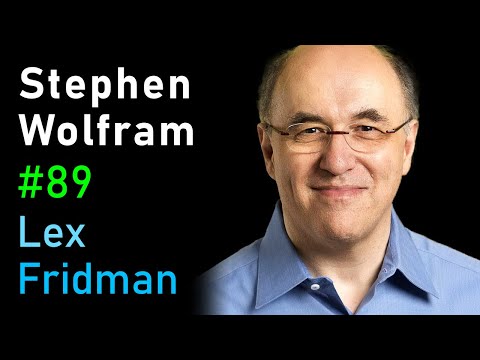
Stephen Wolfram: Cellular Automata, Computation, and Physics | Lex Fridman Podcast #89
Lex Fridman (host), Stephen Wolfram (guest), Lex Fridman (host)
In this episode of Lex Fridman Podcast, featuring Lex Fridman and Stephen Wolfram, Stephen Wolfram: Cellular Automata, Computation, and Physics | Lex Fridman Podcast #89 explores stephen Wolfram Reimagines Physics, Intelligence, and Reality as Computation Lex Fridman and Stephen Wolfram discuss Wolfram’s lifelong project of viewing the universe, physics, and intelligence through the lens of computation, especially via simple programs like cellular automata. Wolfram explains how remarkably complex behavior – potentially as rich as human thought – can emerge from extremely simple rules, leading to his Principle of Computational Equivalence and the idea of computational irreducibility. They explore a new candidate framework for fundamental physics based on hypergraph rewriting, in which space, time, relativity, and possibly quantum mechanics emerge from purely combinatorial rules. The conversation also covers Wolfram Language and Wolfram|Alpha as attempts to encode the world’s knowledge computationally, the future of AI and AI ethics, and philosophical questions about consciousness, ego, and the meaning of life in a computational universe.
Stephen Wolfram Reimagines Physics, Intelligence, and Reality as Computation
Lex Fridman and Stephen Wolfram discuss Wolfram’s lifelong project of viewing the universe, physics, and intelligence through the lens of computation, especially via simple programs like cellular automata. Wolfram explains how remarkably complex behavior – potentially as rich as human thought – can emerge from extremely simple rules, leading to his Principle of Computational Equivalence and the idea of computational irreducibility. They explore a new candidate framework for fundamental physics based on hypergraph rewriting, in which space, time, relativity, and possibly quantum mechanics emerge from purely combinatorial rules. The conversation also covers Wolfram Language and Wolfram|Alpha as attempts to encode the world’s knowledge computationally, the future of AI and AI ethics, and philosophical questions about consciousness, ego, and the meaning of life in a computational universe.
Key Takeaways
Simple rules can generate arbitrarily complex behavior, undermining our intuition about complexity.
Through cellular automata like Rule 30, Wolfram shows that extremely simple update rules, iterated over time, can produce patterns as intricate and unpredictable as anything in nature, challenging the assumption that complexity must arise from complicated underlying laws.
Get the full analysis with uListen AI
The Principle of Computational Equivalence blurs the line between intelligence and “mere” computation.
Wolfram argues that once a system’s behavior is not obviously simple, its computation is as sophisticated as any other – including human brains – meaning there is no sharp theoretical boundary between weather systems, cellular automata, AIs, and human thought, only differences in context and what we care about.
Get the full analysis with uListen AI
Computational irreducibility limits prediction and explains why many processes can’t be shortcut.
If our brains are computationally equivalent to the systems we study, we often cannot “jump ahead” and predict outcomes faster than simulating them step by step, implying fundamental limits on forecasting physics, evolution, AI behavior, or long-term societal futures.
Get the full analysis with uListen AI
A radically simple, discrete computational substrate might underlie space, time, and physics.
Wolfram is developing a physics model where the universe is a hypergraph whose nodes and hyperedges are rewritten by local rules; from the causal structure of these rewrites, familiar concepts like 3D space, a single thread of time, and special relativity (via causal invariance) could emerge without being put in by hand.
Get the full analysis with uListen AI
Encoding the world in a computational language could be as transformative as inventing mathematical notation.
Wolfram Language aims to provide a high-level, symbolic way to represent real-world entities, processes, and knowledge (from volcanoes to neural nets) so both humans and machines can reason about them, enabling things like Wolfram|Alpha, computational contracts, and future “symbolic discourse” between humans and AIs.
Get the full analysis with uListen AI
AI ethics will likely require multiple, explicit value systems rather than a single universal morality.
For tasks like content ranking or automated decisions, Wolfram suggests we’ll need a menu of computable ethical frameworks (analogous to different political or philosophical doctrines) that individuals or societies choose among, rather than one monolithic “correct” AI ethics module.
Get the full analysis with uListen AI
Ego and optimism are double-edged but often necessary to attempt “impossible” scientific projects.
Wolfram admits that strong intellectual confidence (often criticized as ego) and optimistic underestimation of difficulty were crucial for him to attempt projects like A New Kind of Science, Wolfram|Alpha, and a fundamental theory of physics – while also acknowledging they sometimes lead to errors and long slogs.
Get the full analysis with uListen AI
Notable Quotes
“There really isn’t a bright line between the intelligent and the merely computational.”
— Stephen Wolfram
“The big surprise was that even very simple rules produce behavior as sophisticated as anything, including our brains.”
— Stephen Wolfram
“If we can jump ahead and predict the universe, we’d have to be more special than anything else in the universe – and I don’t think we are.”
— Stephen Wolfram
“Any area where there wasn’t some expert who helped us figure out what to do wouldn’t be right.”
— Stephen Wolfram
“It is perhaps a little humbling to discover that we as humans are, in effect, computationally no more capable than cellular automata with very simple rules.”
— Stephen Wolfram (quoted by Lex Fridman from Wolfram’s writing)
Questions Answered in This Episode
If a simple hypergraph rewrite rule ultimately explains our universe, what does that do to our notions of meaning, purpose, and human specialness?
Lex Fridman and Stephen Wolfram discuss Wolfram’s lifelong project of viewing the universe, physics, and intelligence through the lens of computation, especially via simple programs like cellular automata. ...
Get the full analysis with uListen AI
Given computational irreducibility, how should science, engineering, and policy change when we know some systems simply can’t be reliably shortcut or predicted?
Get the full analysis with uListen AI
How might multiple computable ethical frameworks actually be implemented in real-world AI systems without fragmenting societies into incompatible moral silos?
Get the full analysis with uListen AI
Could symbolic discourse language eventually allow AIs to genuinely negotiate, reason, and make agreements with humans in ways that feel like shared understanding?
Get the full analysis with uListen AI
What evidence or concrete predictions would convince skeptical physicists that Wolfram’s hypergraph model, or any similar discrete computation, really underlies quantum field theory and general relativity?
Get the full analysis with uListen AI
Transcript Preview
The following is a conversation with Stephen Wolfram, a computer scientist, mathematician, and theoretical physicist who is the founder and CEO of Wolfram Research, a company behind Mathematica, Wolfram|Alpha, Wolfram Language, and the new Wolfram Physics Project. He's the author of several books, including A New Kind of Science, which, on a personal note, was one of the most influential books in my journey in computer science and artificial intelligence. It made me fall in love with the mathematical beauty and power of cellular automata. It is true that perhaps one of the criticisms of Stephen is on a human level, that he has a big ego, which prevents some researchers from fully enjoying the content of his ideas. We talk about this point in this conversation. To me, ego can lead you astray, but can also be a superpower, one that fuels bold, innovative thinking that refuses to surrender to the cautious ways of academic institutions. And here, especially, I ask you to join me in looking past the peculiarities of human nature and opening your mind to the beauty of ideas in Stephen's work and in this conversation. I believe Stephen Wolfram is one of the most original minds of our time, and at the core is a kind, curious, and brilliant human being. This conversation was recorded in November 2019 when the Wolfram Physics Project was underway, but not yet ready for public exploration as it is now. We now agreed to talk again, probably multiple times in the near future, so this is round one, and stay tuned for round two soon. This is the Artificial Intelligence podcast. If you enjoy it, subscribe on YouTube, review it with five stars on Apple Podcast, support it on Patreon, or simply connect with me on Twitter @lexfridman, spelled F-R-I-D-M-A-N. As usual, I'll do a few minutes of ads now and never any ads in the middle that can break the flow of the conversation. I hope that works for you and doesn't hurt the listening experience. Quick summary of the ads. Two sponsors, ExpressVPN and Cash App. Please consider supporting the podcast by getting ExpressVPN at expressvpn.com/lexpod and downloading Cash App and using code LEXPODCAST. This show is presented by Cash App, the number one finance app in the App Store. When you get it, use code LEXPODCAST. Cash App lets you send money to friends, buy Bitcoin, and invest in the stock market with as little as $1. Since Cash App does fractional share trading, let me mention that the order execution algorithm that works behind the scenes to create the abstraction of fractional orders is an algorithmic marvel. So big props to the Cash App engineers for solving a hard problem that in the end provides an easy interface that takes a step up to the next layer of abstraction over the stock market. This makes trading more accessible for new investors and diversification much easier. So again, if you get Cash App from the App Store or Google Play and use the code LEXPODCAST, you get $10 and Cash App will also donate $10 to FIRST, an organization that is helping to advance robotics and STEM education for young people around the world. This show is presented by ExpressVPN. Get it at expressvpn.com/lexpod to get a discount and to support this podcast. I've been using ExpressVPN for many years. I love it. It's really easy to use. Press the big power on button and your privacy is protected. And if you like, you can make it look like your location is anywhere else in the world. This has a large number of obvious benefits. Certainly it allows you to access international versions of streaming websites like the Japanese Netflix or the UK Hulu. ExpressVPN works on any device you can imagine. I use it on Linux. Shout out to Ubuntu. New version coming out soon actually. Uh, Windows, Android, but it's available anywhere else too. Once again, get it at expressvpn.com/lexpod to get a discount and to support this podcast. And now here's my conversation with Stephen Wolfram. You and your son Christopher helped create the alien language in the movie Arrival. So let me ask maybe a, a bit of a crazy question, but if aliens were to visit us on earth, do you think we would be able to find a common language?
Install uListen to search the full transcript and get AI-powered insights
Get Full TranscriptGet more from every podcast
AI summaries, searchable transcripts, and fact-checking. Free forever.
Add to Chrome