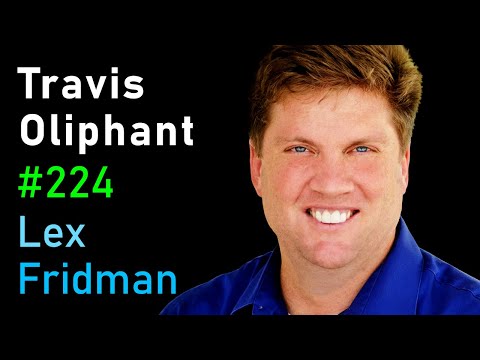
Travis Oliphant: NumPy, SciPy, Anaconda, Python & Scientific Programming | Lex Fridman Podcast #224
Lex Fridman (host), Travis Oliphant (guest), Narrator, Narrator
In this episode of Lex Fridman Podcast, featuring Lex Fridman and Travis Oliphant, Travis Oliphant: NumPy, SciPy, Anaconda, Python & Scientific Programming | Lex Fridman Podcast #224 explores travis Oliphant on building Python’s scientific backbone and beyond Travis Oliphant recounts how his love of math and early programming led him to create Numeric, SciPy, NumPy, and later Anaconda/Conda, which together became the core of scientific and data science computing in Python.
Travis Oliphant on building Python’s scientific backbone and beyond
Travis Oliphant recounts how his love of math and early programming led him to create Numeric, SciPy, NumPy, and later Anaconda/Conda, which together became the core of scientific and data science computing in Python.
He explains the technical and social decisions behind array-based programming, NumPy’s design, and Python’s readability, along with the challenges of packaging, distribution, and performance in real-world scientific workflows.
Travis also describes his journey from academia into entrepreneurship, his attempts to align open source ideals with sustainable business models, and current efforts (Quansight, Quansight Labs, OpenTeams, data-api.org) to fund and coordinate open-source development.
Throughout, he reflects on language shaping thought, the importance of community, the difficulty of leadership in open source, and why sustainable support for the people maintaining critical infrastructure is still an unsolved problem.
Key Takeaways
Readable code and low cognitive overhead attract non-programmers into powerful workflows.
Travis emphasizes that Python and NumPy succeeded in science because scientists could use them productively without becoming professional programmers; syntax aligned closely with how they already thought about math and data.
Get the full analysis with uListen AI
Array-based programming fundamentally changes how you think about problems.
Languages and libraries like APL, MATLAB, Numeric, and NumPy let you operate on whole n‑dimensional arrays at once, shifting you from loop-by-loop thinking to higher-level linear algebraic thinking that maps naturally to modern hardware.
Get the full analysis with uListen AI
Unifying competing stacks early can yield massive long-term benefits.
NumPy arose from Travis’s decision to merge Numeric and NumArray to avoid a fractured ecosystem; he took on backward compatibility and community politics to give Python one common array foundation, which later enabled pandas, scikit-learn, PyTorch-like APIs, and more.
Get the full analysis with uListen AI
Packaging and installation are as critical as the library design itself.
SciPy’s early success depended not just on algorithms but on binary installers and later Conda, which drastically reduced friction for scientists who otherwise could not compile Fortran/C toolchains or reconcile dependency hell.
Get the full analysis with uListen AI
Performance in Python often comes from compiled extensions and selective compilation, not rewriting everything in C.
Tools like NumPy and Numba work by moving hot loops and array operations into compiled code (via C/Fortran or LLVM), letting Python remain the high-level orchestration language while still achieving C-like speed for numeric workloads.
Get the full analysis with uListen AI
Open source impact and open source sustainability are different problems.
NumPy/SciPy became globally indispensable despite Travis never being paid to work on them full time; he argues we still lack robust mechanisms (beyond donations) to reliably fund maintainers of critical infrastructure and is experimenting with models that tie commercial value back into open source.
Get the full analysis with uListen AI
Bridging community and enterprise requires new organizational patterns.
Through Quansight, Quansight Labs, and OpenTeams, Travis is trying to standardize a pattern where consulting revenue, venture funding, and enterprise contracts systematically feed back into open-source development, rather than treating it as unpaid, invisible labor.
Get the full analysis with uListen AI
Notable Quotes
“Python enables you to do a lot without demanding a lot of you.”
— Travis Oliphant
“I could think in Python. That was a big deal for me.”
— Travis Oliphant
“I wrote NumPy as a service. I spent a lot of time doing it and was never paid to work on it.”
— Travis Oliphant
“Nations that code together don’t go to war together.”
— Travis Oliphant
“Build, don’t destroy. You don’t need to destroy something to build something else.”
— Travis Oliphant
Questions Answered in This Episode
If you were designing NumPy from scratch today, with GPUs and accelerators in mind, what would you change in its core type system and API surface?
Travis Oliphant recounts how his love of math and early programming led him to create Numeric, SciPy, NumPy, and later Anaconda/Conda, which together became the core of scientific and data science computing in Python.
Get the full analysis with uListen AI
How can we create sustainable, low-friction funding mechanisms so that users of NumPy/SciPy-like infrastructure can reliably support the maintainers who keep it alive?
He explains the technical and social decisions behind array-based programming, NumPy’s design, and Python’s readability, along with the challenges of packaging, distribution, and performance in real-world scientific workflows.
Get the full analysis with uListen AI
Where should the boundary lie between language-level package managers (like Pip) and cross-language, system-level managers (like Conda or OS package managers)?
Travis also describes his journey from academia into entrepreneurship, his attempts to align open source ideals with sustainable business models, and current efforts (Quansight, Quansight Labs, OpenTeams, data-api. ...
Get the full analysis with uListen AI
What lessons from unifying Numeric and NumArray into NumPy could be applied to today’s fragmented ML ecosystem (PyTorch, TensorFlow, JAX, CuPy, etc.)?
Throughout, he reflects on language shaping thought, the importance of community, the difficulty of leadership in open source, and why sustainable support for the people maintaining critical infrastructure is still an unsolved problem.
Get the full analysis with uListen AI
How can universities and research institutions better recognize and reward the creation of software infrastructure as a first-class form of scientific contribution?
Get the full analysis with uListen AI
Transcript Preview
The following is a conversation with Travis Oliphant, one of the most impactful programmers and data scientists ever. He created NumPy, SciPy, and Anaconda. NumPy formed the foundation of tensor-based machine learning in Python, SciPy formed the foundation of scientific programming in Python, and Anaconda, specifically with Conda, made Python more accessible to a much larger audience. Travis's life work across a large number of programming and entrepreneurial efforts has and will continue to have immeasurable impact on millions of lives by empowering scientists and engineers in big companies, small companies, and open source communities to take on difficult problems and solve them with the power of programming. Plus, he's a truly kind human being, which is something that when combined with vision and ambition, makes for great leader and a great person to chat with. To support this podcast, please check out our sponsors in the description. This is the Lex Fridman podcast, and here is my conversation with Travis Oliphant. What was the first computer program you've ever written? Do you remember?
Whoa. That's a good question. I think it was in fourth grade. Just a simple, uh, loop in Basic.
Basic?
Basic, yeah, on an Atari 800, uh, Atari 400, I think, or maybe it was an Atari 800. It was, uh, part of a class, and we just were, just basic loops to print things out.
Did you use go-to statements?
Um, yes. Yes, we used go-to statements. (laughs)
(laughs) I, I remember in the early days, that's when I first realized there's, like, principles to programming-
Yeah.
... when I was told that don't use go-to statements.
Yeah.
Those are bad software engineering prince, like, it goes against what great, beautiful code is. And I was like, "Oh, okay, there's rules to this game."
(laughs)
(laughs)
I didn't see that until high school when I took an AP Computer Science course.
Right.
I d- I did a lot of other kinds of just low, programming on TI, but finally when I took an AP Computer Science course in Pascal.
Pas... Wow.
That's, yeah, it was Pascal. That's when I, "Oh, there are these principles."
Not C or C++?
No, I didn't take C until (laughs) ha- uh, the next year in college. I had this course in C, um, but I, I haven't done much in Pascal, just that AP Computer Science course. (laughs)
Now, sorry for the romanticized question, but when did you first fall in love with programming?
Oh, man. Good question. I think actually when I was 10. You know, my dad got us a TI- Timex Sinclair, and, uh, he was excited about the spreadsheet capability, and then, but I made him get the, uh, Basic, the add-on so we could actually program in Basic. And just being able to write instructions and have the computer do something. Then we got a TI-90, a TI-99/4A when I was about 12, and I would just, it had sprites and graphics and music. You could actually program it to do music. That's when I really sort of fell in love with programming.
Install uListen to search the full transcript and get AI-powered insights
Get Full TranscriptGet more from every podcast
AI summaries, searchable transcripts, and fact-checking. Free forever.
Add to Chrome