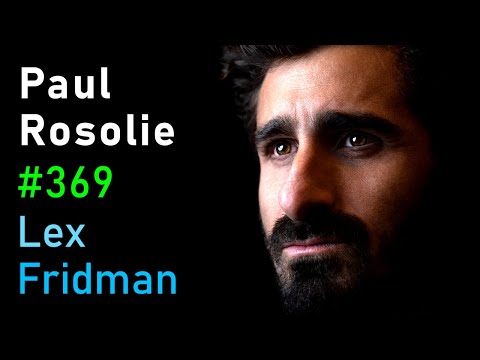
Paul Rosolie: Amazon Jungle, Uncontacted Tribes, Anacondas, and Ayahuasca | Lex Fridman Podcast #369
Paul Rosolie (guest), Lex Fridman (host), Lex Fridman (host), Lex Fridman (host)
In this episode of Lex Fridman Podcast, featuring Paul Rosolie and Lex Fridman, Paul Rosolie: Amazon Jungle, Uncontacted Tribes, Anacondas, and Ayahuasca | Lex Fridman Podcast #369 explores explorer Confronts Amazon’s Beauty, Brutality, and Battle For Survival Lex Fridman speaks with conservationist and explorer Paul Rosolie about his 17 years living in the Amazon rainforest, protecting wildlife and habitat while confronting poachers, loggers, and the harsh realities of jungle life.
Explorer Confronts Amazon’s Beauty, Brutality, and Battle For Survival
Lex Fridman speaks with conservationist and explorer Paul Rosolie about his 17 years living in the Amazon rainforest, protecting wildlife and habitat while confronting poachers, loggers, and the harsh realities of jungle life.
Rosolie shares vivid stories of encounters with giant anacondas, jaguars, caimans, uncontacted tribes, and deadly infections, using them to illustrate both the majesty and the mercilessness of nature.
They discuss indigenous knowledge, ancient Amazonian civilizations, ayahuasca, elephants in India and Africa, the ethics of hunting, and the systemic destruction of rainforests through logging and gold mining.
Throughout, Rosolie argues for focused, pragmatic conservation—protecting specific ecosystems and species—over abstract climate panic, and shows how authentic storytelling and social media can mobilize real-world protection of the Amazon.
Key Takeaways
Direct immersion in wild ecosystems radically reshapes your view of life and risk.
Rosolie’s years living deep in the Amazon—being squeezed by anacondas, stalked by jaguars, and nearly dying from infection—stripped away ego and comfort, leaving a calm acceptance of death and a sharpened sense of what truly matters.
Get the full analysis with uListen AI
Indigenous knowledge is a sophisticated, data-rich system most outsiders can barely comprehend.
Guides like J. ...
Get the full analysis with uListen AI
The Amazon’s greatest threat is human extraction, not wildlife.
Rosolie stresses that loggers, gold miners, and poachers—not snakes, caimans, or jaguars—are what destroy forests and species; he’s watched intact rainforest turned to toxic desert by unregulated gold mining and logging.
Get the full analysis with uListen AI
Converting extractive workers into conservationists can be more effective than fighting them.
By offering better pay, stability, and dignity to loggers and miners—hiring them as rangers and eco‑tourism operators—Jungle Keepers protects over 50,000 acres and shows that economic incentives can flip “villains” into guardians.
Get the full analysis with uListen AI
Large apex predators are powerful environmental indicators and ambassadors.
Anacondas, as top predators that “eat their way up the food chain,” accumulate mercury and reveal ecosystem contamination, while also captivating public imagination and drawing attention to broader conservation issues.
Get the full analysis with uListen AI
Authentic, emotionally raw storytelling can unlock real conservation resources.
A single unfiltered Instagram video of Rosolie sobbing in front of Amazon fires went viral, was amplified by figures like Joe Rogan, and directly led to a major funder stepping in to scale Jungle Keepers’ work when he was ready to quit.
Get the full analysis with uListen AI
Broad climate panic is less actionable than targeted biodiversity protection.
Rosolie distinguishes between the complexity of global climate modeling and the very clear, measurable crisis of biodiversity loss, arguing that individuals should pick a concrete, local cause—like protecting a forest or species—and become truly effective there.
Get the full analysis with uListen AI
Notable Quotes
“The Amazon is the greatest library of life that has ever existed.”
— Paul Rosolie
“Life is just a temporary moment of stasis in the churning, recycling death march that is the Amazon.”
— Paul Rosolie
“You’re standing next to a boulder of destruction about to roll onto the forest, and there’s no one else there. You start asking, ‘Is there any way I can put myself in front of this and hold it back?’”
— Paul Rosolie
“We’ve lost 70% of the wildlife on this planet in the last 50 years. My ask is simple: don’t cut down the 3% of land that holds half the world’s biodiversity.”
— Paul Rosolie
“Every night in the jungle, you live in constant awareness that out there in the darkness are literally millions of heartbeats around you.”
— Paul Rosolie
Questions Answered in This Episode
How should we balance curiosity and scientific value against the right of uncontacted tribes to remain isolated and safe from disease and violence?
Lex Fridman speaks with conservationist and explorer Paul Rosolie about his 17 years living in the Amazon rainforest, protecting wildlife and habitat while confronting poachers, loggers, and the harsh realities of jungle life.
Get the full analysis with uListen AI
What’s the most effective way for an ordinary person, far from the Amazon, to meaningfully contribute to rainforest protection rather than just share outrage online?
Rosolie shares vivid stories of encounters with giant anacondas, jaguars, caimans, uncontacted tribes, and deadly infections, using them to illustrate both the majesty and the mercilessness of nature.
Get the full analysis with uListen AI
Where is the ethical line between using charismatic megafauna (like anacondas or elephants) for media attention and genuinely respecting the animals themselves?
They discuss indigenous knowledge, ancient Amazonian civilizations, ayahuasca, elephants in India and Africa, the ethics of hunting, and the systemic destruction of rainforests through logging and gold mining.
Get the full analysis with uListen AI
How might our understanding of human intelligence and consciousness change if we took animal intelligence—especially elephants, apes, and birds—as seriously as Rosolie does?
Throughout, Rosolie argues for focused, pragmatic conservation—protecting specific ecosystems and species—over abstract climate panic, and shows how authentic storytelling and social media can mobilize real-world protection of the Amazon.
Get the full analysis with uListen AI
Is focusing on local biodiversity loss and ecosystem protection a more practical path forward than trying to solve “climate change” in the abstract—and how do we keep those efforts from being co‑opted or green‑washed?
Get the full analysis with uListen AI
Transcript Preview
... it was just like one of those moments where we saw it at the same time. And we were standing by the tail, and the snake was so big that, I mean, this must have been a 25-foot anaconda dead asleep with a- with a probably a 16-foot anaconda, like, sprawled across her.
Mm-hmm.
And they're laying in the starlight and we're floating on top of a lake standing there in the middle of the Amazon. And J.J. just- I just- I could feel the blood drain out of his face.
Mm-hmm.
And as like a- however old I was, you know, maybe 20 years old, I just said, "If I- if we could somehow show people this, we'll be on the front cover of National Geographic and we can protect all the jungle that we want." And so-
(laughs)
... I tried to catch it. (laughs)
Yeah.
So I jumped on the snake, and the only measurement I have of this animal is that when I wrapped my arms around it, I couldn't touch my fingers.
Yeah.
And so I was, you know- my- my- my feet were dragging. And to her credit, this anaconda did not turn around and eat me 'cause her head was, you know, this big.
Yeah.
And- and she went and she reached the edge of the- the- the grass island and she starts plunging into the dark. And so I'm watching the stars vibrate as this anaconda's going and I had to make the choice of either going headfirst down into the black, which no thank you, or stopping and just keeping my hand on this thing as it raced by me. And I just felt the scales and the muscle and the power go by and then eventually taper down to the tail until it slipped away into the darkness. And I was laying there just panting.
The following is a conversation with Paul Rosolie, a conservationist, explorer, author, filmmaker, and real life Tarzan. Since- for much of the past 17 years, Paul has lived deep in the Amazon rainforest protecting endangered species and trees from poachers, loggers, and foreign nations funding them. He is the founder of Jungle Keepers, which today protects over 50,000 acres of threatened habitat. And Paul is one of the most incredible human beings I've ever met. I hope to travel with him in the Amazon jungle one day because in his eyes, I saw a truth that can only be discovered directly by spending time among the immensity and power of nature at its purest. This is the Lex Fridman Podcast, to support it, please check out our sponsors in the description. And now, dear friends, here's Paul Rosolie. In 2006, at 18 years old, you fled New York and traveled to the Amazon. This started a journey that I think lasts to this day. Uh, tell me about this first leap. What in your heart pulled you towards the Amazon jungle?
Install uListen to search the full transcript and get AI-powered insights
Get Full TranscriptGet more from every podcast
AI summaries, searchable transcripts, and fact-checking. Free forever.
Add to Chrome