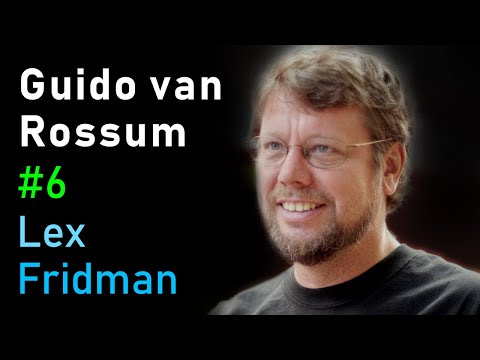
Guido van Rossum: Python | Lex Fridman Podcast #6
Lex Fridman (host), Guido van Rossum (guest)
In this episode of Lex Fridman Podcast, featuring Lex Fridman and Guido van Rossum, Guido van Rossum: Python | Lex Fridman Podcast #6 explores guido van Rossum on Python, intelligence, and the future of code Guido van Rossum reflects on his early life, influences, and the tinkering mindset that eventually led him to create Python as a highly productive, in‑between language bridging shell scripting and C.
Guido van Rossum on Python, intelligence, and the future of code
Guido van Rossum reflects on his early life, influences, and the tinkering mindset that eventually led him to create Python as a highly productive, in‑between language bridging shell scripting and C.
He and Lex Fridman explore deep questions about human nature, consciousness, and artificial intelligence, contrasting rule-based algorithms with data-driven learning and emergent complexity (e.g., Conway’s Game of Life).
Guido discusses his practical, atheist view of minds as complex information-processing systems shaped by evolution and rich sensory input, and why he believes future machine consciousness would more likely emerge from embodied systems like self‑driving cars than abstract data centers.
He also explains major design choices and community dynamics around Python, from Python 3’s breaking changes to his dramatic resignation as Python’s “benevolent dictator for life,” and shares pragmatic views on concurrency, packaging, and Python’s long‑term direction.
Key Takeaways
Python was designed as a pragmatic tool to boost developer productivity.
Guido consciously positioned Python between shell scripts and C, borrowing the best ideas from existing languages to enable rapid iteration, fewer incidental details, and strong standard libraries—all aimed at making programmers faster and more effective.
Get the full analysis with uListen AI
Consciousness and intelligence are viewed as spectra, not on/off properties.
Guido argues that animals from dogs to fish exhibit varying degrees of intelligence and that human consciousness likely arose gradually through evolution, especially as sensory systems like vision became richer and demanded complex processing.
Get the full analysis with uListen AI
Emergent complexity often can’t be fully captured by classic mathematical analysis.
Using Conway’s Game of Life, Guido notes that simple rules can produce surprisingly intricate behavior that we mostly understand by running the system, suggesting some phenomena resist neat closed-form explanations even though no “magic” is involved.
Get the full analysis with uListen AI
Modern AI shifts from explicit algorithms to data-driven pattern matching.
Guido distinguishes classical, fully-understood algorithms from neural-network-style systems trained on large datasets, where even their creators can’t precisely explain internal mechanisms—indicating we’re moving toward new forms of “programming” that look more like training.
Get the full analysis with uListen AI
Python is unlikely to become a high-parallelism language at its core.
Because of its design, usage patterns, and implementation details (like the GIL), Guido thinks Python itself won’t be the prime vehicle for automatic parallelization; instead, heavy numerical or parallel work is offloaded to optimized libraries in C/C++ (NumPy, TensorFlow, etc. ...
Get the full analysis with uListen AI
Large-scale software engineering requires different thinking than “programming in the small.”
Guido stresses that most education focuses on tiny programs where bugs can be eliminated, but real-world large systems accept imperfect code, use retries and fallbacks, and rely on teams, processes, and tooling—something many students only grasp when they see industry codebases.
Get the full analysis with uListen AI
Healthy language evolution depends on open criticism and resilient governance.
The contentious debates over Python 3 changes and PEP 572 contributed to Guido’s decision to step down as BDFL, but he sees vigorous (non-abusive) criticism as essential and believes the diverse core-dev community is now strong enough to guide Python without a single dictator.
Get the full analysis with uListen AI
Notable Quotes
“I've always been very focused on the activity of programming itself and not so much what happens with the program you write.”
— Guido van Rossum
“I totally believe that brains are computers in some sense… I don't believe in a separate thing that infuses us with intelligence or consciousness.”
— Guido van Rossum
“Consciousness and intelligence are not all or nothing. It's a spectrum.”
— Guido van Rossum
“Every task that AI has tackled in the past, at some point we realized how it was done and then it was no longer considered part of artificial intelligence.”
— Guido van Rossum
“Python is definitely the best thing I've ever done, and I wouldn't just say the creation of Python, but the way I raised Python like a baby.”
— Guido van Rossum
Questions Answered in This Episode
How might future programming tools blend explicit coding with data-driven training in a way that remains understandable and controllable by humans?
Guido van Rossum reflects on his early life, influences, and the tinkering mindset that eventually led him to create Python as a highly productive, in‑between language bridging shell scripting and C.
Get the full analysis with uListen AI
If consciousness and intelligence are spectra, what criteria should we use to decide when an AI system deserves moral consideration or rights?
He and Lex Fridman explore deep questions about human nature, consciousness, and artificial intelligence, contrasting rule-based algorithms with data-driven learning and emergent complexity (e. ...
Get the full analysis with uListen AI
What trade-offs should language designers accept between backward compatibility and fixing long-standing “warts” that impede clarity or correctness?
Guido discusses his practical, atheist view of minds as complex information-processing systems shaped by evolution and rich sensory input, and why he believes future machine consciousness would more likely emerge from embodied systems like self‑driving cars than abstract data centers.
Get the full analysis with uListen AI
In a world where most performance-critical work is done in libraries, how should we teach new developers about low-level optimization versus high-level productivity?
He also explains major design choices and community dynamics around Python, from Python 3’s breaking changes to his dramatic resignation as Python’s “benevolent dictator for life,” and shares pragmatic views on concurrency, packaging, and Python’s long‑term direction.
Get the full analysis with uListen AI
Could embodied AI systems like self-driving cars ever develop forms of awareness or self-modeling that meaningfully resemble human consciousness, or will they always remain specialized tools?
Get the full analysis with uListen AI
Transcript Preview
The following is a conversation with Guido van Rossum, creator of Python, one of the most popular programming languages in the world. Used in almost any application that involves computers, from web backend development to psychology, neuroscience, computer vision, robotics, deep learning, natural language processing, and almost any subfield of AI. This conversation is part of MIT course on Artificial General Intelligence, and the Artificial Intelligence podcast. If you enjoy it, subscribe on YouTube, iTunes, or your podcast provider of choice, or simply connect with me on Twitter @lexfridman, spelled F-R-I-D. And now, here's my conversation with Guido van Rossum. You were born in the Netherlands in 1956. Your parents and the world around you was deeply impacted by World War II, as was my family from the Soviet Union. So with that context-
Well...
... what is your view of human nature? Are some humans inherently good and some inherently evil, or do we all have both good and evil within us?
Ouch. (laughs) I did not expect, uh, such a deep one. I, I guess we all have good and evil potential in us, and a lot of it depends on circumstances and context.
Out of that world, at least on the Soviet Union side in Europe, sort of out of suffering, out of challenge, out of that kind of, uh, set of traumatic events often emerges beautiful art, music, literature. In a interview I read or heard you said you enjoy Dutch literature s- when, when you were a child.
Mm-hmm.
Can, can you tell me about the books that had an influence on you in your childhood?
Well, wes- as a teenager, my favorite writer was... My favorite Dutch author was a guy named Willem Frederik Hermans.
Mm-hmm.
Whose writing, certainly his early novels were all about sort of, uh, ambiguous things that happened during World War II.
Okay.
I think he was a young adult during that time, and he wrote about it a lot, and, and very interesting, very good books I thought, I think. And-
In a non-fiction way?
No, it was all fiction, but it was very much set in, in the ambiguous world of resistance against the Germans, where often you couldn't tell whether someone was truly in the resistance or really a spy for the Germans, and, and some of the characters in his novels sort of crossed that line, and you never really find out what exactly happened.
And in his novels, there was always a good guy and a bad guy. Is it the nature of good and evil? Is it-
Uh...
... clear there's a hero?
It's... No, his heroes are often more... His main characters are often anti-heroes.
Mm-hmm.
And, and, and so they're, they're not, not very heroic. They're, they're often... They, they fail at some level to accomplish their lofty goals.
And looking at the trajectory through the rest of your life, has literature, Dutch or English or translation, had an impact outside the technical world that you existed in?
Install uListen to search the full transcript and get AI-powered insights
Get Full TranscriptGet more from every podcast
AI summaries, searchable transcripts, and fact-checking. Free forever.
Add to Chrome