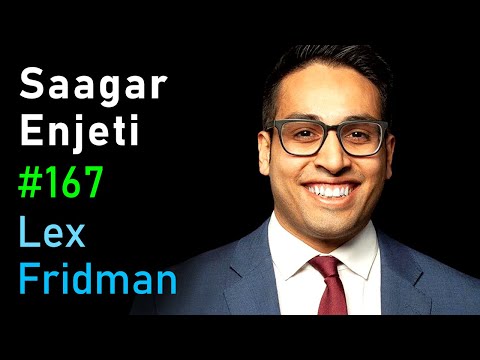
Saagar Enjeti: Politics, History, and Power | Lex Fridman Podcast #167
Lex Fridman (host), Saagar Enjeti (guest), Narrator
In this episode of Lex Fridman Podcast, featuring Lex Fridman and Saagar Enjeti, Saagar Enjeti: Politics, History, and Power | Lex Fridman Podcast #167 explores saagar Enjeti Dissects Power, Presidents, and America’s Political Machinery Lex Fridman and Saagar Enjeti use Hitler biographies, Trump, and FDR/LBJ as entry points to examine how power really works in modern and historical politics. They argue that systems and incentives, more than individual ideology, shape outcomes in Washington, with the presidency powerful in theory but constrained by bureaucracy and personnel. The conversation explores why Trump’s charisma works in person, why both Obama and Trump failed to radically change the system, and how culture war and negative partisanship now dominate American politics. They close by discussing the future of media, Texas as an emerging tech/political hub, and the enduring human drive toward exploration and greatness.
Saagar Enjeti Dissects Power, Presidents, and America’s Political Machinery
Lex Fridman and Saagar Enjeti use Hitler biographies, Trump, and FDR/LBJ as entry points to examine how power really works in modern and historical politics. They argue that systems and incentives, more than individual ideology, shape outcomes in Washington, with the presidency powerful in theory but constrained by bureaucracy and personnel. The conversation explores why Trump’s charisma works in person, why both Obama and Trump failed to radically change the system, and how culture war and negative partisanship now dominate American politics. They close by discussing the future of media, Texas as an emerging tech/political hub, and the enduring human drive toward exploration and greatness.
Key Takeaways
Charisma is partly trained, but power reveals more than it changes.
Saagar argues that figures like Hitler and Trump cultivated skills—reading rooms, controlling conversations, understanding opponents—but their core traits predated power; once in office, the spotlight simply amplifies and exposes those underlying tendencies.
Get the full analysis with uListen AI
Real power in Washington sits in systems and staff, not just presidents.
Even a disruptive president like Trump was repeatedly stalled by generals and bureaucrats who could slow-walk or dilute his agenda; without a 'hyper-intentional' plan and loyal, competent appointees, the federal apparatus defaults to its own culture and priorities.
Get the full analysis with uListen AI
Negative partisanship and culture war now drive voting more than policy.
Trump gained votes in 2020 despite thin policy delivery because many voters primarily wanted to spite or block the other side—e. ...
Get the full analysis with uListen AI
Personnel is policy: hiring establishment insiders recreates old outcomes.
Obama staffing up with Clinton-era economic advisers and Trump hiring Bush-world figures and Goldman Sachs alumni meant both administrations reproduced neoliberal economic and foreign policy patterns, undermining their promised “change” and illustrating how crucial personnel choices are.
Get the full analysis with uListen AI
Popular economic moves can unite a divided country if done cleanly.
Policies like stimulus checks poll around 80% approval across parties, but both parties sabotage their unifying potential by bundling them with polarizing cultural riders or partisan wish lists instead of passing them as standalone, clearly messaged actions.
Get the full analysis with uListen AI
Media is fragmenting into niche authority rather than mass 'papers of record.'
Saagar sees the future in personality-driven podcasts, Substacks, and social feeds where many figures are 'very famous to a few,' while institutions like the New York Times shift from universal arbiters to premium brands serving a specific upper-middle-class liberal niche.
Get the full analysis with uListen AI
Crises reveal missed opportunities for greatness and system redesign.
From COVID to 9/11 and the 2008 crash, Saagar believes leaders repeatedly failed to use crises as FDR or LBJ did—to reset economic arrangements or state capacity—opting instead for cautious, coalition-preserving moves that leave structural problems intact.
Get the full analysis with uListen AI
Notable Quotes
“They don't think about themselves the way that we think about them.”
— Saagar Enjeti (on powerful figures like Trump)
“If you don't have a hyper-intentional view of how to change foreign policy, they are just gonna go on autopilot.”
— Saagar Enjeti
“The true power currently lies with the autopilot. AKA deep state.”
— Lex Fridman (paraphrasing Saagar’s point)
“The future of politics looks like AOC... once-in-a-generation media genius, even if I don’t like her politics.”
— Saagar Enjeti
“There is no greatness without fulfilling the ultimate calling of the human spirit—which is more.”
— Saagar Enjeti
Questions Answered in This Episode
If systems and staff matter more than presidents, what concrete reforms could rebalance power toward democratic accountability without veering into conspiratorial 'deep state' thinking?
Lex Fridman and Saagar Enjeti use Hitler biographies, Trump, and FDR/LBJ as entry points to examine how power really works in modern and historical politics. ...
Get the full analysis with uListen AI
How can a leader practically resist culture-war incentives long enough to build a cross-partisan agenda around popular economic policies?
Get the full analysis with uListen AI
What would it actually take—politically, bureaucratically, and culturally—for a future president to treat UFO transparency or pandemic response with the intentionality Saagar describes for FDR and LBJ?
Get the full analysis with uListen AI
As media fragments into niche audiences, how can citizens avoid being trapped in new, smaller echo chambers while still benefiting from trusted, aligned voices?
Get the full analysis with uListen AI
Is there a realistic path for a truly 'great' 21st-century U.S. president—someone combining Elon/Musk-like risk appetite with FDR/LBJ-level system mastery—or are institutional constraints now too strong?
Get the full analysis with uListen AI
Transcript Preview
The following is a conversation with Saagar Enjeti. He is a DC-based political correspondent, host of The Rising with Krystal Ball, and host of The Realignment podcast with Marshall Kosloff. He has interviewed Donald Trump four times, and has interviewed a lot of major political figures and human beings who wield power. He loves policy and loves history, which makes him a great person to sail through the, uh, sometimes stormy waters of political discourse. He showed up to this conversation with a gift of the second volume of Ian Kershaw's biography on Hitler, a two-volume set that is widely acknowledged as one of the greatest, if not the greatest, most definitive studies of Hitler. Nothing wins my heart faster (laughs) on a first meeting or a first date (laughs) than a great book about the darkest aspects of human nature and human history. I think I started saying that as a joke, but actually there's probably a lot of truth to it. I love it when we skip the small talk and go straight to the in-depth conversation about the best and worst of human nature. A quick mention of our sponsors: Jordan Harbinger Show, Grammarly grammar assistant, Eight Sleep self-cooling bed, and Magic Spoon low-carb cereal. Click the sponsor links to get a discount and to support this podcast. As a side note, let me say that for better or for worse, I would like to avoid the trap of surface political bickering of the day. I do find politics fascinating, but not the talking points produced by the industrial engagement complex of red versus blue division. Instead, I'm fascinated by human beings who seek power and how power changes them. I don't have a political affiliation. And my ideas, at least I hope so, are defined more by curiosity and learning in the face of uncertainty and less by the echo chambers who tell me what I'm supposed to think. I'm constantly evolving, learning, and doing my best to do so without ego and with empathy. Please be patient with me. As far as I'm aware, I do not have any derangement syndromes nor do I get a medical prescription of blue, red, white, or black pills. If I say something, I say it because I'm genuinely thinking and struggling with the ideas. I have no agenda, just a bit of a hope to add more love to the world. If you enjoy this thing, subscribe on YouTube, review it on Apple Podcasts, follow on Spotify, support it on Patreon, or connect with me on Twitter @lexfriedman. And now, here's my conversation with Saagar Enjeti. There's no, uh, better gifts in this world-
(laughs)
... than a book about Hitler, so thank you so much (laughs) . I- I've gotten a gift when I was... what? We were just talking about-
Yes. Right, right.
... wine, the watch from Joe Rogan, and this almost beats it. So, uh-
(laughs)
So tell me what, uh, this particular book on Hitler is. So this is volume two?
Install uListen to search the full transcript and get AI-powered insights
Get Full TranscriptGet more from every podcast
AI summaries, searchable transcripts, and fact-checking. Free forever.
Add to Chrome