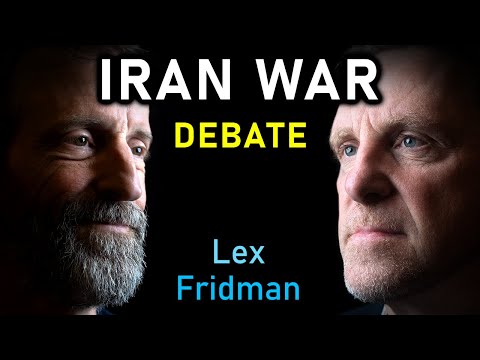
Iran War Debate: Nuclear Weapons, Trump, Peace, Power & the Middle East | Lex Fridman Podcast #473
Mark Dubowitz (guest), Scott Horton (guest), Lex Fridman (host), Lex Fridman (host), Lex Fridman (host), Lex Fridman (host), Lex Fridman (host), Lex Fridman (host), Lex Fridman (host), Lex Fridman (host), Lex Fridman (host)
In this episode of Lex Fridman Podcast, featuring Mark Dubowitz and Scott Horton, Iran War Debate: Nuclear Weapons, Trump, Peace, Power & the Middle East | Lex Fridman Podcast #473 explores fury Over Iran: Deterrence, Deception, and America’s War Choices Debated Lex Fridman moderates an intense, highly detailed debate between anti-war libertarian Scott Horton and Iran-hawk policy analyst Mark Dubowitz about Iran’s nuclear program, recent U.S.–Israeli strikes, and the broader U.S. role in the Middle East.
Fury Over Iran: Deterrence, Deception, and America’s War Choices Debated
Lex Fridman moderates an intense, highly detailed debate between anti-war libertarian Scott Horton and Iran-hawk policy analyst Mark Dubowitz about Iran’s nuclear program, recent U.S.–Israeli strikes, and the broader U.S. role in the Middle East.
Dubowitz argues Iran has pursued a deliberate, decades‑long nuclear weapons capability and supports terrorism, requiring firm U.S. deterrence, sanctions, and, if needed, selective military strikes to prevent a bomb and wider proliferation.
Horton contends the U.S. and Israel have repeatedly exaggerated or fabricated Iran’s nuclear threat, sabotaged workable diplomatic deals like the JCPOA, and launched wars and covert actions that actually incentivize states like Iran to seek nuclear deterrents.
Both agree a negotiated settlement is preferable, that a full ground war in Iran would be catastrophic, and that Trump’s next moves—between diplomacy and escalation—will strongly shape nuclear proliferation and regional stability.
Key Takeaways
Iran’s nuclear intentions are fiercely contested and hinge on how you interpret past evidence.
Dubowitz cites IAEA reports, the stolen nuclear archive, and U. ...
Get the full analysis with uListen AI
Recent U.S.–Israeli strikes may have set back Iran’s program—but could also push Tehran toward a real bomb.
Dubowitz frames Operation Midnight Hammer as a limited, successful blow that destroyed key sites and scientists, enhancing deterrence and leverage for a tougher deal; Horton argues bombing a non‑nuclear NPT member for “latent capability” proves only nukes can deter the U. ...
Get the full analysis with uListen AI
Your stance on enrichment is the fulcrum between a possible deal and endless confrontation.
Dubowitz insists any sustainable agreement must mean zero enrichment and full dismantlement, offering proliferation‑proof civilian reactors instead; Horton says Iran will never surrender enrichment because it is their latent deterrent and NPT‑backed right, so demanding zero is a poison pill that ensures perpetual crisis or war.
Get the full analysis with uListen AI
U.S. credibility—both in using and restraining force—shapes global nuclear proliferation decisions.
Dubowitz warns that failing to stop an Iranian bomb would spur Saudi, Turkish, and Asian nuclear programs, while a firm U. ...
Get the full analysis with uListen AI
Intelligence and media narratives from past wars are central to how each side reads today’s threats.
Horton repeatedly invokes Iraq WMD lies, MEK disinformation, and misreported Iran–Al-Qaeda links to argue skeptically against current “slam dunk” claims; Dubowitz counters with IAEA dossiers and named experts (like David Albright) to say the technical record shows an unmistakable pattern of Iranian deception and weaponization work.
Get the full analysis with uListen AI
Both sides see a full ground war with Iran as disastrous and favor diplomacy—on very different terms.
They agree 500,000 U. ...
Get the full analysis with uListen AI
Beneath the Iran argument is a deeper clash over America’s role: empire vs. restrained republic.
Horton’s libertarian vision favors minimal military posture, non‑intervention, and using U. ...
Get the full analysis with uListen AI
Notable Quotes
“If we want to avoid wars, we have to have serious deterrents because our enemies need to understand we will use selective, focused, overwhelming military power when we are facing threats like an Iranian nuclear weapon.”
— Mark Dubowitz
“I’m not seeing the peace through strength. I’m seeing permanent militarism and permanent war through strength.”
— Scott Horton
“Do you ever, ever hold our adversaries responsible or do you just don’t think we have any adversaries?”
— Mark Dubowitz
“The easiest kind of nuke to make out of uranium is a simple gun‑type nuke... but it’d essentially be useless to them. What are they gonna do, drive it to Israel in a flatbed truck?”
— Scott Horton
“The rules‑based order has been maintained by the United States since World War II... If we want to avoid wars, we have to have serious deterrents.”
— Mark Dubowitz
Questions Answered in This Episode
How should viewers weigh highly technical nuclear claims when even experts disagree on what the evidence from Iran actually shows?
Lex Fridman moderates an intense, highly detailed debate between anti-war libertarian Scott Horton and Iran-hawk policy analyst Mark Dubowitz about Iran’s nuclear program, recent U. ...
Get the full analysis with uListen AI
Does demanding zero enrichment from Iran increase or decrease the chances of a real war and a real Iranian bomb over the next decade?
Dubowitz argues Iran has pursued a deliberate, decades‑long nuclear weapons capability and supports terrorism, requiring firm U. ...
Get the full analysis with uListen AI
What criteria should decide when U.S. military strikes are justified to prevent proliferation, and when they are counterproductive or illegitimate?
Horton contends the U. ...
Get the full analysis with uListen AI
Given the history of Iraq, Libya, and North Korea, is it rational—or inevitable—for threatened regimes to seek nuclear weapons as insurance against regime change?
Both agree a negotiated settlement is preferable, that a full ground war in Iran would be catastrophic, and that Trump’s next moves—between diplomacy and escalation—will strongly shape nuclear proliferation and regional stability.
Get the full analysis with uListen AI
Can the U.S. realistically remain the ‘indispensable power’ without sliding into the kind of permanent militarization Eisenhower warned about in his farewell address?
Get the full analysis with uListen AI
Transcript Preview
If we want to avoid wars, we have to have serious deterrents because our enemies need to understand we will use selective, focused, overwhelming military power when we are facing threats like an Iranian nuclear weapon.
I'm not seeing the peace through strength. I'm seeing permanent militarism and permanent war through strength.
Do you ever, ever hold our adversaries responsible or do you just don't think we have any adversaries?
The easiest kind of nuke to make out of uranium is a simple gun-type nuke.
Are you saying that Mossad fabricated it?
Yeah. Yeah.
That's what you're claiming. Here's the offer, take it or leave it, zero enrichment, full dismantlement.
The Iranians told the IAEA, "You can inspect any five out of ten facilities here. Carte blanche, go ahead." And they did and found nothing.
Experts in Iran's nuclear program, including David Albright who actually saw the archive, went in there, wrote a whole book on it, and there's a lot of detail about how Iran had an active nuclear weapons program called the mod to build five nuclear weapons.
I have to refute virtually everything he just said, which is completely false.
I mean, really everything? There was, there was not one thing I said that was true? Just one thing.
I mean, Iran is a nation over there somewhere. You got that part right.
22 years of working on Iran and I got that right.
But do you know the population of Iran?
92 million. (laughs)
Okay.
Give me a pound, dude.
There we go.
Agreement.
The following is a debate between Scott Horton and Mark Dubowitz on the topic of Iran and Israel. Scott Horton is author and editorial director of antiwar.com, host of the Scott Horton Show, and for the past three decades, a staunch critic of US foreign policy and military interventionism. Mark Dubowitz is a chief executive of the Foundation for Defense of Democracies, host of the Iran Breakdown podcast, and he has been a leading expert on Iran and its nuclear program for over 20 years. This is the Lex Fridman Podcast. To support it, please check out our sponsors in the description and consider subscribing to this channel. If you do, I promise to work extremely hard to always bring you nuanced, long-form conversations with a very wide range of interesting people from all walks of life. And now, dear friends, here's Scott Horton and Mark Dubowitz. Gentlemen.
All right.
It's great to have you here. Uh, let's try to have a nuanced discussion/debate and maybe even steel man opposing perspectives as much as possible. All right, as it stands now, there's a barely stable ceasefire between Iran and Israel. Let's, uh, maybe rewind a little bit. Uh, can we first lay out the context for this Iran-Israel war and try to describe the key events that happened over the past two weeks, maybe even the, uh, a bit of the deep roots of the conflict.
Install uListen to search the full transcript and get AI-powered insights
Get Full TranscriptGet more from every podcast
AI summaries, searchable transcripts, and fact-checking. Free forever.
Add to Chrome