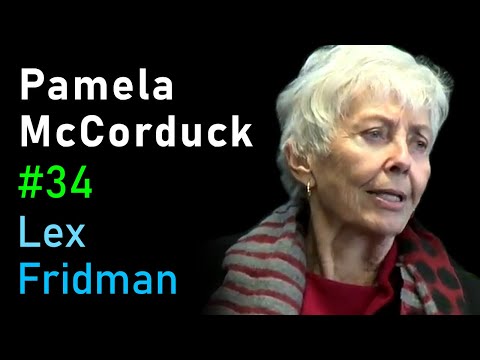
Pamela McCorduck: Machines Who Think and the Early Days of AI | Lex Fridman Podcast #34
Lex Fridman (host), Pamela McCorduck (guest), Narrator
In this episode of Lex Fridman Podcast, featuring Lex Fridman and Pamela McCorduck, Pamela McCorduck: Machines Who Think and the Early Days of AI | Lex Fridman Podcast #34 explores pamela McCorduck recalls AI’s mythic roots and scientific audacity Pamela McCorduck, author of *Machines Who Think*, reflects on the early days of artificial intelligence, when the field’s founders saw themselves as launching something historically important despite being scientific outsiders. She traces AI’s roots beyond math and computer science into ancient myths, religious tensions, literature, and long-standing human desires to create intelligence outside the human brain.
Pamela McCorduck recalls AI’s mythic roots and scientific audacity
Pamela McCorduck, author of *Machines Who Think*, reflects on the early days of artificial intelligence, when the field’s founders saw themselves as launching something historically important despite being scientific outsiders. She traces AI’s roots beyond math and computer science into ancient myths, religious tensions, literature, and long-standing human desires to create intelligence outside the human brain.
McCorduck discusses the personalities and motivations of AI pioneers like Newell, Simon, Minsky, and McCarthy, contrasting their pragmatic goals with later spiritual and apocalyptic narratives about AI. She challenges the popular notion of “AI winters” as commercial phenomena rather than true scientific stagnation, emphasizing the continuity of basic research.
The conversation also explores symbolic vs. algorithmic AI, the influence of complexity science at the Santa Fe Institute, and speculative futures including empathetic “geriatric robots.” McCorduck weaves in feminist perspectives, arguing that AI can undermine the idea that intelligence is inherently male and critiquing male-driven existential fears about superintelligence.
Ultimately, she remains a cautious optimist about AI’s future, worried more about unforeseeable side effects than scripted doomsday scenarios, and grateful to have witnessed the birth and evolution of a field she believes will fundamentally change the world.
Key Takeaways
AI’s roots are as much mythological and literary as they are mathematical.
McCorduck argues that the impulse to create artificial minds extends back through Homer, religious stories, early automata, and Babbage, showing AI as a continuation of a deep human desire to ‘forge the gods,’ not just a 20th‑century technical project.
Get the full analysis with uListen AI
Early AI founders knew they were creating a new field and acted accordingly.
Figures like Newell, Simon, Minsky, and McCarthy saw themselves as launching a historically significant discipline, even when others in computer science treated AI as fringe; they pursued cognitive modeling, mathematical formalisms, and “cool” problems with long‑term societal impact in mind.
Get the full analysis with uListen AI
The AI “winter” is largely a commercial story, not a scientific one.
McCorduck contends that the supposed winters were mainly about funding and unmet commercial hype, while fundamental research in areas like expert systems and symbolic reasoning quietly laid essential groundwork that later technologies build on.
Get the full analysis with uListen AI
Symbolic reasoning remains an underdeveloped frontier alongside today’s algorithms.
While deep learning and algorithmic approaches dominate current applications, she notes that higher‑level symbolic processing and knowledge representation have not been fully realized, representing fertile ground for future researchers.
Get the full analysis with uListen AI
Common AI fears reflect deep psychological and cultural patterns, including religious and gendered biases.
She connects primal anxieties about ‘blasphemy’ and Frankenstein myths to modern AI panic, and argues that male technologists’ fear of being outsmarted by machines—the “male gaze”—colors existential risk narratives more than we acknowledge.
Get the full analysis with uListen AI
AI could play a powerful role in care, companionship, and aging.
Her speculative ‘geriatric robot’ illustrates how AI might meaningfully support the elderly by listening, remembering, and caring without human ulterior motives, while also highlighting the complex human desire for both attentive service and personal space.
Get the full analysis with uListen AI
AI can help dismantle the notion that intelligence is inherently male.
McCorduck realized that part of her attraction to AI was wanting intelligence to be seen outside the ‘male cranium’; successful machine intelligence undermines gendered assumptions about who can be smart and what forms intelligence can take.
Get the full analysis with uListen AI
Notable Quotes
“Artificial intelligence began with the ancient wish to forge the gods.”
— Paraphrased by Lex Fridman from Pamela McCorduck’s *Machines Who Think*
“The idea of intelligence outside the human cranium—this was a phenomenal idea.”
— Pamela McCorduck
“AI winter is, to me, a crock… Science has a much longer view than commerce.”
— Pamela McCorduck
“This is the first guys who have always been the smartest guy on the block, and here comes something that might be smarter. Ooh, let’s stamp it out before it takes over.”
— Pamela McCorduck (on male fears of superintelligence)
“I was so tired of hearing that intelligence was inside the male cranium… I wanted something besides male smarts.”
— Pamela McCorduck
Questions Answered in This Episode
How would our public narratives about AI change if they drew more on the ‘Hellenic’ celebration of artificial beings rather than ‘Hebraic’ anxieties about blasphemy?
Pamela McCorduck, author of *Machines Who Think*, reflects on the early days of artificial intelligence, when the field’s founders saw themselves as launching something historically important despite being scientific outsiders. ...
Get the full analysis with uListen AI
What concrete research directions could revive and integrate symbolic AI with today’s dominant deep learning approaches?
McCorduck discusses the personalities and motivations of AI pioneers like Newell, Simon, Minsky, and McCarthy, contrasting their pragmatic goals with later spiritual and apocalyptic narratives about AI. ...
Get the full analysis with uListen AI
To what extent are current AI safety debates driven by genuine risk analysis versus psychological threats to status, power, and identity among human elites?
The conversation also explores symbolic vs. ...
Get the full analysis with uListen AI
How might wide adoption of caregiving or companion robots reshape our understanding of loneliness, dignity, and dependence in aging societies?
Ultimately, she remains a cautious optimist about AI’s future, worried more about unforeseeable side effects than scripted doomsday scenarios, and grateful to have witnessed the birth and evolution of a field she believes will fundamentally change the world.
Get the full analysis with uListen AI
If AI helps decouple intelligence from gender, what new forms of bias or hierarchy might emerge in how we relate to artificial and human minds?
Get the full analysis with uListen AI
Transcript Preview
The following is a conversation with Pamela McCorduck. She's an author who has written on the history and the philosophical significance of artificial intelligence. Her books include Machines Who Think in 1979, The Fifth Generation in 1983 with Ed Feigenbaum, who's considered to be the father of expert systems, The Edge of Chaos, The Futures of Women, and many more books. I came across her work in an unusual way, by stumbling on a quote from Machines Who Think that is something like, "Artificial intelligence began with the ancient wish to forge the gods." That was a beautiful way to draw a connecting line between our societal relationship with AI, from the grounded day-to-day science, math and engineering, to popular stories and science fiction and myths of automatons that go back for centuries. Through her literary work, she has spent a lot of time with the seminal figures of artificial intelligence, including the founding fathers of AI from the 1956 Dartmouth summer workshop where the field was launched. I reached out to Pamela for a conversation in hopes of getting a sense of what those early days were like, and how their dreams continue to reverberate through the work of our community today. I often don't know where the conversation may take us, but I jump in and see. Having no constraints, rules or goals is a wonderful way to discover new ideas. This is the Artificial Intelligence podcast. If you enjoy it, subscribe on YouTube, give it five stars on iTunes, support it on Patreon, or simply connect with me on Twitter @lexfridman, spelled F-R-I-D-M-A-N. And now, here's my conversation with Pamela McCorduck. In 1979, your book, Machines Who Think was published. In it, you interview some of the early AI pioneers and explore the idea that AI was born not out of maybe math and computer science, but out of myth and legend.
(laughs)
(laughs) So, uh, tell me if you could the story of how you first arrived at the book, the journey of-
Oh.
... beginning to write it.
I had been a novelist. I'd published two novels. And I was sitting, uh, under, uh, the portal at Stanford one day in the house we were renting for the summer, and I thought, "I should write a novel about these weird people in AI I know." And then I thought, "Ah, don't write a novel. Write a history. Simple. Just go around, you know, interview them, splice it together. Voila, instant book. Ha, ha, ha." It was much harder than that. (laughs) But nobody else was doing it. And so I thought, "Well, this is a great opportunity." And there were people who, uh, John McCarthy for example, thought it was a nutty idea. There were much... You know, the field had not evolved yet, so on. And he had some mathematical thing he thought I should write instead. And I said, "No, John. I am not a woman in search of a project. I'm... This is what I want to do. I hope you'll cooperate." And he said, "Oh, mutter mutter. Well, okay. It's your, your time." And-
Install uListen to search the full transcript and get AI-powered insights
Get Full TranscriptGet more from every podcast
AI summaries, searchable transcripts, and fact-checking. Free forever.
Add to Chrome