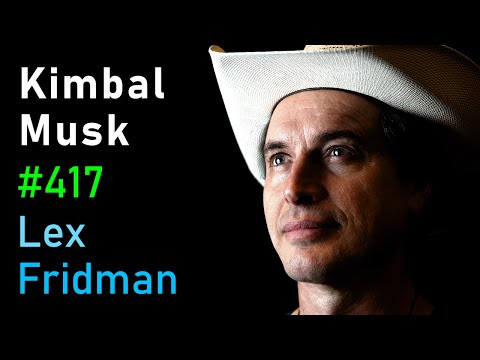
Kimbal Musk: The Art of Cooking, Tesla, SpaceX, Zip2, and Family | Lex Fridman Podcast #417
Kimbal Musk (guest), Lex Fridman (host), Narrator, Narrator, Narrator
In this episode of Lex Fridman Podcast, featuring Kimbal Musk and Lex Fridman, Kimbal Musk: The Art of Cooking, Tesla, SpaceX, Zip2, and Family | Lex Fridman Podcast #417 explores kimbal Musk on food, family, mortality, joy, and building futures Kimbal Musk joins Lex Fridman to explore how food, entrepreneurship, and near-death experiences shaped his life. He reflects on growing up amid South African violence, his traumatic family history, and how those experiences informed his deep appreciation for the value of human life and of America. The conversation moves through his love of cooking as an art of community-building, the philosophy behind his restaurants and cookbook, and the emotional power of gathering around food. They also discuss Zip2, Tesla, and SpaceX, along with meditation, psychedelics, and what gives Kimbal hope about humanity’s long-term trajectory.
Kimbal Musk on food, family, mortality, joy, and building futures
Kimbal Musk joins Lex Fridman to explore how food, entrepreneurship, and near-death experiences shaped his life. He reflects on growing up amid South African violence, his traumatic family history, and how those experiences informed his deep appreciation for the value of human life and of America. The conversation moves through his love of cooking as an art of community-building, the philosophy behind his restaurants and cookbook, and the emotional power of gathering around food. They also discuss Zip2, Tesla, and SpaceX, along with meditation, psychedelics, and what gives Kimbal hope about humanity’s long-term trajectory.
Key Takeaways
Food is a daily gift and a powerful tool for connection.
Kimbal views each meal as a gift we give ourselves three times a day, best shared with others. ...
Get the full analysis with uListen AI
Physical gathering around food humanizes people across deep ideological divides.
At his restaurants and bars, Kimbal sees Trump supporters, conspiracy theorists, and people of all views converse civilly when sharing a table. ...
Get the full analysis with uListen AI
Technique and attention matter more than complexity in cooking.
He emphasizes mastering simple dishes like scrambled eggs and steak through focus, repetition, and understanding ingredients (e. ...
Get the full analysis with uListen AI
Trauma can teach what not to do, but it also quietly shapes behavior.
Growing up with a verbally abusive father taught Kimbal how not to live and lead, but it also left him with coping mechanisms like mentally dissociating during conversations. ...
Get the full analysis with uListen AI
Near-death experiences can radically clarify priorities.
After breaking his neck and facing paralysis, Kimbal had a prolonged sense of inner clarity—“a voice of God” or deeper self—directing him to work on kids and food. ...
Get the full analysis with uListen AI
Innovations that seem obvious in hindsight often meet indifference at first.
From automating bank reports in Lotus 1‑2‑3 to launching vector-based maps online with Zip2, Kimbal repeatedly saw breakthroughs treated as minor curiosities. ...
Get the full analysis with uListen AI
Progress is real but noisy; zooming out shows a hopeful trajectory.
Kimbal argues that despite daily chaos, metrics like poverty, infant mortality, and war frequency have improved over decades. ...
Get the full analysis with uListen AI
Notable Quotes
“The definition for me of a good party is that people laugh and cry.”
— Kimbal Musk
“Food is a gift we give ourselves three times a day. Let’s make it a good one.”
— Kimbal Musk
“If you want to live forever, wrap yourself in cotton wool in your basement. You might not die from COVID, but you’ll die from misery.”
— Kimbal Musk
“We were the first two humans to see door‑to‑door directions on the internet.”
— Kimbal Musk
“It’s less about hope, it’s more about perspective and reflection. If you step back a little, things are actually getting better. It’s just a bumpy ride.”
— Kimbal Musk
Questions Answered in This Episode
How has Kimbal’s experience with severe trauma and a near-death injury influenced how he leads teams and raises his children today?
Kimbal Musk joins Lex Fridman to explore how food, entrepreneurship, and near-death experiences shaped his life. ...
Get the full analysis with uListen AI
What practical steps can ordinary people take to turn their own meals into deeper moments of connection and vulnerability rather than routine refueling?
Get the full analysis with uListen AI
Where is the line between healthy dietary discipline and a joy-killing, stressful relationship with food, and how can someone find that balance?
Get the full analysis with uListen AI
What lessons from the early failures and near-bankruptcy moments at Tesla and SpaceX are most transferable to non-tech, everyday businesses?
Get the full analysis with uListen AI
How should we interpret experiences like “the voice of God” during trauma or psychedelics—neuroscience, spirituality, or some integration of both?
Get the full analysis with uListen AI
Transcript Preview
For me, cooking is an art.
What's your favorite ingredient to cook with?
There isn't one. It's more like when there is one, it really is one. You know, like those peaches on the- on the cover of this cookbook. Those peaches, those were in August, Colorado peaches. It just doesn't get any better than that.
On that day, at that moment, that was the best ƒ ingredient, yeah? (laughs)
That was the be- But that only lasts for a week.
(laughs) Yeah.
And then they don't taste so great.
Yeah. (laughs)
(laughs) But damn, are they so good in that moment, and you just can't stop wanting to use that ingredient.
The following is a conversation with Kimbal Musk, a longtime entrepreneur and chef, and author of a new cookbook called The Kitchen Cookbook: Cooking For Your Community. You should check it out. It is, in fact, the first cookbook I've ever owned. I've already made stuff from it, and it's delicious. This is the Lex Fridman Podcast. To support it, please check out our sponsors in the description. And now, dear friends, here's Kimbal Musk. Growing up in South Africa, you said it was a violent place. What are some formative moments that you remember from that time?
South Africa was... So I grew up in, uh, ap- apartheid South Africa, but more specifically, the fall of apartheid. So it was- it was the '80... I was a teenager in the '80s. And, uh, our community would- would, um... Part of our social life, frankly, was the anti-apartheid protests and to go be with white people, Black people, kind of mix- mixing it all together. The most formative experiences, frankly how much I appreciate a place like America where we have value for human life. So there was a country where- where bl- li- human life was not valued. It was a... it's a weird thing to come from that to here where- where we- we take it so seriously if someone dies in a war or something like that. And, um, we just didn't take it seriously in South Africa that people died, that people were killed. I saw someone killed in front of me. Um, was, uh, was getting off a train, and it's a very violent train, known- known for violence. We were stupid kids. We didn't really listen to our parents. We went on this train, and, uh, the doors opened, and I had people trying to get off the train. And in front of me, uh, two Black people, one Black guy just stabbed this knife in the side of this other Black guy's head. And you're like, "What the fuck?" And you just... I've- I'm tr- I feel, I gotta get off the train.
How old were you at this time?
Probably 16 or 17. And I gotta get off the train, and everyone is trying to get me to get off because, you know, they're all behind me. So I step off, and I step into the pool of blood with one foot, and then I just walk for about 100 paces while the stickiness of the blood just kind of on my sneakers just on one foot just, like, leaves a footprint behind me. And you just walk on. You just walk on.
Install uListen to search the full transcript and get AI-powered insights
Get Full TranscriptGet more from every podcast
AI summaries, searchable transcripts, and fact-checking. Free forever.
Add to Chrome