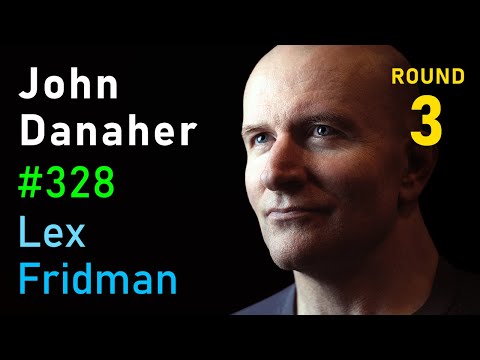
John Danaher: Grappling, Jiu Jitsu, ADCC, and Animal Combat | Lex Fridman Podcast #328
John Danaher (guest), Lex Fridman (host), Narrator, Narrator, Narrator, Narrator, Lex Fridman (host), Narrator
In this episode of Lex Fridman Podcast, featuring John Danaher and Lex Fridman, John Danaher: Grappling, Jiu Jitsu, ADCC, and Animal Combat | Lex Fridman Podcast #328 explores john Danaher on rebuilding greatness, ADCC dominance, and real combat Lex Fridman and John Danaher trace the implosion and rebirth of Danaher’s team between the failed Puerto Rico move, a painful team split, and an unexpectedly dominant ADCC 2022 performance.
John Danaher on rebuilding greatness, ADCC dominance, and real combat
Lex Fridman and John Danaher trace the implosion and rebirth of Danaher’s team between the failed Puerto Rico move, a painful team split, and an unexpectedly dominant ADCC 2022 performance.
Danaher explains how he rebuilt from almost no athletes or gym infrastructure, detailing the technical and psychological preparation that produced Gordon Ryan’s historic double-gold run and breakout champions like Giancarlo Bodoni and Nicholas Meregali.
They dive deeply into training methodology: offensive and defensive skill progression, confidence as a byproduct of physical competence, rule‑set specific preparation, takedown systems for jiu jitsu, and integrating wrestling, judo, and MMA.
The conversation also wanders into animal combat hypotheticals, the limits of human vs. animal fighting, the role of ego and team conflict, jiu jitsu as therapy for veterans, and broader philosophical themes about excellence, ambition, and love.
Key Takeaways
Rebuilds start with environment and standards, not stars.
After most of his athletes left and he lost his gym, Danaher rebuilt in Austin by teaching small local classes, spotting potential, and then filtering recruits by work ethic, team fit, and willingness to endure an extreme training schedule rather than chasing big names.
Get the full analysis with uListen AI
Confidence is earned through accumulated, tested skills—not speeches.
Danaher argues that real competitive confidence comes from repeatedly applying specific offensive and defensive skills under progressively harder resistance and in competitions, not from motivational psychology or hype.
Get the full analysis with uListen AI
Train offense and defense with opposite progressions.
For offense, he starts athletes against weaker partners and gradually increases the level to build successful reps; for defense, he deliberately throws them into deep water against strong partners to expose vulnerabilities, then steps resistance down and rebuilds their confidence.
Get the full analysis with uListen AI
Rule sets and time horizons must shape training plans.
Gordon’s ADCC camp had to account for multiple events, different rule sets (WNO, no‑time‑limit, ADCC), and scoring structures (e. ...
Get the full analysis with uListen AI
Extreme excellence often conflicts with comfort and relationships.
Danaher is candid that his constant demands for more work and a more complete skill set can drive athletes away, especially once they’re already “incredibly good” and praised by everyone else; he frames the choice as excellence versus a more balanced, enjoyable life.
Get the full analysis with uListen AI
Technical depth in defense unlocks offensive freedom.
He credits Gordon Ryan’s dominance not just to offense but to absurdly deep defensive training from terrible positions; knowing he can survive worst‑case scenarios lets him attack without fear and removes obvious tactical weak points.
Get the full analysis with uListen AI
Audacious goals can pull performance far beyond expectations.
Meregali’s near‑insane goal—gi absolute gold and ADCC absolute gold in the same year, starting with zero no‑gi or wrestling—forced him to aggressively close weaknesses (leglocks, wrestling) and resulted in a gi absolute title and an ADCC medal, a “failure” that was still extraordinary.
Get the full analysis with uListen AI
Notable Quotes
“It’s so easy to let a minute of anger destroy 10 years of friendship.”
— John Danaher
“Confidence doesn’t come from words. It comes from accumulated skills which experience shows you have been responsible for successful performances in the past.”
— John Danaher
“You can be the best you possibly can, or you can be incredibly good and maybe just enjoy your life a little more.”
— John Danaher
“I had many students, but only one Gordon Ryan.”
— John Danaher
“If you can’t wrap your head around the idea that trying to acquire new skills will create a temporary time where your effectiveness diminishes, you’re never going to make it.”
— John Danaher
Questions Answered in This Episode
How much should a coach prioritize keeping a team together versus allowing inevitable splits when personalities and ambitions clash?
Lex Fridman and John Danaher trace the implosion and rebirth of Danaher’s team between the failed Puerto Rico move, a painful team split, and an unexpectedly dominant ADCC 2022 performance.
Get the full analysis with uListen AI
If confidence is mostly a byproduct of physical skills, what’s the real value—if any—of sports psychology and mental coaching?
Danaher explains how he rebuilt from almost no athletes or gym infrastructure, detailing the technical and psychological preparation that produced Gordon Ryan’s historic double-gold run and breakout champions like Giancarlo Bodoni and Nicholas Meregali.
Get the full analysis with uListen AI
Where is the line between a healthy pursuit of greatness and an unhealthy sacrifice of relationships, health, and enjoyment?
They dive deeply into training methodology: offensive and defensive skill progression, confidence as a byproduct of physical competence, rule‑set specific preparation, takedown systems for jiu jitsu, and integrating wrestling, judo, and MMA.
Get the full analysis with uListen AI
What can hobbyist grapplers realistically borrow from Danaher’s methods without burning out or getting injured on limited training time?
The conversation also wanders into animal combat hypotheticals, the limits of human vs. ...
Get the full analysis with uListen AI
Do you agree with Danaher that some areas of life, like romantic love, should remain un‑systematized and free of ‘expertise’ to preserve their magic?
Get the full analysis with uListen AI
Transcript Preview
A male chimp is more than enough to kill any human on the planet, including Gordon Ryan.
So Gordon Ryan fighting a chimp-
Dead.
... a good size-
Dead.
No, a thousand times. How many times does he win?
He loses a thousand times. It's not even competitive. It's not even remotely competitive.
Do you think he will disagree?
No.
Okay. Do you think anyone will disagree? Anyone-
Yeah, morons.
(laughs) The following is a conversation with John Danaher, his third time on this podcast. He's widely considered to be one of the greatest minds in martial arts history. This is a Lex Fridman podcast. To support it, please check out our sponsors in the description. And now, dear friends, here's John Danaher. The ADCC is the premier submission grappling tournament in the world. We just had it a couple of weeks ago. We saw many demonstrations of greatness from athletes you coached. But a year ago, the team and you were at a very low point. Take me through that journey. What was the lowest point?
We ha- had a very, very tight team for many years, uh, which began N- in New York City. During the peak of COVID, training in New York became very difficult to sustain, so, um, most of the team, uh, despised the city of New York. I, I was the only person in the group that liked living in New York. Um, I think part of the problem was that, uh, uh, I was the only one who actually lived in Manhattan. The others had to commute to New York. And there's a world of difference between living in New York and commuting to New York. So most of them had a very negative view of New York City. That was compounded by COVID, uh, when even the basic act of training became very, very difficult. And, uh, so everyone decided they want to leave. So there was a prospect of a complete breakup between myself and the team, or I would have to leave New York. I... It was a difficult decision for me to make 'cause I'd lived in New York for 30 years. Um, I had built my life there and had most of my friends and associates, uh, uh, that I know here in America w- New Yorkers. So I thought, you know, these guys have been an unsaint- uh, incredibly loyal to me as students, so I should also be loyal to them, of course. So I decided that if they wanted to leave, I would go with them. We decided, uh, to go to Puerto Rico because there was a, uh, a private gym where we could train through the COVID period. Um, I personally wanted to go to Texas. I thought that Texas was a, a better place for the team to go. But, um, many of the students, uh, including senior students like, uh, Gordon Ryan, Craig Jones, had been to Puerto Rico and stayed with one of the head officials of ADCC, Moe Jasem. So, uh, they loved their experience in Puerto Rico and, uh, almost everyone wanted to go down there. So I tried to explain to them there's a world of difference between going to a place for vacation versus living there, but that didn't have any effect. So the decision was made, a majority decision was made to go to Puerto Rico. Um, in Puerto Rico, the conditions in which the team lived changed significantly. When you're in New York, New York is such a big city that if there's any, uh, tension between team members and inevitably there will be in a competitive sport where everyone's fighting each other, you can kind of bury them in the size of the city because there's so many distractions in New York. You know, you come in, you do your workout, you go outside, and it's, it's New York City. Um, in Puerto Rico, we lived in a very small, uh, local town, Dorado, and, um, most of the athletes were living with each other. And so unlike New York where there was always a break, you train together but when training was over, you went about your life in New York and New Jersey. Um, with everyone living in very close proximity to each other, any tensions got magnified because there was no relief from them. You didn't get to get away from people. If you had a problem with someone on the mat, well, now you had to do, to live with them for, uh, the rest of the, the day and the night, and this goes on for long periods of time. So I believe it had the effect of magnifying whatever tensions there were. In particular, there was a, uh, a family tension between two brothers which magnified over time. Um, uh, and, you know, as, as so often is the case, you get two brothers growing up, one older, one younger, and the younger one wants to grow and, uh, and feel somewhat like a, a young tree underneath a bigger tree. And, um, uh, sometimes people just need their space. So there was some, there was some unhappiness and, um-
Install uListen to search the full transcript and get AI-powered insights
Get Full TranscriptGet more from every podcast
AI summaries, searchable transcripts, and fact-checking. Free forever.
Add to Chrome