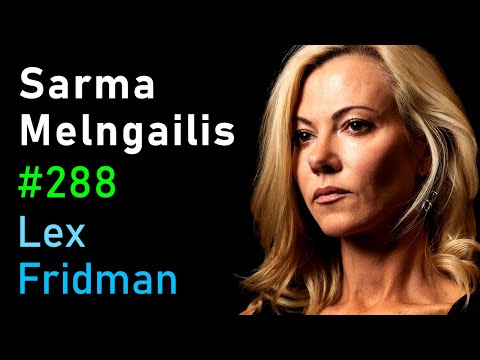
Sarma Melngailis: Bad Vegan, Fraud, Prison, and Sociopathy | Lex Fridman Podcast #288
Sarma Melngailis (guest), Lex Fridman (host), Narrator, Narrator, Narrator, Narrator, Narrator
In this episode of Lex Fridman Podcast, featuring Sarma Melngailis and Lex Fridman, Sarma Melngailis: Bad Vegan, Fraud, Prison, and Sociopathy | Lex Fridman Podcast #288 explores bad Vegan revisits love, fraud, coercion, and redemption on mic Lex Fridman speaks with Sarma Melngailis about her life before, during, and after the events depicted in Netflix’s 'Bad Vegan,' focusing on how she sees her own story versus the documentary’s narrative.
Bad Vegan revisits love, fraud, coercion, and redemption on mic
Lex Fridman speaks with Sarma Melngailis about her life before, during, and after the events depicted in Netflix’s 'Bad Vegan,' focusing on how she sees her own story versus the documentary’s narrative.
She describes her childhood, her rise as a celebrated raw vegan restaurateur in New York, and the complex, coercive relationship with Anthony Strangis that coincided with financial collapse and criminal charges.
They explore psychological manipulation, sociopathy, cult‑like dynamics, and how someone intelligent and successful can still be pulled into delusional, destructive situations.
Sarma also reflects on prison life at Rikers, moral questions about guilt and responsibility, her enduring bond with her dog Leon, and tentative hopes for rebuilding her life, work, and capacity for love.
Key Takeaways
Coercive control can override intelligence and common sense in slow, nearly invisible steps.
Sarma emphasizes that the relationship with Strangis developed gradually through grooming, exhaustion, fear, and isolation, making her more susceptible to delusional thinking and bad decisions she would never have made in a normal state.
Get the full analysis with uListen AI
Pleading guilty is often a pragmatic legal choice, not a clean moral admission.
She explains she accepted a plea to avoid the risk, cost, and psychological strain of a trial she couldn’t afford, highlighting how many defendants plead guilty for survival reasons rather than because the legal narrative matches what actually happened.
Get the full analysis with uListen AI
Media narratives can be powerfully misleading when they compress or splice reality.
Sarma criticizes 'Bad Vegan' for editing that implied she married for money and still flirts with Strangis, arguing that context—like her recording him strategically—is crucial, and that viewers should be wary of neat, sensational story arcs.
Get the full analysis with uListen AI
Understanding sociopathy is vital for self‑protection in personal and public life.
Drawing on books like 'Confessions of a Sociopath,' she notes sociopaths’ emotional hollowness, lack of startle and guilt, and skill at reading and exploiting vulnerabilities—traits that can manifest in romance, business, politics, and cults.
Get the full analysis with uListen AI
Responsibility and guilt are not the same, but both can coexist after harm.
She says she feels deeply responsible for the collapse of her restaurant and the suffering of staff and investors, even while believing her intent was not criminal and that much of the harm flowed from Strangis’s manipulation.
Get the full analysis with uListen AI
Prison exposes systemic injustice and unexpected humanity at the same time.
Her months at Rikers showed her how many people are jailed pre‑trial simply for lack of small amounts of bail money, but also how much kindness, generosity, and dark humor can exist among incarcerated women living in chaotic conditions.
Get the full analysis with uListen AI
Food ethics and health are complex; rigid labels often obscure nuance.
Though known for raw vegan cuisine, she resists identity labels, eats animal products in some contexts, and thinks deeply about factory farming, hunting, subsidies, and how bodies intuitively crave certain foods or nutrients.
Get the full analysis with uListen AI
Notable Quotes
“I don’t feel guilt, I feel responsibility.”
— Sarma Melngailis
“It was like being in a cult of one.”
— Sarma Melngailis
“He made me think everything was going to be reversed and okay, that anyone money was borrowed from would get it back, maybe tenfold.”
— Sarma Melngailis
“The only person who understands what I went through is the person who put me through it.”
— Sarma Melngailis
“Confront the dark parts of yourself and work to banish them with illumination and forgiveness. Your willingness to wrestle with your demons will cause your angels to sing.”
— August Wilson (quoted by Lex Fridman)
Questions Answered in This Episode
Where do you personally draw the line between moral responsibility and victimization when someone acts under coercive psychological control?
Lex Fridman speaks with Sarma Melngailis about her life before, during, and after the events depicted in Netflix’s 'Bad Vegan,' focusing on how she sees her own story versus the documentary’s narrative.
Get the full analysis with uListen AI
How should documentaries and true‑crime media balance storytelling with ethical obligations to portray complex realities accurately?
She describes her childhood, her rise as a celebrated raw vegan restaurateur in New York, and the complex, coercive relationship with Anthony Strangis that coincided with financial collapse and criminal charges.
Get the full analysis with uListen AI
What concrete signs or 'micro‑red‑flags' can people watch for early in relationships to detect manipulation or sociopathic behavior before it escalates?
They explore psychological manipulation, sociopathy, cult‑like dynamics, and how someone intelligent and successful can still be pulled into delusional, destructive situations.
Get the full analysis with uListen AI
Given your experience at Rikers, what specific reforms would you prioritize in bail laws, pre‑trial detention, or conditions of confinement?
Sarma also reflects on prison life at Rikers, moral questions about guilt and responsibility, her enduring bond with her dog Leon, and tentative hopes for rebuilding her life, work, and capacity for love.
Get the full analysis with uListen AI
If you could rebuild Pure Food & Wine or One Lucky Duck from scratch today, what would you do differently in the business structure and in your own boundaries?
Get the full analysis with uListen AI
Transcript Preview
He made me think that, you know, everything was gonna be reversed and okay, and anybody that money was borrowed from, they would get it back, you know, maybe tenfold. And so it was this weird situation of having, like, one foot in his reality and potentially believing the things he was saying, or even, over time, wanting to believe them more and more because the alternative was so... The alternative was worse. The alternative was like... Was increasingly a bigger and bigger nightmare.
The following is a conversation with Sarma Melngailus, a chef and restaurateur who was the subject of the Netflix documentary Bad Vegan: Fame, Fraud, and Fugitives, that documents the rise and fall of her vegan raw food restaurants in New York City, that ended in what she called a road trip from hell, being arrested in Tennessee or pleading guilty for stealing over two million dollars and serving four months at Rikers Island Jail. Sarma disputes the veracity of the documentary and its conclusions, saying that she was misrepresented. So I wanted to talk to her to get the full story and to seek understanding of who she is as a human being, the good and the bad. This is the Lex Fridman Podcast. To support it, please check out our sponsors in the description, and now, dear friends, here's Sarma Melngailus. You've said that you did a lot of reading when you were growing up, and you mentioned Fear and Loathing in Las Vegas by Hunter S. Thompson. So from the reading you've done in those early days, how did you see the world? Was it to you a beautiful place or a cruel place?
I don't think I thought about the world.
You were focused on family? Just basic day-to-day life?
I think I was focused on day-to-day. I had an awareness of not fitting in, but I think back then it felt like something was wrong versus some people are just that way. And speaking of books, I read a book called, um, Party of One by a woman named Anneli Rufus that somebody gave me and suggested I read, and that helped a lot. That was, that was one book that made me feel like... It made me understand things from the past that I hadn't understood before, specifically kind of feeling out of place even among my family, which is where you're not supposed to feel out of place.
Yeah, I'm not sure where I saw it, but I think you mentioned that you were a bit of a loner, and I also think I saw somewhere pictures of you with, uh, with green hair in high school and, and, and a wild haircut. What was that about? Is that... Was that real? Am I just imagining things?
No, you're not imagining it. It's strange because I was kind of a, a loner, so it'd be strange to do something that calls so much attention to yourself.
Install uListen to search the full transcript and get AI-powered insights
Get Full TranscriptGet more from every podcast
AI summaries, searchable transcripts, and fact-checking. Free forever.
Add to Chrome