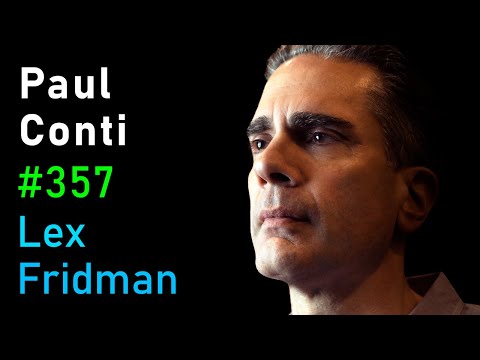
Paul Conti: Narcissism, Sociopathy, Envy, and the Nature of Good and Evil | Lex Fridman Podcast #357
Paul Conti (guest), Lex Fridman (host), Narrator, Narrator
In this episode of Lex Fridman Podcast, featuring Paul Conti and Lex Fridman, Paul Conti: Narcissism, Sociopathy, Envy, and the Nature of Good and Evil | Lex Fridman Podcast #357 explores psychiatrist Paul Conti Dissects Envy, Evil, Trauma, and Meaning Lex Fridman and psychiatrist Paul Conti explore how psychiatry, trauma, and unconscious forces reveal human nature, especially around narcissism, envy, sociopathy, and evil. Conti argues that narcissism is rooted not in arrogance but in a profound sense of inadequacy, fueled by envy that can scale from petty interpersonal harm to genocidal leaders like Hitler. They connect individual psychology to culture, power, and history, emphasizing how unprocessed trauma and collective envy can create destructive societies, while humility, gratitude, and truthful self-knowledge foster health and goodness. The conversation also covers the role of emotions, the unconscious, childhood trauma, therapy, meaning in life, and how small daily acts of kindness and honesty can counteract entropy and evil.
Psychiatrist Paul Conti Dissects Envy, Evil, Trauma, and Meaning
Lex Fridman and psychiatrist Paul Conti explore how psychiatry, trauma, and unconscious forces reveal human nature, especially around narcissism, envy, sociopathy, and evil. Conti argues that narcissism is rooted not in arrogance but in a profound sense of inadequacy, fueled by envy that can scale from petty interpersonal harm to genocidal leaders like Hitler. They connect individual psychology to culture, power, and history, emphasizing how unprocessed trauma and collective envy can create destructive societies, while humility, gratitude, and truthful self-knowledge foster health and goodness. The conversation also covers the role of emotions, the unconscious, childhood trauma, therapy, meaning in life, and how small daily acts of kindness and honesty can counteract entropy and evil.
Key Takeaways
Narcissism is rooted in inadequacy and envy, not arrogance.
Conti defines narcissism as a deep, unquestioned sense of inadequacy and fear of annihilation, compensated by aggressive, envy-driven defenses. ...
Get the full analysis with uListen AI
Envy is qualitatively different from jealousy and drives much orchestrated evil.
Jealousy can be benign and motivating (wanting what another has and striving for it or accepting you don’t have it), whereas envy wants to pull the other down so you feel better. ...
Get the full analysis with uListen AI
Trauma warps both brain biology and self-beliefs, especially in childhood.
Adverse childhood experiences over-activate fear and vigilance circuits and teach false lessons: “I’m not safe, not good enough, can’t protect myself. ...
Get the full analysis with uListen AI
Processing trauma requires bringing it into words and shared awareness.
Unspoken trauma festers in intrusive emotional loops and unconscious shame. ...
Get the full analysis with uListen AI
Emotion almost always overrides logic, and we routinely mistake feelings for facts.
Humans tend to treat emotions—anger, shame, fear—as reality and then build beliefs and narratives around them. ...
Get the full analysis with uListen AI
Culture can amplify or restrain individual envy, narcissism, and violence.
Demagogues “lasso” the envy and insecurity of thousands, converting personal grievances into mass hatred and violence. ...
Get the full analysis with uListen AI
Small, local acts of kindness and integrity matter more than grand abstractions.
Overwhelmed by global crises and information overload, young people can become nihilistic. ...
Get the full analysis with uListen AI
Notable Quotes
“Narcissism is not arrogance. Narcissism is the opposite of arrogance. There is such a deep sense of inadequacy and incompetence in the self that the defensive structure around that becomes dominated by rocket-fueled envy.”
— Paul Conti
“I believe the capacity for evil is in all of us. There’s a difference between having the capacity and nurturing the seed of evil versus choosing not to water it.”
— Paul Conti
“We are all infinitely fascinating because our consciousness is standing on the shoulders of a giant of many, many levels of emergence, so many of which we don’t understand.”
— Paul Conti
“Much unhappiness has come into the world because of things left unsaid.”
— Lex Fridman (quoting Albert Camus and applying it to therapy and communication)
“If we could add a healthy dose of gratitude and humility to everyone in our society, there would be a sea change.”
— Paul Conti
Questions Answered in This Episode
If envy is such a central driver of orchestrated evil, what practical cultural or educational interventions could realistically reduce envy at scale without suppressing healthy ambition?
Lex Fridman and psychiatrist Paul Conti explore how psychiatry, trauma, and unconscious forces reveal human nature, especially around narcissism, envy, sociopathy, and evil. ...
Get the full analysis with uListen AI
Given that emotions override logic, how should we redesign institutions—schools, media, politics—to account for emotional realities instead of pretending people are primarily rational?
Get the full analysis with uListen AI
How can someone distinguish between jealousy that can be productively channeled and early signs of destructive envy in themselves or people around them?
Get the full analysis with uListen AI
What would a truly trauma-informed society look like in terms of parenting, schooling, healthcare, and criminal justice, and what trade-offs would it require?
Get the full analysis with uListen AI
In an age of social media and information overload, how can individuals maintain the “tapestry view” of their lives and avoid being hijacked by moment-to-moment emotional reactions?
Get the full analysis with uListen AI
Transcript Preview
Narcissism is not arrogance. Na- narcissism is the opposite of arrogance. There is such a deep sense of inadequacy and incompetence in the self that the defensive structure around that becomes dominated by rocket-fueled envy.
The following is a conversation with Paul Conti, a psychiatrist and a brilliant scholar of human nature. My friend, Andrew Huberman, told me that Paul and I absolutely must meet and talk, not just about the topic of trauma, which Paul wrote a- an amazing book about, but broadly about human nature. About narcissism, sociopathy, psychopathy, good and evil, hate and love, happiness and envy. As usual, Andrew was right. This was a fascinating conversation. As the old meme goes, one does not simply doubt the advice of Andrew Huberman. Allow me to also quickly mention that I disagree with Paul a bunch in this episode, as I do in other episodes, even with experts. In part for fun, and in part because I think the tension of ideas and conversation is what creates insights and wisdom. My goal is to always empathize, understand, and explore ideas of the person sitting across from me. Disagreement is just one of the ways I think it's fun to do just that, as long as I do so, uh, from a place of curiosity and compassion. This is the Lex Fridman podcast. To support it, please check out our sponsors in the description, and now, dear friends, here's Paul Conti. Do you see psychiatry as fundamentally a study of the human mind and not just a set of tools for treating psychological maladies?
Absolutely. I think psychiatry is our best way to understand who we are as people. I mean, it looks at our biology, you know, how does our brain work? How does, how does it connect the parts with one another? How does the chemistry in it work? It's the very foundational aspects of who we are and then it manifests as psychology. What do we think, what do we feel? What are our strivings? What are our fears? So yeah, I think psychiatry provides tools that we can use to, to help each other, but those tools come through it being a discipline of understanding.
So with every patient you see, with every mind you explore, are you picking up a deeper understanding of the human mind?
I think I'm trying to. I mean, I think we should learn, should be able to take something away from everything we do, you know, every interaction to some small degree.
Every conversation? It doesn't have to be a patient? Just anywhere? At Starbucks getting a coffee, you can learn something from that little experience?
Yeah, even if you just reinforce sort of gentle kindness and gratitude and, and decent human interaction. There's a reinforcement of that, that even if we don't take away memories or lessons so to speak, we can reinforce who we choose to be.
So understanding ourselves from those interactions too, not just the general sort of philosophical human mind, but understanding our own mind. Introspect on how our own mind works.
Install uListen to search the full transcript and get AI-powered insights
Get Full TranscriptGet more from every podcast
AI summaries, searchable transcripts, and fact-checking. Free forever.
Add to Chrome