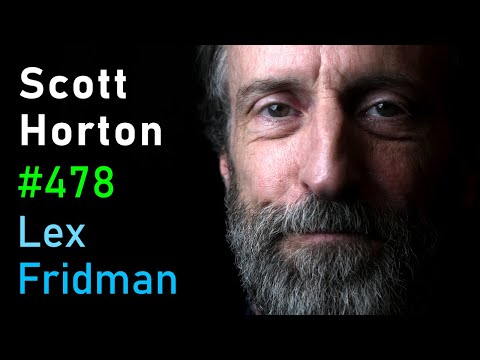
Scott Horton: The Case Against War and the Military Industrial Complex | Lex Fridman Podcast #478
Lex Fridman (host), Scott Horton (guest), Lex Fridman (host), Lex Fridman (host), Lex Fridman (host), Scott Horton (guest), Scott Horton (guest), Scott Horton (guest), Scott Horton (guest), Lex Fridman (host), Narrator, Narrator, Lex Fridman (host), Scott Horton (guest), Scott Horton (guest)
In this episode of Lex Fridman Podcast, featuring Lex Fridman and Scott Horton, Scott Horton: The Case Against War and the Military Industrial Complex | Lex Fridman Podcast #478 explores scott Horton Dissects U.S. Wars, Blowback, and Permanent War Machine Scott Horton joins Lex Fridman to lay out a long, detailed narrative of U.S. foreign policy from the Cold War through the War on Terror, arguing that interventions in the Middle East and beyond were driven by self‑interested bureaucracies, the military‑industrial complex, and allied lobbies rather than genuine national security needs.
Scott Horton Dissects U.S. Wars, Blowback, and Permanent War Machine
Scott Horton joins Lex Fridman to lay out a long, detailed narrative of U.S. foreign policy from the Cold War through the War on Terror, arguing that interventions in the Middle East and beyond were driven by self‑interested bureaucracies, the military‑industrial complex, and allied lobbies rather than genuine national security needs.
He traces how specific decisions—CIA coups, the Carter Doctrine, arming Afghan mujahideen, backing Saddam against Iran, dual containment of Iraq and Iran, post‑9/11 policy, and the Iraq invasion—created blowback that empowered groups like al‑Qaeda and destabilized entire regions.
Horton emphasizes the human and financial costs: millions dead or displaced abroad, tens of thousands of U.S. veterans damaged or suicidal, trillions of dollars spent, and a domestic polity increasingly warped by secrecy, propaganda, and economic distortion.
Throughout, he stresses the importance of whistleblowers, independent journalism, and public skepticism, arguing that ordinary citizens and non‑elite experts often see the dangers of war more clearly than the policymakers who authorize it.
Key Takeaways
The ‘national interest’ is often a cover for bureaucratic and private interests.
Horton uses public choice theory and insider accounts to argue that what gets labeled ‘national interest’ is usually what benefits decision‑makers, agencies, and contractors in the short term, even when it clearly harms the country and the world long term.
Get the full analysis with uListen AI
U.S. interventions repeatedly generate blowback that then justifies more war.
From arming Afghan mujahideen against the Soviets to stationing troops in Saudi Arabia and enforcing lethal sanctions on Iraq, Horton traces how these choices created grievances that bin Laden and others exploited to recruit for attacks like 9/11.
Get the full analysis with uListen AI
The Iraq War was not an honest mistake but a deliberate, multi‑front sales campaign.
He details how neoconservatives in government and think tanks, aligned with parts of the Israel lobby and defense contractors, bypassed and distorted intelligence (via entities like the Office of Special Plans) to sell WMD myths and al‑Qaeda links to the public and media.
Get the full analysis with uListen AI
Allied governments and lobbies can significantly shape U.S. war decisions.
Through examples like the ‘clean break’ strategy, Iran–Iraq War maneuvering, and Israeli and Kuwaiti roles before Gulf War I and the Iraq invasion, Horton argues U. ...
Get the full analysis with uListen AI
The true costs of war are vastly understated and persist for decades.
Beyond headline casualty numbers, Horton highlights millions displaced, destroyed infrastructure, malnutrition in places like Afghanistan, and tens of thousands of U. ...
Get the full analysis with uListen AI
Media narratives and ‘noble lies’ are central tools of the war machine.
He recounts episodes such as the Iraqi incubator hoax, inflated nuclear threats, and selective leaks, arguing that officials know they must emotionally manipulate the public—through fear, atrocity stories, and moral framing—to overcome common‑sense resistance to war.
Get the full analysis with uListen AI
Independent information habits are essential for resisting future wars.
Horton urges people to read sites like Antiwar. ...
Get the full analysis with uListen AI
Notable Quotes
“The only thing we really got out of these wars is better Luke Skywalker hands. That’s it.”
— Scott Horton
“Terrorism is a small price to pay for being a superpower—that was the cliché in the Pentagon.”
— Scott Horton
“Bin Laden’s strategy was to get us to strap on the suicide vest—to provoke us into overreacting and breaking our own empire on the rocks of Afghanistan.”
— Scott Horton
“Any government powerful enough to keep the peace between the 50 states is powerful enough to try it for the rest of the world—and that’s exactly what they’ve done.”
— Scott Horton
“If you think you can run the world by threatening everybody with military power, considering all the varied cultures and histories of the world, you’re going to fuck things up.”
— Lex Fridman
Questions Answered in This Episode
If the structural incentives of the military‑industrial and foreign‑policy establishment are so misaligned with the public interest, what institutional reforms—if any—could realistically change U.S. behavior?
Scott Horton joins Lex Fridman to lay out a long, detailed narrative of U. ...
Get the full analysis with uListen AI
How should citizens distinguish between legitimate security threats and manufactured or exaggerated crises designed to justify intervention?
He traces how specific decisions—CIA coups, the Carter Doctrine, arming Afghan mujahideen, backing Saddam against Iran, dual containment of Iraq and Iran, post‑9/11 policy, and the Iraq invasion—created blowback that empowered groups like al‑Qaeda and destabilized entire regions.
Get the full analysis with uListen AI
To what extent can blowback from past interventions be ‘undone,’ and what would a serious program of de‑escalation and reparations look like in regions like Iraq and Afghanistan?
Horton emphasizes the human and financial costs: millions dead or displaced abroad, tens of thousands of U. ...
Get the full analysis with uListen AI
How do we evaluate the morality of whistleblowing in national security when it pits secrecy laws against preventing mass violence and public deception?
Throughout, he stresses the importance of whistleblowers, independent journalism, and public skepticism, arguing that ordinary citizens and non‑elite experts often see the dangers of war more clearly than the policymakers who authorize it.
Get the full analysis with uListen AI
Is it possible for the U.S. to maintain alliances and deter aggression without sustaining a permanent, global military footprint, and what would a genuinely non‑interventionist grand strategy look like in practice?
Get the full analysis with uListen AI
Transcript Preview
The following is a conversation with Scott Horton. He's the director of the Libertarian Institute, editorial director of endtwar.com, co-host of Provoked, and host of the Scott Horton Show on which he has done over 6,000 interviews since 2003. He's the author of Provoked, Enough Already, and other books and articles that have, over the past three decades, criticized US foreign policy, especially in regard to military interventionism and the military-industrial complex. This is the Lex Fridman Podcast. To support it, please check out our sponsors in the description and now, dear friends, here's Scott Horton. I think one of the darkest and most disturbing chapters of modern American history is everything that happened around conducting the so-called Wars on Terror. I think, to me, it was a wake-up call. I think it was a wake-up call to a lot of Americans in understanding and seeing the military-industrial complex and seeing what the government's capacity is to mislead us into war and to continuously erode basic human freedoms. Uh, if I can, allow me to list some of the estimates from the Cost of War Project from Brown University just so we understand the cost of these wars. The post-911 wars in Afghanistan, Iraq, Syria, Pakistan, and Yemen led to an estimated 900,000 to 940,000 direct deaths and 3.6 to 3.8 million indirect deaths. And the cost, in terms of dollars, was $8 trillion with $2.2 trillion on Afghanistan and $2.9 trillion on Iraq and, uh, Syria and the result on every front, as we'll talk about, I think it's fair to say they did not accomplish its purpose, and in fact, if we even just look at the human toll of the people of Afghanistan, I was also looking at the, the numbers before the war and after the war. Percent of Afghans facing food insecurity went from 62% to 92%. Percent of children under five experiencing acute malnutrition went from 9% to 50%. Percent of Afghans living in poverty went from 80% to 97%. So it was extremely costly for Americans, and it was extremely costly for Afghans. As you do in your book, Enough Already, uh, can you lay out how, the full history, the full context of how it is that the American people were misled into this War on Terror that was so costly in so many ways?
Yeah, well first of all, thank you for having me again. It's great to be with you on the show. One important statistic, uh, that you could mention from the Cost of War Project as well is 37 million people displaced from their homes, right, and the same group, um, it was... Well, 'cause I'm telling you this like at least five years ago, God, it's the future now, this, this may have been seven, eight years ago that they did a study that determined that 30,000 American servicemen had blown their own brains out since then, well, one way or the other, deliberately crashing their motorcycle or whatever it is. So, talk about the cost of war, that's far beyond, you know, the actual deaths in the war. We had about 4,500 in Iraq and about 2,500 in Afghanistan of just official airmen, marines, and soldiers on the ground killed plus contractors and all that.
Install uListen to search the full transcript and get AI-powered insights
Get Full TranscriptGet more from every podcast
AI summaries, searchable transcripts, and fact-checking. Free forever.
Add to Chrome