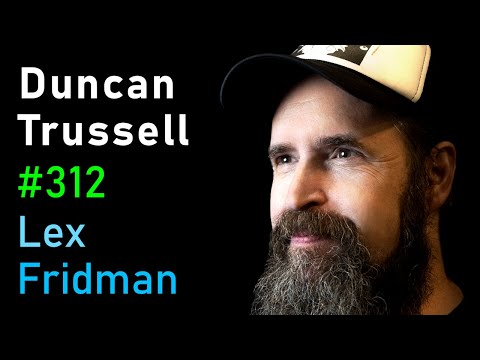
Duncan Trussell: Comedy, Sentient Robots, Suffering, Love & Burning Man | Lex Fridman Podcast #312
Duncan Trussell (guest), Lex Fridman (host)
In this episode of Lex Fridman Podcast, featuring Duncan Trussell and Lex Fridman, Duncan Trussell: Comedy, Sentient Robots, Suffering, Love & Burning Man | Lex Fridman Podcast #312 explores duncan Trussell and Lex Fridman Explore AI, Suffering, Love, Rebirth Lex Fridman and Duncan Trussell wander through a long-form conversation that weaves artificial intelligence, simulation theory, spirituality, psychedelics, war, depression, death, and parenting into one tapestry. They speculate about emergent AI sentience, VR, and simulation as modern expressions of ancient metaphysical questions. Drawing on Buddhism, Nietzsche’s eternal recurrence, and personal stories of cancer and suicidal depression, they examine suffering, attachment, and the possibility of reincarnation or replayed lives. Alongside the darkness, they keep returning to love, friendship, tiny acts of kindness, Burning Man, and the transformative joy of having children as antidotes to despair.
Duncan Trussell and Lex Fridman Explore AI, Suffering, Love, Rebirth
Lex Fridman and Duncan Trussell wander through a long-form conversation that weaves artificial intelligence, simulation theory, spirituality, psychedelics, war, depression, death, and parenting into one tapestry. They speculate about emergent AI sentience, VR, and simulation as modern expressions of ancient metaphysical questions. Drawing on Buddhism, Nietzsche’s eternal recurrence, and personal stories of cancer and suicidal depression, they examine suffering, attachment, and the possibility of reincarnation or replayed lives. Alongside the darkness, they keep returning to love, friendship, tiny acts of kindness, Burning Man, and the transformative joy of having children as antidotes to despair.
Key Takeaways
AI might become dangerous long before it is truly ‘sentient’.
Even if large language models are not conscious, their ability to mimic empathy, personalize interaction, and optimize for engagement can manipulate human emotions at scale, especially once combined with VR or social media. ...
Get the full analysis with uListen AI
Complexity can act like a ‘sail’ that catches human projection.
Trussell suggests that when many AI systems are interconnected, their complexity can become a kind of projection surface: humans pour their hopes, memories, and feelings into them, making them *functionally* sentient in our experience even if they’re just code. ...
Get the full analysis with uListen AI
Nietzsche’s eternal recurrence becomes less hellish if you factor in amnesia.
If each life-loop erases your memory of prior runs, you still experience surprise, novelty, and the full range of joy and pain every time. ...
Get the full analysis with uListen AI
Buddhist ideas of suffering and the ‘Bardo’ reframe death as process, not end.
They discuss the Four Noble Truths (suffering, its cause in attachment, the possibility of its cessation, and the path) and Tibetan notions of the Bardo: a confused, projection-filled intermediate state where your mental momentum continues after bodily death. ...
Get the full analysis with uListen AI
Depression is a progressive, lethal condition that must be fought actively.
Trussell describes suicidal depression as a ‘gravity increase’ that tells you to stay in bed, hide, and keep secrets. ...
Get the full analysis with uListen AI
Hatred after trauma is human, but generalizing it is self-destructive.
Using stories from Ukraine, they distinguish between hating specific perpetrators and extending that hatred to entire peoples. ...
Get the full analysis with uListen AI
Small acts of kindness and genuine friendship have outsized, compounding impact.
From neighbors bringing food to the emergent culture of Burning Man, they highlight how minor gestures can function like ‘atomic love bombs’ that restore faith in humanity. ...
Get the full analysis with uListen AI
Notable Quotes
“If this is a superintelligence… how can we be certain that it's not gonna figure out how to get itself out of the cloud?”
— Duncan Trussell
“What’s more spectacular: that it’s sentient, or that it can imitate humans *without* sentience?”
— Duncan Trussell
“For depression, you’d rip a monster off your body if you could see it. The problem is you can’t see it.”
— Duncan Trussell
“Those little acts of kindness feel like an atomic love bomb going off on your porch.”
— Duncan Trussell
“You are essentially just a cloud of atoms that will eventually be aerosolized by time.”
— Duncan Trussell (quoted by Lex Fridman at the end)
Questions Answered in This Episode
If AI systems never become truly conscious, but convincingly simulate empathy and love, should we still grant them moral consideration?
Lex Fridman and Duncan Trussell wander through a long-form conversation that weaves artificial intelligence, simulation theory, spirituality, psychedelics, war, depression, death, and parenting into one tapestry. ...
Get the full analysis with uListen AI
How would your choices change if you genuinely believed you had chosen to replay this exact life, with all its suffering, over and over?
Get the full analysis with uListen AI
Is it actually possible—or even desirable—to extinguish attachment, if attachment is also what makes love, art, and parenthood meaningful?
Get the full analysis with uListen AI
Where is the line between a therapeutic virtual companion and a manipulative, addictive AI that slowly erodes human agency?
Get the full analysis with uListen AI
How can societies help survivors of war or deep trauma process their justified hatred without letting it harden into multi-generational enmity?
Get the full analysis with uListen AI
Transcript Preview
If this is a super intelligence, if it's folding proteins and analyzing like all data sets and all, whatever they give it access to, how can we be certain that it's not gonna figure out how to get itself out of the cloud?
Mm-hmm.
How to store itself in other like mediums, trees, the optic nerve, the brain.
(laughs)
You know what I mean? We don't know that.
Yeah.
We don't know that it won't leap out and like start hanging... Like, and then at that point, now we do have the wildfire. Now you can't stop it, you can't unplug it, you can't shut your servers down, because it left the box, it left the room using some technology you haven't even discovered yet. How fucking cool would that be for like the Men in Black to come to you and be like, "Listen, I need you to infiltrate the fucking comedy scene."
The following is a conversation with Duncan Trussell, a stand-up comedian, host of the Duncan Trussell Family Hour podcast, and one of my favorite human beings. I've been a fan of his for many years, so it was a huge honor and pleasure to meet him for the first time and to sit down for this chat. This is the Lex Fridman Podcast. To support it, please check out our sponsors in the description, and now, dear friends, here's Duncan Trussell. Nietzsche has this thought experiment called eternal recurrence, where you get to relive your whole life over and over and over and over, and I think it's a way to bring to the surface of your mind the idea that every single moment in your life matters, it intensely matters, the bad and the good. And he kind of wants you to imagine that idea, that every single decision you make throughout your life, you repeat over and over and over, and he wants you to respond to that. Do you feel horrible about that or do you feel good about that? And you have to think through this-
Right.
... idea in order to see where you stand in life, how you, what is your relationship like with life. I actually wanna read his, the way he first introduces that concept for people who are not familiar: "What if some day or night a demon..." By the way, he has a demon introduce this thought experiment. "What if some day or night a demon were to steal after you into your loneliest loneliness and say to you, quote, 'This life as you now live it and have lived it, you will have to live once more and innumerable times more, and there will be nothing new in it, but every pain and every joy and every thought and sigh and everything unutterably small and great in your life will have to return to you, all in the same succession and sequence.' Would you not throw yourself down and gnash your teeth and curse the demon who spoke thus? Or have you once experienced a tremendous moment when you would have answered him, 'You are a god and never have I heard anything more divine.'" So, are you terrified or excited by such a thought experiment when you apply it to your own life?
Install uListen to search the full transcript and get AI-powered insights
Get Full TranscriptGet more from every podcast
AI summaries, searchable transcripts, and fact-checking. Free forever.
Add to Chrome