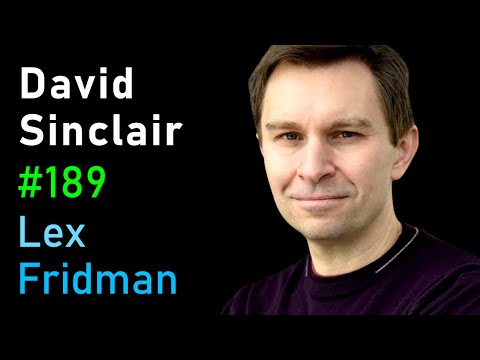
David Sinclair: Extending the Human Lifespan Beyond 100 Years | Lex Fridman Podcast #189
Lex Fridman (host), David Sinclair (guest)
In this episode of Lex Fridman Podcast, featuring Lex Fridman and David Sinclair, David Sinclair: Extending the Human Lifespan Beyond 100 Years | Lex Fridman Podcast #189 explores david Sinclair and Lex Fridman Reimagine Aging As an Engineering Problem Lex Fridman and Harvard geneticist David Sinclair explore aging as an information problem in biology that might be slowed, reset, or even partially reversed. Sinclair explains his theory that aging stems from loss and corruption of epigenetic information—"scratches on a CD"—and describes experiments in mice that can both accelerate and reverse signs of aging using genetic reprogramming. They discuss current and near‑term tools for extending healthspan: wearables, continuous monitoring, blood and DNA-based clocks, personalized AI-driven recommendations, as well as lifestyle levers like fasting, diet, exercise, sleep, and stress management. The conversation also dives into philosophical and societal implications of long lives, digital immortality, brain uploading, and whether death is necessary for meaning.
David Sinclair and Lex Fridman Reimagine Aging As an Engineering Problem
Lex Fridman and Harvard geneticist David Sinclair explore aging as an information problem in biology that might be slowed, reset, or even partially reversed. Sinclair explains his theory that aging stems from loss and corruption of epigenetic information—"scratches on a CD"—and describes experiments in mice that can both accelerate and reverse signs of aging using genetic reprogramming. They discuss current and near‑term tools for extending healthspan: wearables, continuous monitoring, blood and DNA-based clocks, personalized AI-driven recommendations, as well as lifestyle levers like fasting, diet, exercise, sleep, and stress management. The conversation also dives into philosophical and societal implications of long lives, digital immortality, brain uploading, and whether death is necessary for meaning.
Key Takeaways
Treat aging as an information-maintenance problem, not just wear and tear.
Sinclair argues that the primary driver of aging is loss and corruption of epigenetic information—the system that tells cells which genes to turn on or off—analogous to a scratched CD whose data is intact but poorly read. ...
Get the full analysis with uListen AI
Partial cellular reprogramming can reverse some aspects of aging in animals.
Using three of the four Yamanaka factors, Sinclair’s lab has restored vision in old or damaged mouse eyes and is now rejuvenating prematurely aged mouse brains, suggesting there is a “backup” of youthful epigenetic information that can be safely accessed without turning cells into tumors or stem cells.
Get the full analysis with uListen AI
Continuous measurement plus AI will soon outperform traditional, episodic medicine.
Medical-grade biosensors (rings, patches, bio-buttons) can already track heart, sleep, temperature, respiration, and more, with AI systems (e. ...
Get the full analysis with uListen AI
When you eat may matter more for longevity than what you eat.
Animal data show that time-restricted feeding—eating once per day—extends lifespan regardless of macronutrient mix, likely by activating longevity pathways (e. ...
Get the full analysis with uListen AI
Targeted lifestyle changes can likely add at least a decade of healthy life.
Combining moderate exercise, calorie restriction/fasting, mostly plant-based diets rich in “stressed” colorful plants (xenohormesis), good sleep, low psychological stress, and possibly drugs like metformin or rapamycin, Sinclair believes many people can realistically reach or surpass 100 years with extended healthspan.
Get the full analysis with uListen AI
Data ownership, privacy, and sharing models will shape the future of health.
As health monitoring becomes ubiquitous and cheap, key questions arise about who controls and accesses that data—individuals, hospitals, insurers, or tech companies—and how people can voluntarily share, revoke, or monetize their information while benefiting from large-scale, anonymized analyses.
Get the full analysis with uListen AI
Extending life raises deep questions about meaning, motivation, and identity.
They challenge the idea that death is required for meaningful life, suggesting one can sustain wonder and joy regardless of lifespan, while also acknowledging evolutionary denial of death and the psychological stress that explicit awareness of mortality—or its postponement—can create.
Get the full analysis with uListen AI
Notable Quotes
“We're trying to turn aging into an engineering problem.”
— David Sinclair
“I think you can boil aging down to an equation: preservation of information versus loss due to entropy.”
— David Sinclair
“We can make a mouse old in a matter of months and now we’re reversing those mice.”
— David Sinclair
“It’s far more important when you eat than what you eat.”
— David Sinclair
“I don’t get joy out of every day because I think I’m going to die. I get joy out of every day because every day is joyous, and I make it that way.”
— David Sinclair
Questions Answered in This Episode
If partial epigenetic reprogramming becomes safe in humans, how should it be regulated and who should decide when and how often we “reset” aging tissues?
Lex Fridman and Harvard geneticist David Sinclair explore aging as an information problem in biology that might be slowed, reset, or even partially reversed. ...
Get the full analysis with uListen AI
To what extent should individuals be allowed to trade health data for financial incentives or better insurance terms, and what privacy safeguards are non-negotiable?
Get the full analysis with uListen AI
Could dramatically extended lifespans exacerbate social inequalities (between those who can access longevity technologies and those who cannot), and how might policy address that?
Get the full analysis with uListen AI
Would knowing you could live 150–200 years change your personal goals, risk tolerance, and moral priorities—or would your day-to-day life feel mostly the same?
Get the full analysis with uListen AI
How might digital resurrection—AI avatars of deceased loved ones or historical figures—alter our grieving process, our sense of identity, and our understanding of what it means to be a person?
Get the full analysis with uListen AI
Transcript Preview
The following is a conversation with David Sinclair. He's a professor in the Department of Genetics at Harvard, and co-director of the Paul F. Glenn Center for the Biology of Aging at Harvard Medical School. He's the author of the book Lifespan, and co-founder of several biotech companies. He works on turning age into an engineering problem and solving it, driven by a vision of a world where billions of people can live much longer and much healthier lives. Quick mention of our sponsors: Onnit, Cleer, National Instruments, NI, SimpliSafe, and Linode. Check them out in the description to support this podcast. As a side note, let me say that longevity research challenges us to think how science and engineering will change society. Imagine if you could live 100,000 years, even under controlled conditions, like in a spaceship, say. Then suddenly, a trip to Alpha Centauri that is, uh, 4.37 light years away takes a single human lifespan. And on the psychological, maybe even philosophical level, as the horizons of death drifts farther into the distance, how will our search for meaning change? Does meaning require death or does it merely require struggle? Reprogramming our biology will require us to delve deeper into understanding the human mind and the robot mind. Both of these efforts are as exciting of a journey as I can imagine. This is The Lex Fridman Podcast, and here is my conversation with David Sinclair. I usually feel like the same person when I was 12, like when I, right now, as I think about myself, I feel like exactly the same person that I was when I was 12. And yet, um, I am getting older, both body and mind, and still feel like time hasn't passed at all. Do you, um, feel this tension in yourself that you're the same person and yet you're aging?
Yeah, I have this tension that, that I'm still a kid, um, but that helps in my career. Scientists need to have a wonder about the world and you don't want to grow up. Uh, 12-year-olds and, and even younger, I would say six, seven-year-olds, have still got that boy in me and I can look at things... It's a gift, I think, that I can see things for the first time if I choose to and then explain them as I would to a six euro- six-year-old 'cause I, I am that mentally. But on the other hand, I'm getting older, right? I run a lab of 20 people at Harvard. I've got a book, I've got, uh, you know, science to do, companies to run. And so I have to, um, on most days, just pretend to be a grownup and, and be mature, but I definitely don't feel that way.
There's uh, there's something I really appreciated. In the opening of your book, you talked about your grandmother and on this kind of theme, on this kind of topic, uh, she first of all had a big influence on you. My grandma- mother had a big influence on me. And you also mentioned this poem by the author of Winnie-the-Pooh, Alan Alexander Milne. Maybe I can read it real quick 'cause I... (laughs) . On the topic of being children, "When I was one, I had just begun. When I was two, I was nearly new. When I was three, I was hardly me. When I was four, I was not much more. When I was five, I was just alive. But now I am six. I am as clever, as clever, so I think I'll be six now, forever and ever." Um, so this idea of being six and staying six forever, being youthful, being curious, being childlike, this and other things. What, uh, influence has your grandmother had in your thinking about life, about death, about, uh, love?
Install uListen to search the full transcript and get AI-powered insights
Get Full TranscriptGet more from every podcast
AI summaries, searchable transcripts, and fact-checking. Free forever.
Add to Chrome