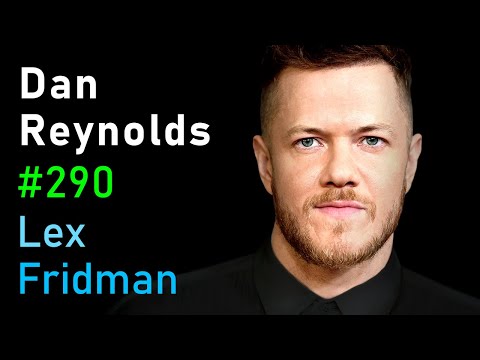
Dan Reynolds: Imagine Dragons | Lex Fridman Podcast #290
Lex Fridman (host), Dan Reynolds (guest), Dan Reynolds (guest), Dan Reynolds (guest), Dan Reynolds (guest)
In this episode of Lex Fridman Podcast, featuring Lex Fridman and Dan Reynolds, Dan Reynolds: Imagine Dragons | Lex Fridman Podcast #290 explores dan Reynolds on pain, faith, fame, and creating truthful music Dan Reynolds talks with Lex Fridman about his creative process, mental health struggles, and the search for spiritual meaning beyond organized religion. He describes how songwriting, like programming, is about building something from nothing and how real art depends on authenticity rather than polish. Reynolds reflects on fame’s loneliness, the emotional whiplash of touring, and why therapy, psychedelics, and honest self-examination reshaped his relationship with depression and faith. Throughout, he emphasizes self‑love, compassion for others, and humility about what we can ever really know about God, death, or the meaning of life.
Dan Reynolds on pain, faith, fame, and creating truthful music
Dan Reynolds talks with Lex Fridman about his creative process, mental health struggles, and the search for spiritual meaning beyond organized religion. He describes how songwriting, like programming, is about building something from nothing and how real art depends on authenticity rather than polish. Reynolds reflects on fame’s loneliness, the emotional whiplash of touring, and why therapy, psychedelics, and honest self-examination reshaped his relationship with depression and faith. Throughout, he emphasizes self‑love, compassion for others, and humility about what we can ever really know about God, death, or the meaning of life.
Key Takeaways
Authenticity is the core of powerful art.
Reynolds argues that audiences have a strong “bullshit detector”; what makes songs, performances, and even acting resonate is not technical perfection but whether the artist clearly believes and feels what they’re expressing.
Get the full analysis with uListen AI
Creation is a holistic, iterative process, not a linear formula.
He experiences songs as a full “soundscape” where lyrics, melody, rhythm, and emotion arrive together, and he finishes hundreds of complete ideas—then only releases a small fraction that genuinely move him.
Get the full analysis with uListen AI
Fame can intensify loneliness and identity confusion.
Becoming ‘Dan from Imagine Dragons’ made him feel pressured to perform a version of himself for everyone, even family, eroding the simple social integrity of knowing when people like you for you.
Get the full analysis with uListen AI
Sustained mental health requires both basics and professional help.
He stresses exercise, diet, daily joy, and especially therapy as essential tools, describing how stigma and pride nearly kept him from life‑saving treatment and how real therapy is hard, structured work.
Get the full analysis with uListen AI
Spiritual crises can evolve into open‑ended seeking rather than nihilism.
Losing his Mormon faith left Reynolds angry and unmoored, but ayahuasca experiences and reflection shifted him from “there’s nothing” to “there’s more to be known,” with humility about any final answers.
Get the full analysis with uListen AI
Pain can be a powerful teacher and creative fuel.
Using songs like “Believer,” he explains how some of his deepest losses and struggles with depression and faith became catalysts for growth, perspective, and meaningful work rather than mere wounds.
Get the full analysis with uListen AI
Self‑love and forgiveness are crucial life skills.
His advice to young people centers on learning to like themselves, allow mistakes, and stop chasing conditional happiness (“I’ll be happy when…”), recognizing that real success is inner peace, not fame.
Get the full analysis with uListen AI
Notable Quotes
“People have a really good bullshit indicator. In art, they need to believe that you believe what you’re doing.”
— Dan Reynolds
“It’s really easy to kill an artist.”
— Dan Reynolds
“My life has been, probably unhealthily, committed to finding answers about God—or the lack thereof—and mortality.”
— Dan Reynolds
“Once you’re famous, you’re now this person in everyone’s head, and you can feel confined to be that person—even to your own family.”
— Dan Reynolds
“Above all, know that we don’t know jack shit.”
— Dan Reynolds
Questions Answered in This Episode
How can artists balance the need to experiment and evolve with fans’ expectations for a consistent sound or identity?
Dan Reynolds talks with Lex Fridman about his creative process, mental health struggles, and the search for spiritual meaning beyond organized religion. ...
Get the full analysis with uListen AI
Where is the line between healthy self‑criticism that drives improvement and destructive self‑criticism that fuels depression?
Get the full analysis with uListen AI
What responsibilities, if any, do successful artists have to speak out on social issues like LGBTQ rights or mental health?
Get the full analysis with uListen AI
How should parents talk honestly with children about death and the afterlife without either lying or crushing their sense of security?
Get the full analysis with uListen AI
Could psychedelics like ayahuasca become a mainstream therapeutic tool for spiritual and psychological crises, or are their risks too great?
Get the full analysis with uListen AI
Transcript Preview
When you imagine a song, is it the opening you imagine?
No. It's- it's kind of a- a- just a s- a... I never think opening, I never think final. I think soundscape of how I'm feeling right now. So it could be the middle of the song for all I know when I'm, you know, when I'm- when I'm doing that. But my process for me is very much lyrics, and melody, and music really come at the same time. Like, I f- by same time, I mean, I'm- I'm, uh, a- as I'm expressing maybe, you know, I'm feeling like (imitates percussion) like, it's not that simple, but it's, like, I'll- I'll hear it. Like, it's like here's all the orchestra and you're kinda just pressing all the buttons at once. And melody in my voice is just one of those instruments.
The following is a conversation with Dan Reynolds, the lead singer of Imagine Dragons, one of the most popular bands in the world, with over 75 million records sold and with four songs being streamed over a billion times on Spotify. Given all that, Dan is one of the most down to earth, kind, thoughtful, and fascinating human beings I've ever met, grounded in part by his lifelong struggle with mental health. The darkness, the love, and the creative brilliance are all there in this one humble mind. For this reason, and many others, we became fast friends. Plus, he recently started his journey in programming, which funny enough, is where we start this wide-ranging, deeply personal, and fun conversation. This is a Lex Fridman podcast. To support it, please check out our sponsors in the description, and now, dear friends, here's Dan Reynolds. So we were talking offline that you're not just getting into programming. What- what's, uh, the most beautiful program you've ever written? Something that brought you joy.
I... there's something... I really love completion. It's the reason that I'm addicted to songwriting. I like there being nothing and then having some blocks or tools and building them into what you want it to look like and th- and then I find it incredibly rewarding to stand back and- and look at what you did at the end. It could be anything. For me, it's- it was as simple to begin with as just, you know... because it's ar- object oriented, like making a cube move. Like, that... as simple as that. Understanding that and knowing that I built that and made it do that is really rewarding. Uh, and I think it's the thing that drew me into- to wanting to learn more. But as far as what is some grandio- like, some big piece of code that I've done, like, absolutely not. It's more I'm still at a level where it's more like, "What is a tutorial that I followed-"
Right.
... and- and got, you know? And- and then, you know... Yeah. So I- I couldn't say I'm at a level where I've done anything beautiful at all in code.
Install uListen to search the full transcript and get AI-powered insights
Get Full TranscriptGet more from every podcast
AI summaries, searchable transcripts, and fact-checking. Free forever.
Add to Chrome