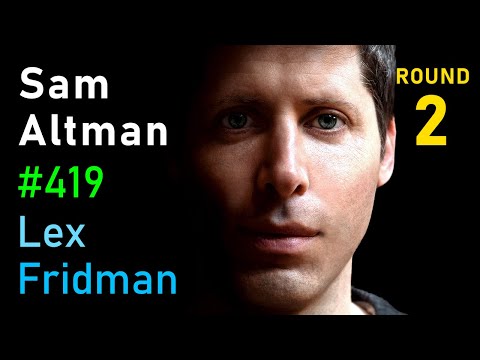
Sam Altman: OpenAI, GPT-5, Sora, Board Saga, Elon Musk, Ilya, Power & AGI | Lex Fridman Podcast #419
Sam Altman (guest), Lex Fridman (host), Narrator, Narrator
In this episode of Lex Fridman Podcast, featuring Sam Altman and Lex Fridman, Sam Altman: OpenAI, GPT-5, Sora, Board Saga, Elon Musk, Ilya, Power & AGI | Lex Fridman Podcast #419 explores sam Altman on power, safety, AGI timelines, and OpenAI’s future Sam Altman joins Lex Fridman to dissect the OpenAI board crisis, his personal fallout from it, and what it taught him about governance, power, and trust in the race to AGI.
Sam Altman on power, safety, AGI timelines, and OpenAI’s future
Sam Altman joins Lex Fridman to dissect the OpenAI board crisis, his personal fallout from it, and what it taught him about governance, power, and trust in the race to AGI.
They explore OpenAI’s structure, board composition, Elon Musk’s lawsuit and criticisms, and the tension between openness, safety, and commercialization as AI capabilities scale.
Altman discusses Sora, GPT‑4 and the path to GPT‑5, the centrality of compute and energy (especially nuclear) to AI progress, and how AI may transform scientific discovery, work, and information access.
Throughout, they wrestle with existential risk, political and cultural polarization around AI, and what it means for one company—or one person—to sit near the center of a potentially world‑changing technology.
Key Takeaways
The OpenAI board crisis exposed serious governance weaknesses that must be fixed before AGI arrives.
Altman describes the attempted ouster as chaotic, painful, and nearly company‑destroying, revealing how much unchecked power a nonprofit board held and how fragile OpenAI’s structure was under pressure; he now sees resilient governance as core AGI work, not a side issue.
Get the full analysis with uListen AI
Powerful AI requires governance that diffuses control beyond any single individual or company.
Altman repeatedly stresses he does not want super‑voting control and believes governments must set ‘rules of the road,’ arguing that no one person—and likely no single company—should control AGI, even as he acknowledges how the public effectively overruled the board in his case.
Get the full analysis with uListen AI
The debate with Elon Musk is less about ‘open’ vs. closed models and more about control and history.
Altman says Musk originally wanted OpenAI under Tesla’s control and later mischaracterized their evolution into a capped‑profit structure; he sees the lawsuit as more performative than legal, laments the loss of friendly competition, and argues that Musk should ‘just win’ by building better products.
Get the full analysis with uListen AI
Safety and bias must be treated as explicit, testable product behaviors, not vague principles.
Reacting to missteps like Google’s ‘black Nazis’ images, Altman favors publishing concrete behavior expectations (e. ...
Get the full analysis with uListen AI
Compute and energy will be strategic bottlenecks for AI, making nuclear power increasingly critical.
Altman predicts compute will become ‘the currency of the future’ and argues demand will scale like energy, not smartphones—essentially unbounded as costs fall—requiring massive new data centers, chip capacity, and especially nuclear fission and fusion to power them.
Get the full analysis with uListen AI
Model progress is continuous and exponential, but feels like sudden ‘leaps’ from the outside.
Inside OpenAI, GPT‑3 → 4 → 5 is seen as a steady curve of hundreds of incremental innovations; Altman expects GPT‑5’s improvement over 4 to mirror 4 over 3 and is considering even more granular, iterative releases to avoid shocking the world with abrupt capability jumps.
Get the full analysis with uListen AI
Altman expects highly capable systems this decade, with AGI defined by real‑world impact, not a label.
He avoids a rigid definition of AGI but says that by the end of the 2020s we’ll likely have systems that dramatically accelerate scientific discovery; for him, a key threshold is when AI significantly boosts the rate of new science and technology, measurably changing the global economy.
Get the full analysis with uListen AI
Notable Quotes
“Compute is gonna be the currency of the future. I think it will be maybe the most precious commodity in the world.”
— Sam Altman
“The road to AGI should be a giant power struggle. Whoever builds AGI first gets a lot of power.”
— Sam Altman
“My company very nearly got destroyed. We think a lot about many of the other things we've gotta get right for AGI, but thinking about how to build a resilient org... I think that's super important.”
— Sam Altman
“I think this whole thing is unbecoming of a builder, and I respect Elon as one of the great builders of our time.”
— Sam Altman
“I expect that by the end of this decade, and possibly somewhat sooner than that, we will have quite capable systems that we look at and say, ‘Wow, that's really remarkable.’”
— Sam Altman
Questions Answered in This Episode
How can OpenAI or any AI lab design a governance structure that genuinely constrains its own power once its systems become indispensable to the global economy?
Sam Altman joins Lex Fridman to dissect the OpenAI board crisis, his personal fallout from it, and what it taught him about governance, power, and trust in the race to AGI.
Get the full analysis with uListen AI
At what point should governments intervene more aggressively in AI development, and what kinds of regulations would meaningfully reduce risk without freezing innovation?
They explore OpenAI’s structure, board composition, Elon Musk’s lawsuit and criticisms, and the tension between openness, safety, and commercialization as AI capabilities scale.
Get the full analysis with uListen AI
How should society balance the benefits of open‑source AI against the risks of powerful models being widely weaponized by bad actors?
Altman discusses Sora, GPT‑4 and the path to GPT‑5, the centrality of compute and energy (especially nuclear) to AI progress, and how AI may transform scientific discovery, work, and information access.
Get the full analysis with uListen AI
If compute and energy become the ‘currency of the future,’ who should control access to them, and how do we prevent a new kind of geopolitical resource oligopoly?
Throughout, they wrestle with existential risk, political and cultural polarization around AI, and what it means for one company—or one person—to sit near the center of a potentially world‑changing technology.
Get the full analysis with uListen AI
What concrete signals would convince you that AI has truly begun to accelerate scientific discovery rather than just helping humans write code and papers faster?
Get the full analysis with uListen AI
Transcript Preview
I think compute is gonna be the currency of the future. I think it will be maybe the most precious commodity in the world. I expect that by the end of this decade, and possibly somewhat sooner than that, we will have quite capable systems that we look at and say, "Wow, that's really remarkable." The road to AGI should be a giant power struggle. I expect that to be the case.
Whoever builds AGI first gets a lot of power. Do you trust yourself with that much power? The following is a conversation with Sam Altman, his second time on the podcast. He is the CEO of OpenAI, the company behind GPT-4, ChatGPT, Sora, and perhaps one day the very company that will build AGI. This is the Lex Fridman Podcast. To support it, please check out our sponsors in the description. And now, dear friends, here's Sam Altman. Take me through the OpenAI board saga that started on Thursday, November 16th, maybe Friday, November 17th for you.
That was definitely the most painful professional experience of my life, and... chaotic, and shameful, and upsetting, and a bunch of other negative things. Uh, there were great things about it too, and I wish, I wish it had not been in such an adrenaline rush that I wasn't able to stop and appreciate them at the time, but, um... I came across this old tweet of mine, or this tweet of mine from that time period, which was like, it was like, you know, kind of going to your own eulogy, watching people say all these great things about you, and, uh, just, like, unbelievable support from people I- I love and care about. Uh, that was really nice. Um, that whole weekend I- I kind of like felt, with one big exception, I- I felt, like, a great deal of love. And very little hate. Um... Even though it felt like it just, I have no idea what's happening and what's gonna happen here, and this feels really bad, and... There were definitely times I thought it was gonna be like, one of the worst things to ever happen for AI safety. But I also think I'm happy that it happened relatively early. I thought at some point between when OpenAI started and when we created AGI, there was gonna be something crazy and explosive that happened. But there may be more crazy and explosive things still to happen. Um, it still, I think, helped us build up some resilience and be ready for... more challenges in the future.
But the thing y- you had a sense that you would experience is some kind of power struggle.
The road to AGI should be a giant power struggle. Like, the world should... I- like, well, not should. I expect that to be the case.
And so you have to go through that as, like you said, iterate as often as possible, uh, in figuring out how to have a board structure, how to have organization, how to have, um, the kind of people that you're working with, how to communicate, all that, i- in order to, uh, deescalate the power struggle as much as possible.
Install uListen to search the full transcript and get AI-powered insights
Get Full TranscriptGet more from every podcast
AI summaries, searchable transcripts, and fact-checking. Free forever.
Add to Chrome