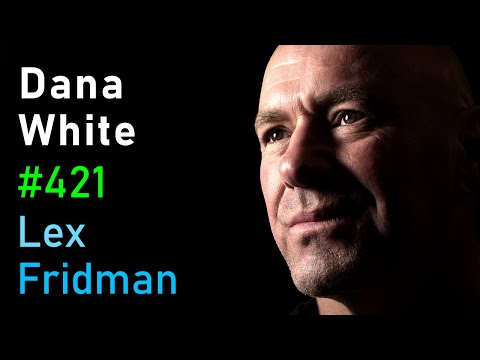
Dana White: UFC, Fighting, Khabib, Conor, Tyson, Ali, Rogan, Elon & Zuck | Lex Fridman Podcast #421
Dana White (guest), Lex Fridman (host), Narrator
In this episode of Lex Fridman Podcast, featuring Dana White and Lex Fridman, Dana White: UFC, Fighting, Khabib, Conor, Tyson, Ali, Rogan, Elon & Zuck | Lex Fridman Podcast #421 explores dana White on UFC’s rise, real fighting, legends, and loyalty Dana White sits down with Lex Fridman to trace his journey from obsessive boxing fan to architect of the modern UFC, explaining how he reshaped combat sports production, matchmaking, and business. He details the UFC’s origin story, early chaos, and the importance of passion, vision, and relentless work in building a global brand. White reflects on legends like Ali, Tyson, Jon Jones, Khabib, and Conor, and explains how underdog matchups and real risk create true greatness. He also explores his loyalty to people like Joe Rogan and Donald Trump, his love of gambling and chaos, and why he believes fighting is hard‑wired into human nature and adored by the world’s most powerful people.
Dana White on UFC’s rise, real fighting, legends, and loyalty
Dana White sits down with Lex Fridman to trace his journey from obsessive boxing fan to architect of the modern UFC, explaining how he reshaped combat sports production, matchmaking, and business. He details the UFC’s origin story, early chaos, and the importance of passion, vision, and relentless work in building a global brand. White reflects on legends like Ali, Tyson, Jon Jones, Khabib, and Conor, and explains how underdog matchups and real risk create true greatness. He also explores his loyalty to people like Joe Rogan and Donald Trump, his love of gambling and chaos, and why he believes fighting is hard‑wired into human nature and adored by the world’s most powerful people.
Key Takeaways
Use what you love and hate in competitors to design a better product.
White obsessed over boxing broadcasts, adopting what worked (big-fight feel) and ruthlessly eliminating what he hated (negative, detached commentary), which shaped the UFC’s fan-centric production style.
Get the full analysis with uListen AI
Vision plus relentless execution beats experience when you’re building something new.
He and the Fertittas knew nothing about TV production when they bought the UFC, but a clear vision of what fights should look and feel like, combined with building the right team and firing the wrong one, allowed them to reinvent the product.
Get the full analysis with uListen AI
Real legends are forged by taking dangerous fights, not protecting records.
White argues that greatness comes from accepting bad odds and high risk—examples like Poirier, Strickland, Conor, and Jones show that stepping up against killers, even as an underdog, is what cements legacy.
Get the full analysis with uListen AI
Commentary and storytelling are as crucial as the fights themselves.
He contrasts HBO’s critical “talking heads” with UFC’s ex-fighters like Joe Rogan and Daniel Cormier, whose passion and technical insight help casual fans understand the ground game and emotionally connect with fighters.
Get the full analysis with uListen AI
Loyalty and shared hardship build unusually strong long-term partnerships.
White’s defense of Rogan during cancelation attempts and his stories about Trump and the Fertittas show a pattern: he rewards people who backed him when the UFC was small and treats loyalty as a two-way, non-negotiable value.
Get the full analysis with uListen AI
True commitment often demands extreme sacrifice and an ‘all-in’ mentality.
White moved the birth of his son for a Chuck Liddell fight, worked through years of losses and brutal budget meetings, and still keeps a full schedule post–UFC sale, underscoring his belief that entrepreneurship leaves no room for “balance” early on.
Get the full analysis with uListen AI
Fighting taps into something universal and primal across culture and class.
From presidents and tech billionaires to fans in Mexican arenas, White notes that everyone is captivated when a fight breaks out, arguing that combat is in our DNA and explains why the world’s most powerful people obsess over it.
Get the full analysis with uListen AI
Notable Quotes
“The most powerful people in the world are all obsessed with fighting.”
— Dana White
“Without the vision, there’s nothing. That’s what I do—I’m the vision part of this thing.”
— Dana White
“We don’t determine who wins and loses. If we did, we’d be the WWE.”
— Dana White
“If Conor McGregor showed up to shit on time, I wouldn’t have one bad thing to say about him.”
— Dana White
“Every day when I get out of bed, life’s standing right there to kick you in the fucking face. You have to strap up and go to war.”
— Dana White
Questions Answered in This Episode
Does building a sport around constant high-risk matchups shorten fighters’ careers, and how should that be balanced against creating legends?
Dana White sits down with Lex Fridman to trace his journey from obsessive boxing fan to architect of the modern UFC, explaining how he reshaped combat sports production, matchmaking, and business. ...
Get the full analysis with uListen AI
How would the UFC be different today if boxing’s production and business model had evolved more successfully in the 1990s and 2000s?
Get the full analysis with uListen AI
Where is the ethical line between celebrating fighting as human nature and exploiting fighters’ health and financial vulnerability?
Get the full analysis with uListen AI
Could the UFC’s commentary and storytelling model be applied to other complex, technical sports to grow their audiences?
Get the full analysis with uListen AI
How might Dana’s love of chaos and gambling bias his decision-making in ways that are good—or dangerous—for the future of the UFC?
Get the full analysis with uListen AI
Transcript Preview
... Khabib beat Conor. Putin was on FaceTime before he even made it to the, to the locker room. Um, Trump, sitting president, ex-president, watching all the fights, calling, wants to talk about the fights. Um, Valentina Shevchenko, every time she goes home, she meets with the president of the country. The list goes on and on and on. The most powerful... Elon Musk, Zuckerberg. I mean, the list goes on and on and on. The most powerful people in the world are all obsessed with fighting.
The following is a conversation with Dana White, the president of the UFC, a mixed martial arts organization that revolutionized the art, the sport, and the business of fighting. And Dana is truly the mastermind behind the UFC. This is the Lex Fridman Podcast. To support it, please check out our sponsors in the description. And now, dear friends, here's Dana White. Do you remember when you, uh, saw your first fight?
I think so. I remember being at my grandmother's house. And I think it was an Ali fight. And all my uncles were going crazy during the fight, and there was just this buzz and this energy in the house that I liked at, at a very young age. And I'm pretty sure that was my first fight.
Ali was something special.
Yeah. Incredible. I mean, whe- when you look around, um, not just here in the office but at my house, Ali and Tyson are everywhere.
Would you put Ali as the greatest of all time, boxing?
Well, I, I would put Ali as the greatest of all time human being. I mean, when you... It's, it's, it's r- it's easy as a fight fan to focus on him, uh, uh, as a fighter. But when you focus on him as a human, and you think about what he meant at that time and place, the things he said, the poems he came up with, uh, you know, the, just, just the overall brilliance of Muhammad Ali. Um, the guts. The guts to have the strength, mentally, physically, and emotionally to go against the grain at the time that he did it. It was a very dangerous time for him to be who he was. Um, yet, because of how smart he was and because of his personality, and how if you sat down with him, you could- you could be the, the biggest racist on the planet, it's hard to get in a room with Ali and not like Ali.
Yeah. He's all love.
Yeah.
Humor. All of it.
100%.
And had the guts in the ring and the guts to take a stand-
100%.
... when it was hard.
He might be one of the all, all-time greatest humans. You know what I mean? Just an i- impactful, powerful human being who happened to be a great boxer.
And sometimes th- the right moment meets the, the great human being. That's important.
Install uListen to search the full transcript and get AI-powered insights
Get Full TranscriptGet more from every podcast
AI summaries, searchable transcripts, and fact-checking. Free forever.
Add to Chrome