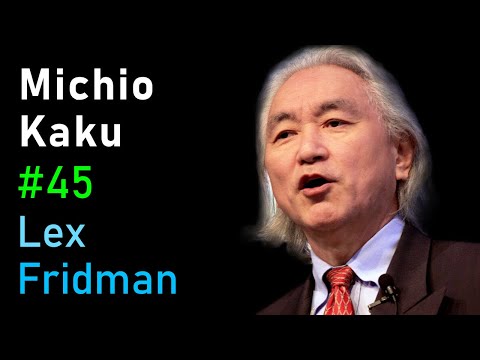
Michio Kaku: Future of Humans, Aliens, Space Travel & Physics | Lex Fridman Podcast #45
Lex Fridman (host), Michio Kaku (guest)
In this episode of Lex Fridman Podcast, featuring Lex Fridman and Michio Kaku, Michio Kaku: Future of Humans, Aliens, Space Travel & Physics | Lex Fridman Podcast #45 explores michio Kaku Envisions Humanity’s Cosmic Future, AI, Immortality, and Mars Michio Kaku and Lex Fridman discuss the likelihood of intelligent alien civilizations, how we might detect them, and how the Kardashev scale frames different levels of cosmic technological power.
Michio Kaku Envisions Humanity’s Cosmic Future, AI, Immortality, and Mars
Michio Kaku and Lex Fridman discuss the likelihood of intelligent alien civilizations, how we might detect them, and how the Kardashev scale frames different levels of cosmic technological power.
Kaku explains multiverse ideas and string theory as a way to unite quantum mechanics and general relativity, touching on philosophical questions about God, meaning, and whether the universe is a simulation.
They explore the future of AI, brain–computer interfaces, and BrainNet, including digital immortality, mind-uploaded interstellar travel, and the ethical and existential risks of advanced machines.
The conversation closes with humanity’s path to becoming a multi-planet, Type I civilization via fusion energy, Mars colonization, and starshot-style probes to nearby stars.
Key Takeaways
Extraterrestrial civilizations are statistically likely, and we may detect them this century.
With billions of Earth-sized exoplanets in our galaxy alone, Kaku argues it is implausible we are alone, and predicts we’ll likely intercept ordinary radio or TV-style emissions and then infer the senders’ Kardashev level from their energy use.
Get the full analysis with uListen AI
Advanced civilizations can be classified by the energy they harness.
Kaku extends the Kardashev scale from Type I (planetary power) through Type III (galactic) up to speculative Type IV (dark energy) and Type V (multiverse), framing our current status as a vulnerable Type 0 civilization still dependent on fossil fuels.
Get the full analysis with uListen AI
String theory offers a candidate “theory of everything,” uniting the very small and the very large.
He describes particles as musical notes on tiny vibrating strings, with physics as harmonies and the universe as a symphony, positioning string theory as the only current framework that can in principle reconcile quantum mechanics and general relativity.
Get the full analysis with uListen AI
Brain–computer interfaces and BrainNet could transform communication and culture.
Kaku forecasts memory chips for Alzheimer’s patients, direct sharing of emotions and sensations over BrainNet, and an entertainment revolution beyond screens, fundamentally deepening empathy and global interconnectedness.
Get the full analysis with uListen AI
Human identity may become digital and cybernetic, enabling new forms of immortality and travel.
Through connectome mapping and AI, he envisions digitizing memories and personality, achieving “digital immortality,” and beaming consciousness as data to remote avatars across the solar system at light speed.
Get the full analysis with uListen AI
Biological aging is a resolvable engineering problem linked to error accumulation, especially in mitochondria.
Kaku suggests that AI analyzing billions of genomes plus gene-editing tools like CRISPR could identify and repair “age genes,” potentially allowing future generations to halt aging around a preferred biological age if youth and health are preserved.
Get the full analysis with uListen AI
Fusion power and space colonization are key steps toward a Type I civilization.
He argues that practical fusion from seawater could provide virtually limitless clean energy, enabling planetary-scale infrastructure, while Mars terraforming and laser-driven starshot probes lay the groundwork for becoming a multi-planet and eventually interstellar species.
Get the full analysis with uListen AI
Notable Quotes
“To believe that we’re the only ones, I think, is rather ridiculous.”
— Michio Kaku
“What is the universe? The universe is a symphony of strings.”
— Michio Kaku
“The mind of God would be cosmic music resonating through 11-dimensional hyperspace.”
— Michio Kaku
“The greatest destroyer of scientists known to science is junior high school.”
— Michio Kaku
“Remember, the dinosaurs did not have a space program.”
— Michio Kaku
Questions Answered in This Episode
If we detect signals from an alien civilization, how should humanity decide whether and how to respond?
Michio Kaku and Lex Fridman discuss the likelihood of intelligent alien civilizations, how we might detect them, and how the Kardashev scale frames different levels of cosmic technological power.
Get the full analysis with uListen AI
What ethical framework should govern technologies like BrainNet, memory recording, and digital immortality?
Kaku explains multiverse ideas and string theory as a way to unite quantum mechanics and general relativity, touching on philosophical questions about God, meaning, and whether the universe is a simulation.
Get the full analysis with uListen AI
How might our concepts of self, free will, and responsibility change if we can fully digitize and edit personalities?
They explore the future of AI, brain–computer interfaces, and BrainNet, including digital immortality, mind-uploaded interstellar travel, and the ethical and existential risks of advanced machines.
Get the full analysis with uListen AI
Who should control and regulate fusion power and planetary engineering as we approach a Type I civilization?
The conversation closes with humanity’s path to becoming a multi-planet, Type I civilization via fusion energy, Mars colonization, and starshot-style probes to nearby stars.
Get the full analysis with uListen AI
If aging becomes optional, how should societies handle population, inequality, and the meaning of a life well-lived?
Get the full analysis with uListen AI
Transcript Preview
The following is a conversation with Michio Kaku. He's a theoretical physicist, futurist, and professor at the City College of New York. He's the author of many fascinating books that explore the nature of our reality and the future of our civilization. They include Einstein's Cosmos, Physics of the Impossible, Future of the Mind, Parallel Worlds, and his latest, The Future of Humanity: Terraforming Mars, Interstellar Travel, Immortality, and Our Destiny Beyond Earth. I think it's beautiful and important when a scientific mind can fearlessly explore through conversation subjects just outside of our understanding. That, to me, is where artificial intelligence is today, just outside of our understanding, a place we have to reach for if we're to uncover the mysteries of the human mind and build human-level and superhuman-level AI systems that transform our world for the better. This is the Artificial Intelligence podcast. If you enjoy it, subscribe on YouTube, give it five stars on iTunes, support it on Patreon, or simply connect with me on Twitter @lexfridman, spelled F-R-I-D-M-A-N. And now, here's my conversation with Michio Kaku. You've mentioned that we just might make contact with aliens, or at least hear from them within this century. Can you elaborate on your intuition behind that optimism?
Well, this is pure speculation, of course.
Of course.
But given the fact that we've already identified 4,000 exoplanets orbiting other stars, and we have a census of the Milky Way galaxy for the first time, we know that on average, every single star, on average, has a planet going around it, and about one-fifth or so of them have Earth-sized planets going around them. So just do the math. We're talking about out of 100 billion stars in the Milky Way galaxy, we're talking about billions of potential Earth-sized planets. And to believe that we're the only one is, I think, rather ridiculous-
(laughs)
... given the odds. And how many galaxies are there? Within sight of the Hubble Space Telescope, there are about 100 billion galaxies. So do the math. How many stars are there in the visible universe? 100 billion galaxies times 100 billion stars per galaxy, we're talking about a number beyond human imagination. And to believe that we're the only ones, I think, is, is rather ridiculous.
So you've talked about different types of, uh, Type 0, 1, 2, 3, 4, and 5 even of the Kardashev scale, um, of the different kind of civilizations. Do... What do you think it takes, if it is indeed a ridiculous notion that we're alone in the universe, what do you think it takes to reach out, first to reach out through communication and connect?
Well, first of all, we have to understand the level of sophistication of an alien life form if we make contact with them. I think in this century, we'll probably pick up signals, signals from an extraterrestrial civilization. We'll pick up their I Love Lucy and their Leave It To Beaver, uh, just ordinary day-to-day transmissions that, uh, they emit. And the first thing we wanna do is to, A, decipher their language, of course, but B, figure out at what level they are advanced on the Kardashev scale. I'm a physicist. We rank things by two parameters: energy and information. That's how we rank black holes. That's how we rank stars. That's how we rank civilizations in outer space. So a Type I civilization is capable of harnessing planetary power. They control the weather, for example, earthquakes, volcanoes. They can modify the course of geological events, sort of like Flash Gordon or Buck Rogers.
Install uListen to search the full transcript and get AI-powered insights
Get Full TranscriptGet more from every podcast
AI summaries, searchable transcripts, and fact-checking. Free forever.
Add to Chrome