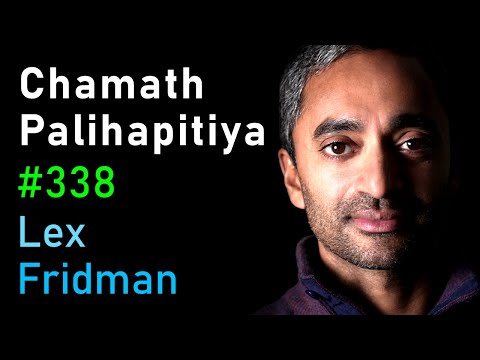
Chamath Palihapitiya: Money, Success, Startups, Energy, Poker & Happiness | Lex Fridman Podcast #338
Chamath Palihapitiya (guest), Lex Fridman (host), Narrator, Narrator
In this episode of Lex Fridman Podcast, featuring Chamath Palihapitiya and Lex Fridman, Chamath Palihapitiya: Money, Success, Startups, Energy, Poker & Happiness | Lex Fridman Podcast #338 explores chamath Palihapitiya on trauma, money, mistakes, power and energy’s future Chamath traces how a childhood of abuse and hypervigilance shaped his adult psychology, drive for external validation, and long process of forgiving his parents and rebuilding self-worth. He and Lex explore how money amplifies character without guaranteeing happiness, why rapid mistake‑making underpins success, and how poker, investing, and life all hinge on managing your own error rate. Chamath lays out big‑picture views on social media, AGI, zero‑marginal‑cost energy and compute, and the geopolitical implications of the coming energy transition. Throughout, he reflects on friendship, love, parenting, and what it means to feel “equal” to others after a life spent feeling less than.
Chamath Palihapitiya on trauma, money, mistakes, power and energy’s future
Chamath traces how a childhood of abuse and hypervigilance shaped his adult psychology, drive for external validation, and long process of forgiving his parents and rebuilding self-worth. He and Lex explore how money amplifies character without guaranteeing happiness, why rapid mistake‑making underpins success, and how poker, investing, and life all hinge on managing your own error rate. Chamath lays out big‑picture views on social media, AGI, zero‑marginal‑cost energy and compute, and the geopolitical implications of the coming energy transition. Throughout, he reflects on friendship, love, parenting, and what it means to feel “equal” to others after a life spent feeling less than.
Key Takeaways
Your early sense of worth shapes decades of behavior unless you confront it.
Growing up in physical and psychological abuse taught Chamath he was “worthless,” driving decades of compartmentalization and external validation via status, money, and achievement. ...
Get the full analysis with uListen AI
Mistakes are the primary engine of learning; shortening the cycle matters more than avoiding them.
Chamath argues that success in poker, startups, investing, and relationships is about “your mistakes minus others’ mistakes. ...
Get the full analysis with uListen AI
Money doesn’t create happiness; it removes constraints and magnifies who you already are.
He describes money as a way to sample the entire ‘table’ of life experiences and discover that items 7–100 on the price ladder don’t contain more happiness than 1–6, just more comfort. ...
Get the full analysis with uListen AI
Great products and companies are built through disciplined experimentation, not grand foresight.
Reflecting on Facebook, Chamath emphasizes that features like News Feed and People You May Know emerged from thousands of experiments, not a 20‑year master plan. ...
Get the full analysis with uListen AI
Social networks fail when they ignore human psychology and the cost of toxicity.
Chamath sees much online vitriol as displaced anger from people who feel “less than” and unrewarded by a system they tried to play by. ...
Get the full analysis with uListen AI
The coming collapse in the marginal cost of energy and compute will reshape power and technology.
He predicts rooftop solar plus home storage will effectively make homeowners competing micro‑utilities, driving the marginal cost of energy toward zero, while GPUs and specialized chips push effective compute cost down as well. ...
Get the full analysis with uListen AI
Success is personal; chasing impact or status before inner stability leads to misery.
Chamath warns that starting with a goal of being ‘successful’ or world‑changing is playing someone else’s game. ...
Get the full analysis with uListen AI
Notable Quotes
“Society tells you, ‘Don’t make mistakes because we will judge you,’ but really it’s the cycle time of mistakes that gets you to success.”
— Chamath Palihapitiya
“Money doesn’t buy happiness, but it buys you a level of comfort to really amplify what happiness is.”
— Chamath Palihapitiya
“Life success really boils down to how do you control your mistakes. And the way you control your mistakes is by making a lot of mistakes.”
— Chamath Palihapitiya
“We are all equal. You will fight this demon inside you that says you are less than a lot of other people… and you’re not.”
— Chamath Palihapitiya
“I don’t believe in this idea of legacy that much. I think it’s a real trap… I really, really hope I’m forgotten.”
— Chamath Palihapitiya
Questions Answered in This Episode
How should individuals balance the drive to take risks and make many mistakes with the real social and financial costs of failure?
Chamath traces how a childhood of abuse and hypervigilance shaped his adult psychology, drive for external validation, and long process of forgiving his parents and rebuilding self-worth. ...
Get the full analysis with uListen AI
If money primarily amplifies who you already are, how can someone consciously shape their character before achieving significant wealth or power?
Get the full analysis with uListen AI
What concrete design choices would make a social network both protective against toxicity and maximally supportive of users’ long-term growth?
Get the full analysis with uListen AI
How plausible is Chamath’s prediction of near‑zero marginal cost energy within a couple of decades, and what political or incumbent resistance could delay it?
Get the full analysis with uListen AI
For someone who grew up feeling ‘less than,’ what practical steps—beyond therapy—can help untie the ‘knots’ of low self-worth and build healthier ambition?
Get the full analysis with uListen AI
Transcript Preview
In terms of your mistakes, society tells you, "Don't make them because we will judge you and we will look down on you." And I think the really successful people realize that actually, no, it's the cycle time of mistakes that gets you to success. Because your error rate will diminish the more mistakes that you make. You observe them, you figure out where it's coming from. Is it a psychological thing? Is it a, you know, cognitive thing? And then you fix it.
The following is a conversation with Chamath Palihapitiya, a venture capitalist and engineer, founder and CEO of Social Capital, previously an early senior executive at Facebook, and is, uh, the co-host of the All-In podcast, a podcast that I highly recommend for the wisdom and the camaraderie of the four co-hosts, also known as besties. This is the Lex Fridman podcast. To support it, please check out our sponsors in the description. And now, dear friends, here's Chamath Palihapitiya. You grew up in a dysfunctional household, on welfare. You've talked about this before. What were, for you, personally, psychologically, some difficult moments in your childhood?
I'll answer that question in a slightly different way, which is that I think when you grow up in a household that's defined by physical abuse and psychological abuse, you're hypervigilant all the time. And so it's actually easier for me to point to moments where I was happy or I felt compassion or I felt safe. Otherwise, every moment... I'll give you a couple of examples, like, you know, I was thinking about this a while ago. There was a tree outside of my apartment where we lived when I was growing up, and my father would sometimes- would make me go outside to take the tree branch that he would hit me with. Um, and so you can imagine if you're a 10, 11-year-old kid and you have to deal with that, what do you do? Well, a hypervigilant child learns how to basically estimate the strength of these branches, right? How far can he go before it breaks? You have to estimate his anger and estimate the effective strength of, you know, branches and bring back something because, you know, th- I remember these moments where if it was- he would look at it and then he would make me go out again and get it, right? Get a different one. Um, or, you know, there was a certain belt that he wore that had this kind of, um, belt buckle that stuck out. And you just wanted to make sure if that- if that was the thing that you were gonna get hit by, that it wasn't the buckle facing out, because that really hurt. And so you became hyper-aware of which part of the buckle was facing out versus facing in in those moments. And there are, like, hundreds of these little examples, which essentially I would- I would say the through line is that you're just so on edge, right? And you walk into this house and you're just basically trying to get to the point where you leave the house. Um, and so in that microcosm of growing up, any moment that's not like that is seared in my memory in a way that I just can't, um, describe to a person. I'll give you an example. I volunteered when I was in grade five or six, I th- can't remember which it was, in the kindergarten of my school. And I would just go and the teacher would, you know, ask you to clean things up. And at the end of that grade five year, she took me and two other kids to Dairy Queen. And I'd never been- I've never- I'd never gone to a restaurant, literally, um, because we just- we didn't have the money. And I remember the first time I tasted this, you know, this Dairy Queen meal, it was like a- a hamburger, fries, a Coke, and a- a Blizzard. And I was like, "What is this?" And I felt so special, you know, because you're getting something that most people would take for granted. "Oh, it's a Sunday." Or it's a, you know, or, "I'm really busy, let me go take my kid to- to fast food." I think that, you know, until I left high school, I think- and this is not just specific to me but a lot of other people, it's you're in this hypervigilant loop punctuated with these incredibly visceral moments of compassion by other people. You know, a different example. Um, we had such a strict budget and we didn't have a car. And so, you know, I was responsible with my mom to always go shopping and so I learned very early on how to, you know, look for coupons, how to buy things that were on sale or special. And we had a very basic diet because you have to budget this thing really precisely. But the end of every year where I lived, there was a large grocery chain called Loblaws, and Loblaws would discount, um, a cheesecake from 7.99 to 4.99. And my parents would buy that once a year, and we probably did that six or seven times. And you can't imagine how special we felt, myself, my two sisters. We would sit there, we would watch the, you know, the New Year's Eve celebration on TV. We would cut this cheesecake into, you know, five pieces. It felt like everything. Um, so that's sort of how, you know, my- my existence when I was at that age is, for better or for worse, that's how I remember it.
Install uListen to search the full transcript and get AI-powered insights
Get Full TranscriptGet more from every podcast
AI summaries, searchable transcripts, and fact-checking. Free forever.
Add to Chrome