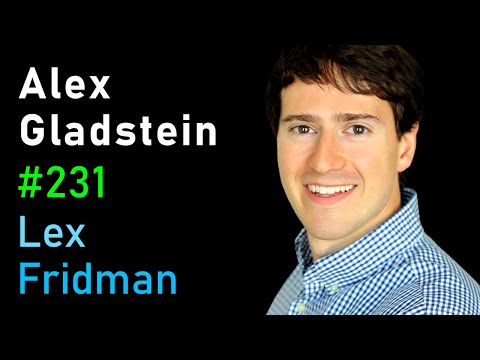
Alex Gladstein: Bitcoin, Authoritarianism, and Human Rights | Lex Fridman Podcast #231
Lex Fridman (host), Alex Gladstein (guest)
In this episode of Lex Fridman Podcast, featuring Lex Fridman and Alex Gladstein, Alex Gladstein: Bitcoin, Authoritarianism, and Human Rights | Lex Fridman Podcast #231 explores bitcoin as Freedom Tech: Fighting Authoritarianism, Surveillance, and Inflation Worldwide Lex Fridman and Alex Gladstein explore how authoritarianism works in practice, why negative rights like free speech and property rights are foundational, and how over half the world lives without them. Gladstein argues that modern digital surveillance, especially in China, is enabling a new, more efficient form of oppression that democracies are ill‑prepared to confront.
Bitcoin as Freedom Tech: Fighting Authoritarianism, Surveillance, and Inflation Worldwide
Lex Fridman and Alex Gladstein explore how authoritarianism works in practice, why negative rights like free speech and property rights are foundational, and how over half the world lives without them. Gladstein argues that modern digital surveillance, especially in China, is enabling a new, more efficient form of oppression that democracies are ill‑prepared to confront.
They frame politics, information, and money as three levers of power, claiming democracy and the internet decentralized the first two, while money remains largely centralized through state fiat currencies and the U.S. dollar system. Bitcoin is presented as a “freedom technology” that decentralizes money, offering a censorship‑resistant savings vehicle and payments network particularly valuable in authoritarian and inflationary economies.
The conversation covers practical human rights work (HRF, dissidents, sanctions, hyperinflation), the ethics of free speech and deplatforming, the dangers and promise of AI and encryption, and the geopolitical stakes of China’s surveillance state and U.S. dollar hegemony. They also discuss the cultural and moral role of celebrities, companies, and citizens in resisting dictatorships, and the need for individuals to understand money and use privacy tools.
Throughout, Gladstein emphasizes that Bitcoin’s incentive structure co‑opts self‑interest and greed to strengthen individual sovereignty worldwide, while Lex presses on the risks of cultish certainty, scams, and technical and political attacks, probing whether Bitcoin can really withstand state power and scale to billions of users.
Key Takeaways
Learn to distinguish negative rights from positive rights to spot real freedom.
Negative rights (free speech, assembly, property, privacy) constrain state power; positive rights (housing, jobs, vacations) are promises easily faked by dictators. ...
Get the full analysis with uListen AI
Use simple litmus tests to identify authoritarianism in practice, not just on paper.
If you can’t safely hold a gay pride parade, publicly mock the government for money on TV, or pass the “town square test” (criticize your ruler without fear), you effectively live under authoritarianism regardless of formal elections or constitutions.
Get the full analysis with uListen AI
Treat money and inflation as core human rights issues, not just economics.
Hyperinflation and chronic debasement in countries like Zimbabwe, Argentina, Nigeria, and Turkey quietly steal people’s time and labor. ...
Get the full analysis with uListen AI
Adopt privacy tools proactively before you need them.
Mass surveillance (from the NSA to China’s AI‑driven police state) relies on data you voluntarily or unknowingly give up. ...
Get the full analysis with uListen AI
Understand Bitcoin’s two primary human rights use cases: savings and payments.
For people under authoritarian rule or weak currencies, Bitcoin can function as a debasement‑resistant savings account (no one can arbitrarily print more) and as a censorship‑resistant payments rail (for remittances, sanctions‑circumventing commerce, and donations where banks can’t or won’t operate).
Get the full analysis with uListen AI
Recognize Bitcoin’s “Trojan horse” dynamic: greed can fund freedom tech.
Corporations, investors, and even dictators may adopt Bitcoin for profit or sanctions evasion (“number go up”), but in doing so they spread and strengthen a monetary network they ultimately can’t control. ...
Get the full analysis with uListen AI
Don’t outsource all moral courage to governments and NGOs—cultural pressure matters.
Looking back at the anti‑apartheid movement, Gladstein highlights how artists, athletes, and companies using boycotts and public stands helped end South African apartheid. ...
Get the full analysis with uListen AI
Notable Quotes
“In my country, we have freedom of speech. We don’t have freedom after speech.”
— Alex Gladstein, quoting Malaysian opposition leader Anwar Ibrahim
“If you cannot have a gay pride parade in your country because you’re fearful that you’re gonna get the crap kicked out of you, you probably live in an authoritarian regime.”
— Alex Gladstein
“The way that you can define a free society is through the town square test: can you go to a public space and criticize your ruler loudly without fear of retribution?”
— Alex Gladstein (summarizing Natan Sharansky)
“Bitcoin is like a Trojan horse. Number‑go‑up technology on the outside, freedom‑go‑up technology on the inside.”
— Alex Gladstein
“If we don’t let freedom guide us, we end up at the prison camps.”
— Alex Gladstein
Questions Answered in This Episode
How realistic is it to expect billions of people in authoritarian or low‑infrastructure environments to adopt and safely custody Bitcoin without falling prey to scams or coercion?
Lex Fridman and Alex Gladstein explore how authoritarianism works in practice, why negative rights like free speech and property rights are foundational, and how over half the world lives without them. ...
Get the full analysis with uListen AI
At what point do democratic governments stop tolerating a truly neutral, censorship‑resistant monetary network, and what forms might a serious state‑level attack on Bitcoin actually take?
They frame politics, information, and money as three levers of power, claiming democracy and the internet decentralized the first two, while money remains largely centralized through state fiat currencies and the U. ...
Get the full analysis with uListen AI
Can AI and big data ever be net positives for civil liberties, or are they inherently more aligned with surveillance and control than with individual empowerment?
The conversation covers practical human rights work (HRF, dissidents, sanctions, hyperinflation), the ethics of free speech and deplatforming, the dangers and promise of AI and encryption, and the geopolitical stakes of China’s surveillance state and U. ...
Get the full analysis with uListen AI
How should citizens and companies in democracies navigate the trade‑off between economic opportunity and complicity when dealing with regimes like China or Saudi Arabia?
Throughout, Gladstein emphasizes that Bitcoin’s incentive structure co‑opts self‑interest and greed to strengthen individual sovereignty worldwide, while Lex presses on the risks of cultish certainty, scams, and technical and political attacks, probing whether Bitcoin can really withstand state power and scale to billions of users.
Get the full analysis with uListen AI
If money, politics, and information are the three pillars of power, what would a fully decentralized, rights‑respecting architecture across all three actually look like in practice?
Get the full analysis with uListen AI
Transcript Preview
The following is a conversation with Alex Gladstein, Chief Strategy Officer at the Human Rights Foundation and the Oslo Freedom Forum. In recent times, Alex has focused on how cryptocurrency, and especially Bitcoin, can be a tool for empowering democracy and civil l- liberties in the world, most crucially, parts of the world that are living under authoritarian regimes. As a side note, let me say that I have been learning a lot about the ways in which money can be used to amass power, and in the same way, the decentralization of money can be used to resist the corrupting nature of this power. Alex and I do not agree on everything, but we strive for the same betterment of humanity. He's sensitive to the suffering in the world and is dedicating his life to finding solutions that lessen that suffering. Whether Bitcoin is one such solution, I don't know, but I think it has a chance, and that means it is worth exploring deeply. I'm staying in this path of learning patiently and with as little ego as possible. I hope you come along with me on this journey as well. This is the Lex Fridman Podcast. To support it, please check out our sponsors in the description. We recorded this conversation a while ago, and I thought I lost the audio, and was really disappointed with myself for messing this thing up. But luckily, last week, I found it, and so, rescued from out of the abyss of nonexistence, here's my conversation with Alex Gladstein. What are some universal human rights that you believe all people should have?
So, free speech, freedom of assembly, freedom of belief, freedom to participate in your government, the freedom to have privacy, the freedom to own things, property rights. These are all basic, fundamental, negative rights, what we call them. These are the basic, fundamental human freedoms.
What does negative rights mean?
Negative rights are liberties, and positive rights are entitlements. So after World War II, when the UN came together, it was largely compromised between the Communist Soviet Union and the, you know, free United States, right? So, the US had, uh, on its side of the UN Declaration of Human Rights, uh, a bunch of li- liberties, essentially, things like free speech, freedom of association, freedom of assembly. The Soviets wanted entitlements, uh, like the right to work, the right to have housing, the right to water, the right to a vacation. So if you actually read the UN Declaration for Human Rights, it's a negotiation between the Soviets and the Americans. Later, there was another document in the '70s released called the International Covenant on Civil and Political Rights, and this is what HRF uses as its sort of, like, lodestar, um, its founding document, and this is, like, essentially an international agreement on the negative rights. Those are the things we choose to focus on, because essentially, authoritarian regimes can commit fraud and claim they're giving the, the positive rights, the entitlements without having any of the negative liberties, and they can do that because they don't have any, like, free speech or press freedom. Um, when you, when you take people's basic fundamental freedoms away, it's quite easy to make, like, a Potemkin village and pretend that there's the entitlements and that we have good, uh, healthcare, and, you know, it's the same sort of thing that authoritarians have done for decades, uh, Cuba and Venezuela and, and the Soviet Union.
Install uListen to search the full transcript and get AI-powered insights
Get Full TranscriptGet more from every podcast
AI summaries, searchable transcripts, and fact-checking. Free forever.
Add to Chrome