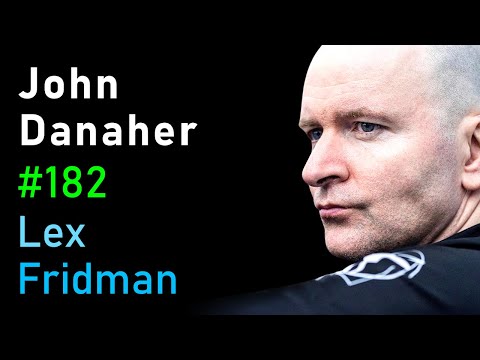
John Danaher: The Path to Mastery in Jiu Jitsu, Grappling, Judo, and MMA | Lex Fridman Podcast #182
Lex Fridman (host), John Danaher (guest), Narrator
In this episode of Lex Fridman Podcast, featuring Lex Fridman and John Danaher, John Danaher: The Path to Mastery in Jiu Jitsu, Grappling, Judo, and MMA | Lex Fridman Podcast #182 explores john Danaher Dissects Death, Mastery, Jiu Jitsu, and Human Potential Lex Fridman and John Danaher explore fear of death, the search for meaning, and how mortality gives urgency and value to life. Danaher lays out his systematic approach to jiu jitsu and grappling: build escapes and defense first, then position, then submissions, and always emphasize control over chaos.
John Danaher Dissects Death, Mastery, Jiu Jitsu, and Human Potential
Lex Fridman and John Danaher explore fear of death, the search for meaning, and how mortality gives urgency and value to life. Danaher lays out his systematic approach to jiu jitsu and grappling: build escapes and defense first, then position, then submissions, and always emphasize control over chaos.
They dive deeply into leg lock systems, drilling methodology, the psychology of training versus competition, and why escapes are the true foundation of confidence and offensive dominance. Danaher also analyzes greatness through case studies of Roger Gracie, Gordon Ryan, and Georges St-Pierre, relating their success to focused systems and innovation.
The conversation ranges into AI, chess, and robotics as analogies for how to formalize combat systems, emphasizing heuristic principles over memorizing endless details. It closes with Danaher’s views on self-defense, meaning in life after survival is solved, and living for something larger than oneself.
Key Takeaways
Build escapes and defense before offense to create true confidence.
Danaher argues the first skills any grappler should master are pin escapes and guard retention. ...
Get the full analysis with uListen AI
Training is for skill development; competition is for victory—do not mix them.
In the gym you should prioritize learning, experimentation, and taking risks, especially against lower belts, even if it means “losing” rounds. ...
Get the full analysis with uListen AI
Effective systems separate control mechanisms from finishing mechanisms.
In leg locks, Danaher distinguishes between the leg entanglement (control) and the heel hook or lock (break). ...
Get the full analysis with uListen AI
Greatness comes from mastering a few core tools, not learning everything.
Danaher notes his athletes have extremely high submission rates while specializing in about six to seven main submissions. ...
Get the full analysis with uListen AI
Heuristic principles beat memorizing endless details in complex skills.
Drawing from computer chess and AI, Danaher emphasizes that humans are best at formulating guiding rules (heuristics) that reduce complexity, not running massive calculations. ...
Get the full analysis with uListen AI
Persistence is mostly mental—progressive, thoughtful training beats blind hard work.
He defines real persistence as continuously refining how you train: setting clear time-bound goals, avoiding boredom plateaus, and adjusting difficulty so challenges grow with your skill instead of endlessly repeating the same drills past the point of improvement.
Get the full analysis with uListen AI
Meaning today often requires living for something larger than yourself.
Once survival is largely solved, humans face a meaning crisis rather than a survival crisis. ...
Get the full analysis with uListen AI
Notable Quotes
“Training is about skill development, not about winning or losing. You don't need to win every battle; you only need to win the battles that count.”
— John Danaher
“Death is probably the single greatest motivator for almost every action we partake in. What gives value to our days is scarcity.”
— John Danaher
“Don't listen to what people say, watch what the best people do, particularly under the stress of high-level competition.”
— John Danaher
“I teach beginners from the ground up, and I teach experts backwards.”
— John Danaher
“If you want to be dominant, you can't do the same things everyone else is doing and expect different results.”
— John Danaher
Questions Answered in This Episode
How would jiu jitsu culture change if most schools reversed their curriculum to focus on escapes and defense for the first year?
Lex Fridman and John Danaher explore fear of death, the search for meaning, and how mortality gives urgency and value to life. ...
Get the full analysis with uListen AI
What other neglected areas in grappling today could undergo a 'leg lock–style' revolution if someone built a full control-based system around them?
They dive deeply into leg lock systems, drilling methodology, the psychology of training versus competition, and why escapes are the true foundation of confidence and offensive dominance. ...
Get the full analysis with uListen AI
How far can the analogy between AI training (self-play, simulation, heuristics) and jiu jitsu development be pushed before it breaks down?
The conversation ranges into AI, chess, and robotics as analogies for how to formalize combat systems, emphasizing heuristic principles over memorizing endless details. ...
Get the full analysis with uListen AI
Is there a practical way for recreational practitioners to balance the pursuit of aesthetic, 'beautiful' techniques with the need for high-percentage, efficient tools?
Get the full analysis with uListen AI
In a world where physical survival is increasingly easy, how can combat sports practitioners deliberately use training to construct a deeper sense of meaning rather than just chasing medals?
Get the full analysis with uListen AI
Transcript Preview
The following is a conversation with John Danaher, widely acknowledged as one of the greatest coaches and minds in the martial arts world, having coached many champions in jujitsu, submission grappling, and MMA, including Gordon Ryan, Garry Tonon, Nick Rodriguez, Craig Jones, Nikki Ryan, Chris Weidman, and Georges St-Pierre. Quick mention of our sponsors: Onnit, SimpliSafe, Indeed, and Linode. Check them out in the description to support this podcast. As a side note, let me say that John is a scholar of not just jujitsu, but judo, wrestling, Muay Thai, boxing, MMA, and outside of that, topics of history, psychology, philosophy, and even artificial intelligence, as you will hear in this conversation. After this chat, I started (laughs) to entertain the possibility of returning back to competition as a black belt, maybe even training with John and his team for a few weeks leading up to the competition. For a recreational practitioner, such as myself, the value of training and competing in jujitsu is that it is one of the best ways to get humbled. To me, keeping the ego in check is essential for a productive and happy life. This is the Lex Fridman Podcast, and here is my conversation with John Danaher. Are you afraid of death? Let's start with an easy question. (laughs)
(laughs) There's no warmup? That's it? We're, we're straight in?
No warmup.
No jumping jacks?
(laughs)
Let's, uh, let's break that down into two questions. Um, I'm a human being. And like any human being, I'm biologically programmed to be terrified of death. Every physical element in our bodies is designed to keep us away from death. Um, I'm no different from anyone else in that regard. If you throw me from the top of the Empire State Building, I'm gonna scream all the way down to the concrete. Um, if you wave a loaded firearm in my face, I'm gonna flinch away in horror the same way anyone else would. Um, so in that f- first sense of, are you afraid of death, uh, my, my body is terrified of injury leading to death, the same way any, any other human being would.
So, when death is imminent, there's a terror that becomes-
Yeah, I, I go through-
... that strong enough, right?
... the same adrenaline dumps that you would go through.
Yeah.
Um, uh, but on the other hand, you're also asking a much deeper question, which is presumably, are you afraid of non-existence-
Yeah.
... what comes after your physical death? And that's the more interesting question. Um, no. Uh, I should start right fr- uh, by, by, by saying fr- from the start, I, I'm a materialist. I, I don't believe that we have an immortal soul. I don't believe there's a life after our physical death. Um, in this sense, from someone who starts from that point of view, you have to understand that everyone has two deaths. We always talk about our death as though there was only one, but we all have two deaths. There was a time before you were born when you were dead.... You weren't afraid of that period of non-existence. You don't even think about it. So, why would you be afraid of your second period of non-existence? You came from non-existence, you're gonna go back into it. You weren't afraid of the first. Why are you somehow afraid of the second? So, it doesn't really make sense to me as to why people would be afraid of, of non-existence. You dealt with it fine the first time. Um, deal with it the second time.
Install uListen to search the full transcript and get AI-powered insights
Get Full TranscriptGet more from every podcast
AI summaries, searchable transcripts, and fact-checking. Free forever.
Add to Chrome