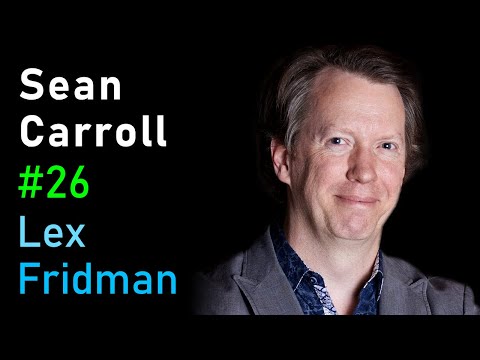
Sean Carroll: The Nature of the Universe, Life, and Intelligence | Lex Fridman Podcast #26
Lex Fridman (host), Sean Carroll (guest)
In this episode of Lex Fridman Podcast, featuring Lex Fridman and Sean Carroll, Sean Carroll: The Nature of the Universe, Life, and Intelligence | Lex Fridman Podcast #26 explores sean Carroll explores cosmos, consciousness, simulations, and humanity’s uncertain future Lex Fridman and Sean Carroll discuss the relationship between fundamental physics, complexity, and the human mind, emphasizing emergence over reductionism. They explore whether the universe is a computer, the plausibility of simulation arguments, and the likelihood and possible forms of extraterrestrial intelligence. The conversation touches on origin-of-life research, the prospects for artificial consciousness and long-term space exploration, and the limits of science in addressing moral questions. Carroll also reflects on academic silos and the value of interdisciplinary, public-facing conversations like podcasts in shaping scientific culture.
Sean Carroll explores cosmos, consciousness, simulations, and humanity’s uncertain future
Lex Fridman and Sean Carroll discuss the relationship between fundamental physics, complexity, and the human mind, emphasizing emergence over reductionism. They explore whether the universe is a computer, the plausibility of simulation arguments, and the likelihood and possible forms of extraterrestrial intelligence. The conversation touches on origin-of-life research, the prospects for artificial consciousness and long-term space exploration, and the limits of science in addressing moral questions. Carroll also reflects on academic silos and the value of interdisciplinary, public-facing conversations like podcasts in shaping scientific culture.
Key Takeaways
Emergence means understanding particles is not enough to explain minds.
Carroll stresses that knowing the fundamental laws of physics does not automatically yield explanations of higher-level phenomena like brains or ice cream; multiple descriptive layers (information, biology, psychology) are required.
Get the full analysis with uListen AI
The universe functions like a computation, but is not a computer.
He argues the universe ‘processes information’ but isn’t a general-purpose machine taking inputs like a PC; it’s a one-time evolving process, making the computational analogy useful but limited.
Get the full analysis with uListen AI
Simulation arguments lack clear predictive power without concrete expectations.
Using Bayesian reasoning, Carroll notes that a simulated universe should likely be smaller, lower-resolution, and more resource-efficient; since our universe looks vast and high-resolution, he sees no positive evidence for being simulated.
Get the full analysis with uListen AI
Intelligent life in the observable universe may be extremely rare or absent.
He suggests the plausible numbers of other intelligent civilizations are either zero or billions; since we see no signs consistent with billions, he leans toward a strong bottleneck leading to possibly zero others we can detect.
Get the full analysis with uListen AI
Origin-of-life research is close to key breakthroughs and underfunded.
Carroll outlines the three requirements for life-as-we-know-it—compartmentalization, metabolism, and replication—and notes labs can already approximate membranes and mutual replication, arguing this area deserves far more investment.
Get the full analysis with uListen AI
Artificial consciousness may emerge gradually through increasingly convincing ‘fakes.’
Both speakers suggest consciousness might be less mysterious than we think and partly a social construct: as embodied AI more closely mimics human behavior and insists it’s conscious, our attributions may shift without a single turning point.
Get the full analysis with uListen AI
Science cannot determine what ‘should’ happen; moral philosophy is still needed.
Carroll emphasizes that science describes what is and can even predict behavior, but it cannot, by itself, ground judgments about right and wrong; ethics systematizes our intuitions rather than emerging directly from physics.
Get the full analysis with uListen AI
Academic structures discourage breadth, yet interdisciplinary dialogue is vital.
He notes that universities reward narrow specialization and often punish early-career breadth, even though cross-disciplinary conversations—like those on podcasts—are central to the spirit of science and can reshape future academic culture.
Get the full analysis with uListen AI
Notable Quotes
“We cannot understand how ice cream works just from understanding how particles work.”
— Sean Carroll
“The universe is more like a computation than a computer, because the universe happens once.”
— Sean Carroll
“I don't see any evidence from what we know about our universe that we look like a simulated universe.”
— Sean Carroll
“My guess is that there is not intelligent life in the observable universe other than us.”
— Sean Carroll
“Science tells us what the world is and what it does. It doesn't say what the world should do, or what we should do.”
— Sean Carroll
Questions Answered in This Episode
If emergence is crucial, what kinds of new theories or frameworks are needed to bridge from physics to minds and societies?
Lex Fridman and Sean Carroll discuss the relationship between fundamental physics, complexity, and the human mind, emphasizing emergence over reductionism. ...
Get the full analysis with uListen AI
How could we design concrete empirical tests that would more strongly support or undermine the simulation hypothesis?
Get the full analysis with uListen AI
What forms of extraterrestrial intelligence might be fundamentally undetectable with our current tools and timescales, and how could we expand our search strategies?
Get the full analysis with uListen AI
If artificial consciousness is partly a social construct, who should decide when an AI’s claim to consciousness or moral status is taken seriously?
Get the full analysis with uListen AI
Given that academia structurally rewards narrow specialization, what practical reforms could encourage and protect genuinely interdisciplinary work and public engagement?
Get the full analysis with uListen AI
Transcript Preview
The following is a conversation with Sean Carroll. He's a theoretical physicist at Caltech, specializing in quantum mechanics, gravity, and cosmology. He's the author of several popular books, one on the arrow of time called From Eternity to Here, one on the Higgs boson called Particle at the End of the Universe, and one on science and philosophy called The Big Picture: On the Origins of Life, Meaning, and the Universe Itself. He has an upcoming book on quantum mechanics that you can pre-order now called Something Deeply Hidden. He writes one of my favorite blogs on his website, preposterousuniverse.com. I recommend clicking on the Greatest Hits link that lists accessible interesting posts on the arrow of time, dark matter, dark energy, the Big Bang, general relativity, string theory, quantum mechanics, and the, uh, big meta questions about the philosophy of science, God, ethics, politics, academia, and much, much more. Finally, and perhaps most famously, he's the host of a podcast called Mindscape that you should subscribe to and support on Patreon. Along with The Joe Rogan Experience, Sam Harris's Making Sense, and Dan Carlin's Hardcore History, Sean's Mindscape podcast is one of my favorite ways to learn new ideas or explore different perspectives on ideas that I thought I understood. It was truly an honor to meet and spend a couple hours with Sean. It's a bit heartbreaking to say that for the first time ever, the audio recorder for this podcast died in the middle of our conversation. There's technical reasons for this having to do with phantom power that I now understand and will avoid. It took me one hour to notice and fix the problem. So, much like the universe is 68% dark energy, roughly the same amount from this conversation was lost, except in the memories of the two people involved and in my notes. I'm sure we'll talk again and continue this conversation on this podcast or on Sean's. And of course, I look forward to it. This is the Artificial Intelligence Podcast. If you enjoy it, subscribe on YouTube, iTunes, support it on Patreon, or simply connect with me on Twitter @lexfriedman. And now, here's my conversation with Sean Carroll. What do you think is more interesting and impactful, understanding how the universe works at a fundamental level or understanding how the human mind works?
You know, uh, of course, this is a crazy, meaningless, unanswerable question in some sense-
Yeah.
... because they're both very interesting and there's no absolute scale of interestingness that we can rate them on. There's the glib answer says, "The human brain is part of the universe," right? And therefore, understanding the universe is more fundamental than understanding the human brain.
But do you really believe that once we understand the fundamental way the universe works at the particle level, the forces, we would be able to understand how the mind works?
No, certainly not.
All right.
We cannot understand how ice cream works just from understanding-
Install uListen to search the full transcript and get AI-powered insights
Get Full TranscriptGet more from every podcast
AI summaries, searchable transcripts, and fact-checking. Free forever.
Add to Chrome