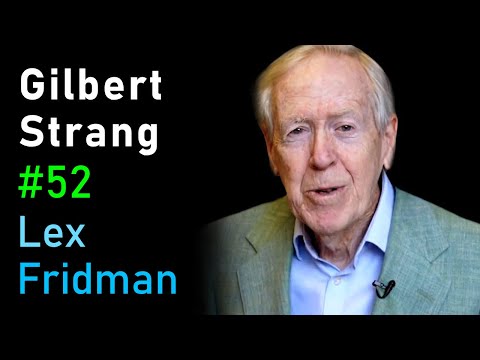
Gilbert Strang: Linear Algebra, Teaching, and MIT OpenCourseWare | Lex Fridman Podcast #52
Lex Fridman (host), Gilbert Strang (guest)
In this episode of Lex Fridman Podcast, featuring Lex Fridman and Gilbert Strang, Gilbert Strang: Linear Algebra, Teaching, and MIT OpenCourseWare | Lex Fridman Podcast #52 explores gilbert Strang on Linear Algebra’s Power, Beauty, and Global Classroom Gilbert Strang and Lex Fridman discuss why linear algebra has become central to modern science, engineering, and artificial intelligence, and how Strang’s MIT OpenCourseWare lectures unexpectedly reached millions worldwide. Strang explains core linear algebra ideas—like vector spaces, the four fundamental subspaces, and singular value decomposition—and how they underpin data science and deep learning. They explore why piecewise-linear neural networks are so expressive, how data-driven methods “learn rules” compared to classical physics, and where the limits may lie. The conversation also touches on math education, the calculus vs. linear algebra imbalance, the joy of teaching, and the comfort and beauty many people find in mathematical truth.
Gilbert Strang on Linear Algebra’s Power, Beauty, and Global Classroom
Gilbert Strang and Lex Fridman discuss why linear algebra has become central to modern science, engineering, and artificial intelligence, and how Strang’s MIT OpenCourseWare lectures unexpectedly reached millions worldwide. Strang explains core linear algebra ideas—like vector spaces, the four fundamental subspaces, and singular value decomposition—and how they underpin data science and deep learning. They explore why piecewise-linear neural networks are so expressive, how data-driven methods “learn rules” compared to classical physics, and where the limits may lie. The conversation also touches on math education, the calculus vs. linear algebra imbalance, the joy of teaching, and the comfort and beauty many people find in mathematical truth.
Key Takeaways
Linear algebra has become a foundational language of modern technology.
Strang emphasizes that matrices and high-dimensional vector spaces now underlie fields from AI and data science to engineering and quantum mechanics, making linear algebra more central than ever.
Get the full analysis with uListen AI
The “four fundamental subspaces” provide a simple, unifying picture of matrices.
Thinking in terms of column space, row space, and their two perpendicular (null) spaces gives students a geometric and conceptual handle on what a matrix really does.
Get the full analysis with uListen AI
Singular value decomposition (SVD) reveals the essential structure in data.
Any matrix can be decomposed into rotations and a stretch (diagonal matrix of singular values), allowing us to separate the most important components of data from noise and redundancy.
Get the full analysis with uListen AI
Deep learning works by composing many simple, piecewise-linear transformations.
Neural networks repeatedly apply linear maps plus simple nonlinear “folds,” creating highly expressive piecewise-linear functions that can approximate complex input–output relationships in real data.
Get the full analysis with uListen AI
There must be underlying structure—signal, not pure noise—for AI to learn.
Strang notes that if data were entirely random, no model could discover meaningful rules; deep learning is powerful precisely because much of the world contains regularities to be uncovered.
Get the full analysis with uListen AI
Linear algebra and probability deserve more weight relative to calculus in curricula.
He argues that undergraduate education overemphasizes calculus, even though modern applications heavily rely on matrices, linear algebra, and statistics, which many students can grasp and use effectively.
Get the full analysis with uListen AI
Joy, curiosity, and good teaching matter more than grades in learning math.
Strang downplays exams and stresses the importance of teachers who genuinely enjoy mathematics, use concrete examples, and help students experience the moment of “getting it.”
Get the full analysis with uListen AI
Notable Quotes
“Linear algebra, as a subject, has just surged in importance.”
— Gilbert Strang
“Every matrix can be written as a rotation, times a stretch, and then another rotation.”
— Gilbert Strang
“All the complications of calculus come from the curves. Linear algebra, the surfaces are all flat.”
— Gilbert Strang
“The whole idea of deep learning is that there’s something there to learn. If the data is totally random, you’re not gonna get anywhere.”
— Gilbert Strang
“I tell the class, ‘I’m here to teach you math, not to grade you.’”
— Gilbert Strang
Questions Answered in This Episode
How might math education change if linear algebra and probability were treated as co-equal to calculus from the start?
Gilbert Strang and Lex Fridman discuss why linear algebra has become central to modern science, engineering, and artificial intelligence, and how Strang’s MIT OpenCourseWare lectures unexpectedly reached millions worldwide. ...
Get the full analysis with uListen AI
What are the most important open theoretical questions about why deep neural networks generalize as well as they do?
Get the full analysis with uListen AI
How far can piecewise-linear architectures be pushed before we fundamentally need different kinds of mathematical building blocks?
Get the full analysis with uListen AI
In what ways could policymakers benefit from a deeper understanding of quantitative reasoning and linear algebra specifically?
Get the full analysis with uListen AI
For someone learning on their own, how should they balance intuition-building through examples with formal proof-based study in mathematics?
Get the full analysis with uListen AI
Transcript Preview
The following is a conversation with Gilbert Strang. He's a professor of mathematics at MIT, and perhaps one of the most famous and impactful teachers of math in the world. His MIT Open Courseware lectures on linear algebra have been viewed millions of times. As an undergraduate student, I was one of those millions of students. There's something inspiring about the way he teaches, that is at once calm, simple, and yet full of passion for the elegance inherent to mathematics. I remember doing the exercises in his book, Introduction to Linear Algebra, and slowly realizing that the world of matrices, of vector spaces, of determinants and eigenvalues, of geometric transformations, and matrix decompositions reveal a set of powerful tools in the toolbox of artificial intelligence; from signals to images, from numerical optimization to robotics, computer vision, deep learning, computer graphics, and everywhere outside AI, including, of course, a quantum mechanical study of our universe. This is the Artificial Intelligence Podcast. If you enjoy it, subscribe on YouTube, give it five stars on Apple Podcasts, support it on Patreon, or simply connect with me on Twitter @lexfridman, spelled F-R-I-D-M-A-N. This podcast is supported by ZipRecruiter. Hiring great people is hard, and to me, is the most important element of a successful mission-driven team. I've been fortunate to be a part of and to lead several great engineering teams. The hiring I've done in the past was mostly through tools that we built ourselves, but reinventing the wheel was painful. ZipRecruiter's a tool that's already available for you. It seeks to make hiring simple, fast, and smart. For example, Codable co-founder, Gretchen Huebner, used ZipRecruiter to find a new game artist to join her education tech company. By using ZipRecruiter's screening questions to filter candidates, Gretchen found it easier to focus on the best candidates and finally hiring the perfect person for the role in less than two weeks from start to finish. ZipRecruiter, the smartest way to hire. See why ZipRecruiter's effective for businesses of all sizes by signing up, as I did, for free at ziprecruiter.com/lexpod. That's ziprecruiter.com/lexpod. This show is presented by Cash App, the number one finance app in the App Store. I personally use Cash App to send money to friends, but you can also use it to buy, sell, and deposit Bitcoin. Most Bitcoin exchanges take days for a bank transfer to become investable. Through Cash App, it takes seconds. Cash App also has a new investing feature. You can buy fractions of a stock, which to me is a really interesting concept. So you can buy of $1 worth, no matter what the stock price is. Brokerage services are provided by Cash App Investing, a subsidiary of Square and member SIPC. I'm excited to be working with Cash App to support one of my favorite organizations that many of you may know and have benefited from called FIRST, best known for their FIRST Robotics and Lego competitions. They educate and inspire hundreds of thousands of students in over 110 countries and have a perfect rating on Charity Navigator, which means the donated money is used to maximum effectiveness. When you get Cash App from the App Store or Google Play and use code LEXPODCAST, you'll get $10 and Cash App will also donate $10 to FIRST, which again is an organization that I've personally seen inspire girls and boys to dream of engineering a better world. And now here's my conversation with Gilbert Strang. How does it feel to be one of the, uh, modern day rockstars of mathematics?
Install uListen to search the full transcript and get AI-powered insights
Get Full TranscriptGet more from every podcast
AI summaries, searchable transcripts, and fact-checking. Free forever.
Add to Chrome