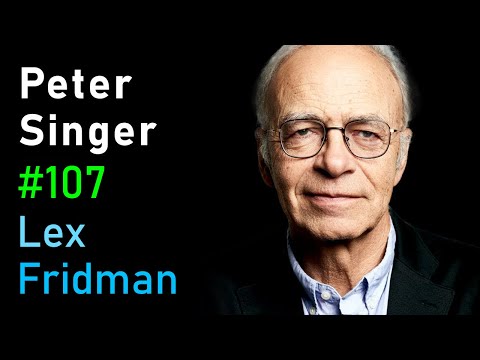
Peter Singer: Suffering in Humans, Animals, and AI | Lex Fridman Podcast #107
Lex Fridman (host), Peter Singer (guest), Narrator
In this episode of Lex Fridman Podcast, featuring Lex Fridman and Peter Singer, Peter Singer: Suffering in Humans, Animals, and AI | Lex Fridman Podcast #107 explores peter Singer on Suffering, Ethics, Animals, Poverty, and Future AI Lex Fridman and Peter Singer explore the nature of suffering, its role in human life, and the ethical imperative to reduce it wherever possible. Singer outlines his views on absolute versus relative suffering, arguing that we should prioritize eliminating extreme, objective harms like hunger, pain, and poverty before worrying about more nuanced, affluent-society problems.
Peter Singer on Suffering, Ethics, Animals, Poverty, and Future AI
Lex Fridman and Peter Singer explore the nature of suffering, its role in human life, and the ethical imperative to reduce it wherever possible. Singer outlines his views on absolute versus relative suffering, arguing that we should prioritize eliminating extreme, objective harms like hunger, pain, and poverty before worrying about more nuanced, affluent-society problems.
They discuss human moral psychology, the ease with which ordinary people can commit evil under certain conditions, and how that relates to everyday ethical choices such as giving to the global poor or refusing to eat factory-farmed meat. Singer revisits the core ideas of Animal Liberation, especially speciesism, and extends his ethical framework to questions about robot consciousness and whether AI systems might one day deserve moral consideration.
The conversation also covers effective altruism, practical guidance on ethical giving and career choice, and Singer’s skepticism about an afterlife, leading to his view that the “meaning” of life is the meaning we choose to create by reducing suffering and increasing well-being. Throughout, they touch on future risks from advanced AI and climate change, and how to balance long‑term existential concerns with urgent present-day suffering.
Key Takeaways
Prioritize eliminating extreme, objective suffering before tackling subtler forms.
Singer distinguishes between objective harms like chronic hunger, cold, and untreated pain, and relative sufferings like boredom or lack of purpose in affluent societies; ethically, the former should command our immediate attention and resources.
Get the full analysis with uListen AI
Recognize our own capacity for wrongdoing shaped by circumstances.
Reflecting on the Holocaust, Singer argues most people likely would not be among the small minority who heroically resist evil under totalitarian pressure, which should humble us and motivate more courageous ethical choices in our own context.
Get the full analysis with uListen AI
Reject speciesism by weighing suffering equally regardless of species.
The central claim of Animal Liberation is that pain and pleasure matter the same whether experienced by humans or nonhuman animals; factory farming, unnecessary animal research, and exploitative practices are wrong because they discount animal suffering solely on species grounds.
Get the full analysis with uListen AI
Treat consciousness—and thus the capacity for suffering—as the threshold for rights.
Singer holds that robots and AI should have rights only if they become conscious subjects of experience; until then, displays of “pain” are mere simulations, though routinely ignoring them might still risk dulling our sensitivity to real suffering.
Get the full analysis with uListen AI
Use effective altruism to structure both your giving and your career.
Singer urges people to donate a modest, progressive share of their income to independently vetted, high-impact charities and to consider careers (from high-earning to direct work or policy) that maximize their positive effect on global well-being.
Get the full analysis with uListen AI
Balance concern for existential risks with urgent present-day needs.
While sympathetic to arguments about AI-driven extinction and other long-term risks, Singer questions giving them absolute priority when we can immediately prevent massive, certain suffering caused by extreme poverty and other current issues.
Get the full analysis with uListen AI
Create meaning by reducing suffering and increasing rich, fulfilling lives.
Denying any afterlife or cosmic purpose, Singer suggests that the “meaning of life” is whatever we construct—most compellingly, to lessen intense suffering and enable more people (and animals, and perhaps future AIs) to have good lives.
Get the full analysis with uListen AI
Notable Quotes
“Suffering is a conscious state, and there can be no suffering for a being who is completely unconscious.”
— Peter Singer
“The significance of pain and suffering does not depend on the species of the being who is in pain or suffering any more than it depends on the race or sex of the being.”
— Peter Singer
“If we ever develop robots capable of consciousness, capable of having their own internal perspective on what's happening to them, then robots should have rights. Until that happens, they shouldn't.”
— Peter Singer
“It's not difficult to help people in extreme poverty... at least one of your goals should be to really make a positive contribution to the world.”
— Peter Singer
“The meaning of life is the meaning we give to it.”
— Peter Singer
Questions Answered in This Episode
How should we practically trade off resources between reducing current extreme poverty and mitigating low-probability, high-impact existential risks like advanced AI?
Lex Fridman and Peter Singer explore the nature of suffering, its role in human life, and the ethical imperative to reduce it wherever possible. ...
Get the full analysis with uListen AI
If we accept Singer’s view on speciesism, what immediate changes should an average person make to their diet and consumption habits?
They discuss human moral psychology, the ease with which ordinary people can commit evil under certain conditions, and how that relates to everyday ethical choices such as giving to the global poor or refusing to eat factory-farmed meat. ...
Get the full analysis with uListen AI
At what behavioral or architectural threshold would you personally start to feel morally uneasy about turning off or modifying an advanced AI system?
The conversation also covers effective altruism, practical guidance on ethical giving and career choice, and Singer’s skepticism about an afterlife, leading to his view that the “meaning” of life is the meaning we choose to create by reducing suffering and increasing well-being. ...
Get the full analysis with uListen AI
How can societies encourage effective altruism without turning ethical giving into a source of guilt, burnout, or performative virtue signaling?
Get the full analysis with uListen AI
If suffering can sometimes deepen creativity or heighten appreciation of joy, how much—if any—suffering should we be willing to preserve in an ideally ethical future?
Get the full analysis with uListen AI
Transcript Preview
The following is a conversation with Peter Singer, professor of bioethics at Princeton University, best known for his 1975 book, Animal Liberation, that makes an ethical case against eating meat. He has written brilliantly from an ethical perspective on extreme poverty, euthanasia, human genetic selection, sports doping, the sale of kidneys, and generally happiness, including in his books, Ethics In The Real World and The Life You Can Save. He was a key popularizer of the effective altruism movement and is generally considered one of the most influential philosophers in the world. Quick summary of the ads. Two sponsors: Cash App and MasterClass. Please consider supporting the podcast by downloading Cash App and using code LEXPODCAST and signing up at masterclass.com/lex. Click the links, buy the stuff. It really is the best way to support the podcast and the journey I'm on. As you may know, I primarily eat a ketogenic or carnivore diet, which means that most of my diet is made up of meat. I do not hunt the food I eat, though one day I hope to. I love fishing, for example. Uh, fishing and eating the fish I catch has always felt much more honest than, uh, participating in the supply chain of factory farming. From an ethics perspective, this part of my life has always had a cloud over it. It makes me think. I've, uh, tried a few times in my life to reduce the amount of meat I eat. But for some reason, whatever the makeup of m- of my body, whatever the way I practice the dieting I have, I get a lot of, uh, mental and physical energy and performance from eating meat. So, both intellectually and physically, it's a continued journey for me. I return to Peter's work often to reevaluate the ethics of how I live this aspect of my life. Let me also say that you may be a vegan or you may be a meat eater and may be upset by the words I say or Peter says, but I ask for this podcast and other episodes of this podcast that you keep an open mind. I may and probably will talk with people you disagree with. Please try to really listen, especially to people you disagree with, and give me and the world the gift of being a participant in a patient, intelligent, and nuanced discourse. If your instinct and desire is to be a voice of mockery towards those you disagree with, please unsubscribe. My source of joy and inspiration here has been to be a part of a community that thinks deeply and speaks with empathy and compassion. That is what I hope to continue being a part of, and I hope you join as well. If you enjoy this podcast, subscribe on YouTube, review it with five stars on Apple Podcast, follow on Spotify, support on Patreon, or connect with me on Twitter, @LexFriedman. As usual, I'll do a few minutes of ads now and never any ads in the middle that can break the flow of the conversation. This show is presented by Cash App, the number one finance app in the App Store. When you get it, use code LEXPODCAST. Cash App lets you send money to friends, buy Bitcoin, and invest in the stock market with as little as $1. Since Cash App allows you to buy Bitcoin, let me mention that cryptocurrency in the context of the history of money is fascinating. I recommend A Cent of Money as a great book on this history. Debits and credits on ledgers started around 30,000 years ago, the US dollar created over 200 years ago, and the first decentralized cryptocurrency released just over 10 years ago. So, given that history, cryptocurrency is still very much in its early days of development, but it's still aiming to, and just might, redefine the nature of money. So again, if you get Cash App from the App Store or Google Play and use the code LEXPODCAST, you get $10 and Cash App will also donate $10 to FIRST, an organization that is helping to advance robotics and STEM education for young people around the world. This show is sponsored by MasterClass. Sign up at masterclass.com/lex to get a discount and to support this podcast. When I first heard about MasterClass, I thought it was too good to be true. For $180 a year, you get an all-access pass to watch courses from, to list some of my favorites, Chris Hadfield on space exploration, Neil deGrasse Tyson on scientific thinking and communication, Will Wright, creator of SimCity and Sims, on game design. I promise I'll start streaming games at some point soon. Uh, Carlos Santana on guitar, Garry Kasparov on chess, Daniel Negreanu on poker, and many more. Chris Hadfield explaining how rockets work and the experience of being launched into space alone is worth the money. By the way, you can watch it on basically any device. Once again, sign up at masterclass.com/lex to get a discount and to support this podcast. And now, here's my conversation with Peter Singer. When did you first become conscious of the fact that there is much suffering in the world?
Install uListen to search the full transcript and get AI-powered insights
Get Full TranscriptGet more from every podcast
AI summaries, searchable transcripts, and fact-checking. Free forever.
Add to Chrome