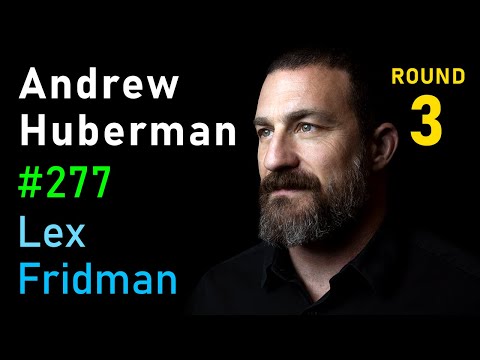
Andrew Huberman: Focus, Stress, Relationships, and Friendship | Lex Fridman Podcast #277
Andrew Huberman (guest), Lex Fridman (host), Narrator, Narrator
In this episode of Lex Fridman Podcast, featuring Andrew Huberman and Lex Fridman, Andrew Huberman: Focus, Stress, Relationships, and Friendship | Lex Fridman Podcast #277 explores huberman and Fridman Explore Focus, Heat, Love, Sex, and Suffering Lex Fridman and Andrew Huberman have a long-form, wide‑ranging conversation that weaves together neuroscience, health protocols, and the psychology of relationships, sex, and friendship.
Huberman and Fridman Explore Focus, Heat, Love, Sex, and Suffering
Lex Fridman and Andrew Huberman have a long-form, wide‑ranging conversation that weaves together neuroscience, health protocols, and the psychology of relationships, sex, and friendship.
They dig into practical tools for focus, stress management, sauna and cold exposure, strength and endurance training, hypnosis, and non‑sleep deep rest (NSDR), always tying back to underlying brain and body mechanisms.
The discussion also ventures into darker human psychology—narcissism, sociopathy, and controversial figures—along with the ethics and difficulty of interviewing “evil” or widely hated people.
Throughout, they reflect on love, attachment, family dinners, the craft of podcasting, and what it takes to build authentic relationships and a meaningful life in a noisy, high‑pressure world.
Key Takeaways
Use heat regularly; time cold carefully if you want adaptation.
Huberman cites Finnish sauna data showing 30 minutes of sauna 2–3 times/week reduces cardiovascular death risk ~27%, and 4+ times/week by ~50%. ...
Get the full analysis with uListen AI
Train focus via vision, environment, and short state‑priming rituals.
Mental focus follows visual focus: narrow your visual aperture (like portrait mode) for 30–60 seconds before work, place screens at or slightly above eye level, and use compact, low‑ceiling spaces for analytic tasks. ...
Get the full analysis with uListen AI
NSDR and self‑hypnosis are powerful, low‑cost tools for recovery and stress.
Non‑sleep deep rest (NSDR) protocols and guided self‑hypnosis (e. ...
Get the full analysis with uListen AI
Structure training around clear goals: strength, size, or endurance.
For strength, Huberman relays Andy Galpin’s “3×5” rule: 3–5 compound exercises, 3–5 sets of 3–5 reps, 3–5 minutes rest, 3–5 days/week, staying shy of failure. ...
Get the full analysis with uListen AI
Stress can enhance performance if you change what you believe about it.
Drawing on Alia Crum’s work, Huberman notes that people perform better when they view stress hormones as sharpening tools rather than damaging forces. ...
Get the full analysis with uListen AI
Attachment patterns from childhood echo into adult love and sex.
They discuss psychoanalytic and attachment models showing that early relationships with caregivers often reappear in adult romantic dynamics—sometimes with genders and roles swapped—affecting jealousy, dependency, fantasy, and how we handle breakups. ...
Get the full analysis with uListen AI
Authenticity and community matter more than hoarding credit or perfection.
Huberman emphasizes generous attribution in science and media, arguing that citing others’ work elevates everyone and combats the competitive scarcity mindset. ...
Get the full analysis with uListen AI
Notable Quotes
“You have to do the work to do the work.”
— Andrew Huberman
“Mental focus follows visual focus.”
— Andrew Huberman
“If you’re going to be a lover, prepare to be both warrior and explorer.”
— Andrew Huberman (paraphrasing a saying)
“You treat kids like morons and they’re going to behave like morons.”
— Andrew Huberman
“What do you want your day to look like? Ultimately, a relationship is going to be part of your daily routine.”
— Andrew Huberman
Questions Answered in This Episode
How can a non‑scientist safely design a weekly protocol that combines strength, hypertrophy, endurance, sauna, and cold exposure without overtraining or blunting adaptations?
Lex Fridman and Andrew Huberman have a long-form, wide‑ranging conversation that weaves together neuroscience, health protocols, and the psychology of relationships, sex, and friendship.
Get the full analysis with uListen AI
What are practical first steps for someone who’s skeptical of meditation but curious about NSDR and hypnosis to manage anxiety or sleep issues?
They dig into practical tools for focus, stress management, sauna and cold exposure, strength and endurance training, hypnosis, and non‑sleep deep rest (NSDR), always tying back to underlying brain and body mechanisms.
Get the full analysis with uListen AI
How can people begin to recognize and change destructive attachment patterns that repeat from childhood into their adult romantic relationships?
The discussion also ventures into darker human psychology—narcissism, sociopathy, and controversial figures—along with the ethics and difficulty of interviewing “evil” or widely hated people.
Get the full analysis with uListen AI
What ethical boundaries should interviewers draw when speaking with controversial or sociopathic figures, and how do you balance empathy with not amplifying harm?
Throughout, they reflect on love, attachment, family dinners, the craft of podcasting, and what it takes to build authentic relationships and a meaningful life in a noisy, high‑pressure world.
Get the full analysis with uListen AI
In an increasingly noisy digital world, how can individuals create environments—physical and social—that reliably put them into optimal states for deep work and genuine connection?
Get the full analysis with uListen AI
Transcript Preview
If you get into a sauna the way I just described, not the two hours a day, but 30 minutes twice a week or three times per week, you reduce the likelihood of dying of a cardiovascular event by 27%.
(exhales)
If you do it four or more times per week, you reduce the probability of dying by 50%.
Is there any scientific evidence that being naked is beneficial in the sauna?
Well, in certain contexts, it leads to, um, childbirth.
Okay. Well, I'll-
Uh...
... have to read up on that.
I think Dorothy Parker said, uh, "The cure for boredom is curiosity. There is no cure for curiosity."
The following is a conversation with Andrew Huberman. His third time on this podcast. He's a brilliant neuroscientist at Stanford University and the host of one of the best, the best if you ask me, health and science podcast in the world called Huberman Lab Podcast. Check him out on Instagram, Twitter, and YouTube. Most importantly, Andrew is a great human being and has quickly become a great friend. This is the Lex Fridman Podcast. To support it, please check out our sponsors in the description, and now, dear friends, here's to Andrew Huberman. We meet again, my friend. Uh, we should talk on each other's podcast once a year. I think we should make a deal. I was just talking to the guys at this show called Louis. I don't know if you know it. And...
Louis C.K.?
Yeah, with Louis C.K., and (laughs) there's this thing called bang bang, which people that are probably watching know exactly what I'm talking about. It's this worst possible thing you can do in terms of meals, which is you go to a restaurant, do a full meal, and then you go to another restaurant and do a full meal, and you pa-
Ugh.
You... (laughs) That's exactly...
It sounds brutal.
So they go Mexican, Italian, sushi, pizza, barbecue, IHOP, that, that one is disgusting. This kind of thing reminds me of the joy of food.
Last time we were hanging out, we went, we went to see Joe do comedy-
Yeah.
... and then we went to eat Russian food.
Yeah.
And it was a particularly fun experience to go to a Russian restaurant. I was the only-
Yeah.
... person there that didn't speak Russian.
Yeah.
And eat Russian food with you. And, um, 'cause I felt walking in, they, they trusted you. They didn't trust me.
Yeah. The funny thing about the, the people there, they were talking to you in Russian. (laughs) And then they refused to sort of, uh, switch to English even though they understood you speak no Russian. This is Russian House in Austin, by the way. Uh, anyway, what... Uh, by way of question, what's the worst or, or the best depending on your perspective cheap meal, let's call it a pigging out meal, but it could be a cheap meal, uh, that you've ever had or you want to have that's like on the bucket list or something that's in the past? Like, where you did the, something like a bang bang, which is like, you're, you're talking about multiple thousands of calories that you just feel horrible about yourself, but you still keep eating 'cause it's delicious, but also great company. Something about the atmosphere is just right. Screw the diet, screw all the things, you know, just like you should be doing, but just throw it all out the window.
Install uListen to search the full transcript and get AI-powered insights
Get Full TranscriptGet more from every podcast
AI summaries, searchable transcripts, and fact-checking. Free forever.
Add to Chrome