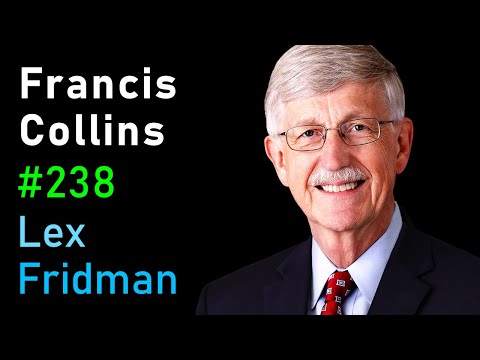
Francis Collins: National Institutes of Health (NIH) | Lex Fridman Podcast #238
Lex Fridman (host), Francis Collins (guest)
In this episode of Lex Fridman Podcast, featuring Lex Fridman and Francis Collins, Francis Collins: National Institutes of Health (NIH) | Lex Fridman Podcast #238 explores francis Collins on COVID, trust in science, faith, and ethics Francis Collins, former NIH Director and leader of the Human Genome Project, discusses COVID-19’s origins, gain-of-function research, vaccine hesitancy, and the broader erosion of trust in science. He explains how scientific uncertainty, political polarization, and disinformation have shaped public discourse around the pandemic, masks, vaccines, and figures like Anthony Fauci and Joe Rogan. Collins also reflects on biosecurity risks, animal research ethics, rapid vaccine development, and large-scale scientific collaborations such as the BRAIN Initiative and ACTIV. The conversation closes with his integration of Christian faith and science, thoughts on mortality and legacy, and his view of life’s meaning as rooted in love, humility, and service.
Francis Collins on COVID, trust in science, faith, and ethics
Francis Collins, former NIH Director and leader of the Human Genome Project, discusses COVID-19’s origins, gain-of-function research, vaccine hesitancy, and the broader erosion of trust in science. He explains how scientific uncertainty, political polarization, and disinformation have shaped public discourse around the pandemic, masks, vaccines, and figures like Anthony Fauci and Joe Rogan. Collins also reflects on biosecurity risks, animal research ethics, rapid vaccine development, and large-scale scientific collaborations such as the BRAIN Initiative and ACTIV. The conversation closes with his integration of Christian faith and science, thoughts on mortality and legacy, and his view of life’s meaning as rooted in love, humility, and service.
Key Takeaways
COVID-19’s origin remains uncertain, but natural spillover is currently more likely than a lab leak.
Collins cannot rule out a lab leak, but emphasizes that available genomic evidence and historical precedent point toward a bat-origin virus possibly passing through an intermediate host, with past examples (SARS, MERS) taking years to fully trace.
Get the full analysis with uListen AI
“Gain-of-function” is a broad scientific term, but only a narrow, high-risk subset is stringently regulated.
Most gain-of-function experiments (like enhancing immune cells to fight cancer) are beneficial; only work that enhances known human pandemic pathogens (EPPP) is subject to strict federal review, and Collins argues the Wuhan-related bat virus work did not meet that threshold.
Get the full analysis with uListen AI
Pandemic-era politics have weaponized scientific ambiguity, eroding trust in scientists and institutions.
Collins describes attacks on Anthony Fauci and the reframing of evolving scientific guidance as “flip-flopping,” saying political actors exploit gray areas and changing data to discredit experts rather than engage honestly with uncertainty.
Get the full analysis with uListen AI
Combating misinformation requires both better data and more humility-driven communication.
He acknowledges widespread confusion and fear, especially around vaccines, and stresses listening first, avoiding condescension, and clearly explaining changing evidence—while criticizing actors who knowingly spread falsehoods for attention or gain.
Get the full analysis with uListen AI
Rapid vaccine development was enabled by decades of basic research and intensive public–private collaboration.
Platforms like mRNA, prior coronavirus work, and NIH-led partnerships (AMP, ACTIV) allowed vaccines to be designed in days and tested in months, with harmonized trial designs and large, coordinated efficacy studies that Collins calls one of science’s “finest hours.”
Get the full analysis with uListen AI
Widespread rapid at-home testing is a powerful but underutilized tool for controlling spread.
Collins strongly supports cheap, ubiquitous home tests, describes NIH’s RADx program and community pilots, and argues that frequent self-testing paired with personal responsibility can dramatically reduce transmission without heavy-handed mandates.
Get the full analysis with uListen AI
Collins sees science and Christian faith as complementary lenses on different kinds of questions.
He became a believer in his 20s, views the genome as an “instruction book” once known only to God, maintains close friendships with outspoken atheists like Christopher Hitchens, and frames life’s meaning as loving others, pursuing holiness, and accepting our finite “blink of an eye” with humility.
Get the full analysis with uListen AI
Notable Quotes
“Science at its best is a source of hope.”
— Lex Fridman
“I can't exclude [a lab leak]. I think it's fairly unlikely.”
— Francis Collins
“If somebody decided…that we just shouldn't be doing these experiments under any circumstances…that would be the conclusion. But it hasn't been so far.”
— Francis Collins
“We have another epidemic besides COVID-19, and it's an epidemic of the loss of the anchor of truth.”
— Francis Collins
“These vaccines are both an amazing scientific achievement and an answer to prayer.”
— Francis Collins
Questions Answered in This Episode
How should policymakers balance the scientific benefits of high-risk pathogen research against the small but nonzero chance of catastrophic accidents or misuse?
Francis Collins, former NIH Director and leader of the Human Genome Project, discusses COVID-19’s origins, gain-of-function research, vaccine hesitancy, and the broader erosion of trust in science. ...
Get the full analysis with uListen AI
What practical strategies could rebuild public trust in health institutions among groups that feel alienated or misled after the pandemic?
Get the full analysis with uListen AI
At what point, if ever, should society decide that certain lines of biological research (e.g., some gain-of-function work) are simply off-limits?
Get the full analysis with uListen AI
How can scientists maintain intellectual humility and openness to criticism while still providing clear, decisive public guidance during crises?
Get the full analysis with uListen AI
In what ways might large-scale public–private collaborations like the BRAIN Initiative and ACTIV change how we handle future pandemics and other global health threats?
Get the full analysis with uListen AI
Transcript Preview
The following is a conversation with Francis Collins, Director of the NIH, the National Institutes of Health, appointed and reappointed to the role by three presidents: Obama, Trump, and Biden. He oversees 27 separate institutes and centers, including NIAD, which makes him Anthony Fauci's boss. At the NIH, Francis helped launch and led a huge number of projects that pushed the frontiers of science, health, and medicine, including one of my favorites, the BRAIN Initiative, that seeks to map the human brain and understand how the function arises from the neural circuitry. Before the NIH, Francis led the Human Genome Project, one of the largest and most ambitious efforts in the history of science. Given all that, Francis is a humble, thoughtful, kind man. And because of this, to me, he's one of the best representatives of science in the world. He's a man of God, and yet, also a friend of the late Christopher Hitchens, who called him, quote, "One of the greatest living Americans." This is a Lex Fridman podcast. To support it, please check out our sponsors in the description, and now, here's my conversation with Francis Collins. Science at its best is a source of hope, so for me, it's been difficult to watch, as it has during the pandemic, become at times a source of division. What I would love to do in this conversation with you is touch some difficult topics, and do so with empathy and humility, so that we may begin to regain a sense of trust in science, and that it may once again become a source of hope. I hope that's okay with you?
I love the goal.
(laughs) Let's start with some hard questions. You called for, quote, "Thorough, expert-driven, and objective inquiry into the origins of COVID-19." So let me ask, is there a reasonable chance that COVID-19 leaked from a lab?
I can't exclude that. (sighs) I think it's fairly unlikely. I wish we had more ability to be able to ask questions of the Chinese government and learn more about what kind of records might have been in the lab that we've never been able to see. But most likely, this was a natural origin of a virus, probably starting in a bat, perhaps traveling through some other intermediate, yet-to-be-identified host, and finding its way into humans.
Is answering this question within the realm of science, do you think? Will we ever know?
I think we might know if we find that intermediate host, um, and there has not yet been a thorough enough investigation to say that that's not going to happen. Remember, it takes a while to do this. Uh, with SARS it was 14 years before we figured out it was the civet cat that was the intermediate host. With MERS, it was a little quicker to discover, it was the camel. With SARS-CoV-2, there's been some looking, but especially now, with everything really tense between the US and China, if there's looking going on, we're not getting told about it.
Install uListen to search the full transcript and get AI-powered insights
Get Full TranscriptGet more from every podcast
AI summaries, searchable transcripts, and fact-checking. Free forever.
Add to Chrome