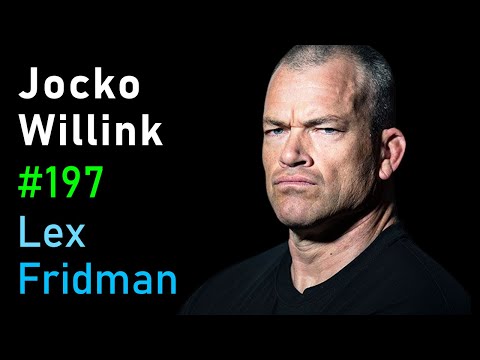
Jocko Willink: War, Leadership, and Discipline | Lex Fridman Podcast #197
Lex Fridman (host), Jocko Willink (guest)
In this episode of Lex Fridman Podcast, featuring Lex Fridman and Jocko Willink, Jocko Willink: War, Leadership, and Discipline | Lex Fridman Podcast #197 explores jocko Willink on war’s horrors, unbreakable bonds, and disciplined leadership Lex Fridman and Jocko Willink explore the paradoxes of war, from the tragic scale of civilian suffering to the profound bonds forged in combat. They dig into World War II strategy and attrition warfare, the ethics of modern conflict, and how leaders should own mistakes that cost human lives. The conversation then shifts to personal domains: the psychology of killing, love of country, autonomous weapons and AI risk, and what makes a good leader in war, business, and life. Jocko closes by detailing his philosophy of discipline, the central role of humility, and how Brazilian jiu-jitsu became the connective tissue linking his thinking on combat, leadership, and human behavior.
Jocko Willink on war’s horrors, unbreakable bonds, and disciplined leadership
Lex Fridman and Jocko Willink explore the paradoxes of war, from the tragic scale of civilian suffering to the profound bonds forged in combat. They dig into World War II strategy and attrition warfare, the ethics of modern conflict, and how leaders should own mistakes that cost human lives. The conversation then shifts to personal domains: the psychology of killing, love of country, autonomous weapons and AI risk, and what makes a good leader in war, business, and life. Jocko closes by detailing his philosophy of discipline, the central role of humility, and how Brazilian jiu-jitsu became the connective tissue linking his thinking on combat, leadership, and human behavior.
Key Takeaways
Shared suffering is a powerful, if tragic, engine of human bonding.
Jocko explains that boot camp, elite training, and especially combat create intense bonds because survival depends on mutual trust and reliance; World War II’s mass civilian and military suffering left a similar shared thread across entire nations.
Get the full analysis with uListen AI
Total war and attrition warfare demand brutal, conscious trade-offs.
Discussing the Soviet Union versus Nazi Germany, Jocko frames Stalin’s “throwing bodies” tactics as attrition warfare in an existential fight—awful but strategically coherent when the choice is “die now fighting or die later on your knees.”
Get the full analysis with uListen AI
Before going to war, leaders must fully face civilian and troop deaths.
Jocko argues leaders often underestimate casualties; any decision to go to war must start with the clear understanding that women, children, civilians, and one’s own troops will die, regardless of precision weapons or discipline.
Get the full analysis with uListen AI
Leadership failure is less about mistakes than denial and ego.
He notes that leaders will inevitably make errors in war, but the unforgivable failure is refusing to admit mistakes, update strategy, and publicly own the consequences, which compounds loss of life.
Get the full analysis with uListen AI
Humility is the core trait of effective leaders and high performers.
Across military and business examples, Jocko insists that confidence without humility leads to ego-driven decisions, poor teamwork, and brittle organizations; humble people self-critique, learn fast, and are easy to coach.
Get the full analysis with uListen AI
Discipline is doing what you’re supposed to do—especially when you don’t feel like it.
Jocko’s daily routine (waking around 4 a. ...
Get the full analysis with uListen AI
Jiu-jitsu is a laboratory for leadership, strategy, and managing ego.
He describes jiu-jitsu as what connected his thinking across combat, human interaction, and tactics: you don’t attack strength directly, you control ego through constant humbling, and you learn to relax under pressure while still acting decisively.
Get the full analysis with uListen AI
Notable Quotes
“The absolute best times of my life were in combat and the worst times of my life were in combat.”
— Jocko Willink
“When you go into a war, civilians are going to die, and you have to understand that.”
— Jocko Willink
“Leaders are going to make mistakes. It’s impossible to know what’s gonna happen in war. If you fail to admit that you made a mistake, that’s where I have a more significant problem.”
— Jocko Willink
“The normal answer that I give, you asked me, ‘What makes a good leader? What makes a good person?’ is being humble.”
— Jocko Willink
“Write down what you’re supposed to do, wake up early, and start doing it.”
— Jocko Willink
Questions Answered in This Episode
How should modern democracies decide when a war is truly ‘just’ given the inevitability of civilian casualties and incomplete information?
Lex Fridman and Jocko Willink explore the paradoxes of war, from the tragic scale of civilian suffering to the profound bonds forged in combat. ...
Get the full analysis with uListen AI
Can large-scale, cross-national bonds and cultural depth be forged without the catalyst of war and shared trauma, or is some form of collective struggle necessary?
Get the full analysis with uListen AI
Where should we draw ethical red lines for AI and autonomous weapons, and who should have the authority to enforce them globally?
Get the full analysis with uListen AI
In high-stakes environments, how can leaders cultivate humility and ownership without losing the decisiveness needed in crises?
Get the full analysis with uListen AI
Is there a healthy way for individuals to seek the growth that comes from struggle and danger—like combat or extreme competition—without the catastrophic risks of war?
Get the full analysis with uListen AI
Transcript Preview
The following is a conversation with Jocko Willink, a retired US Navy SEAL, co-author of Extreme Ownership, Dichotomy of Leadership, Discipline Equals Freedom, and many other excellent books. And he's the host of Jocko podcast. Jocko spent 20 years in the SEAL teams. He was the commander of SEAL Team Three's task unit bruiser that became the most highly decorated special operations unit of the Iraq War. This conversation was intense and to the point. We agreed to talk again, probably many times, and what I find very interesting, aside from the talk of leadership, is the conversation about military tactics of specific battles in history. Quick mention of our sponsors: Linode, Indeed, SimpliSafe, and Ground News. Check them out in the description to support this podcast. Since it's the Fourth of July, a holiday in the United States, let me say a few words about what this country, my country, the United States of America means to me. First, by way of background, I was born and raised in the Soviet Union, just long enough to get a bit of the Russian soul, an appreciation of Soviet history, music, culture, of wrestling and mathematics, of engineering and philosophy, Stoicism and humor, tragedies and triumphs of war and revolutions, all in ways that are uniquely Russian. I do happen to, at times, mention that I'm Russian. This is what I mean, that I got a bit of that Russian soul. But, of course, who I really am is an American. This country gave me the opportunity, the freedom to become and to be who I am, to stand as an individual. This seemingly simple freedom to be a sovereign human being in the face of all the beauty and cruelty of life is why I love this country. Much of life can be unfair, unjust, even tragic, but this is the country where if I'm clever enough, work hard enough, and just get lucky enough, I have a chance to dream big and make my dream a reality. The United States welcomed me, my family, and millions of immigrants throughout its history so that we can make something meaningful of ourselves, to love, to dream, to create, to find joy and meaning. It lets me be the weird kid I am, who wears a suit, talks about love, and has a fascination with robots. I know some people these days have an aversion to pride and love for their country. I don't. I love America. I also love humanity. I believe these two, patriotism and humanism, are not in conflict, much like loving your family and loving your country are not in conflict. They are all manifestations of the human spirit, longing to strive for a better world. I was born a Russian, but I believe I will die an American, a proud American. Hopefully not too soon, but, uh, life is short. I already had one hell of a fun journey, so I'm ready to go when it's time. This is the Lex Fridman podcast, and here is my conversation with Jocko Willink. Is it tragic or beautiful to you that some of the closest bonds that are formed between people are through war often?
Install uListen to search the full transcript and get AI-powered insights
Get Full TranscriptGet more from every podcast
AI summaries, searchable transcripts, and fact-checking. Free forever.
Add to Chrome