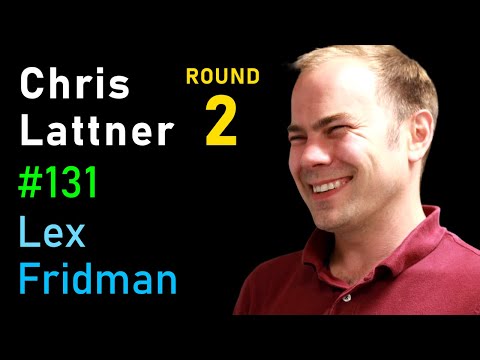
Chris Lattner: The Future of Computing and Programming Languages | Lex Fridman Podcast #131
Lex Fridman (host), Chris Lattner (guest), Narrator, Narrator, Lex Fridman (host)
In this episode of Lex Fridman Podcast, featuring Lex Fridman and Chris Lattner, Chris Lattner: The Future of Computing and Programming Languages | Lex Fridman Podcast #131 explores chris Lattner on future chips, Swift, and human-centered computing design Chris Lattner and Lex Fridman discuss leadership lessons from figures like Steve Jobs, Elon Musk, and Jeff Dean, emphasizing technical depth, vision, and humility. They dive deeply into programming language design, using Swift, Python, and Lisp to explore trade-offs in safety, performance, usability, and community-driven evolution. Lattner explains his work on LLVM, MLIR, RISC‑V, and SiFive, outlining how better compiler and silicon tooling could unleash a wave of specialized chips and new computation models. The conversation widens to machine learning paradigms, GPT‑3, Software 2.0, concurrency, and broader themes of human motivation, societal upheaval, and long‑term optimism about technology and humanity.
Chris Lattner on future chips, Swift, and human-centered computing design
Chris Lattner and Lex Fridman discuss leadership lessons from figures like Steve Jobs, Elon Musk, and Jeff Dean, emphasizing technical depth, vision, and humility. They dive deeply into programming language design, using Swift, Python, and Lisp to explore trade-offs in safety, performance, usability, and community-driven evolution. Lattner explains his work on LLVM, MLIR, RISC‑V, and SiFive, outlining how better compiler and silicon tooling could unleash a wave of specialized chips and new computation models. The conversation widens to machine learning paradigms, GPT‑3, Software 2.0, concurrency, and broader themes of human motivation, societal upheaval, and long‑term optimism about technology and humanity.
Key Takeaways
Deep technical competence is essential for effective technical leadership.
Lattner argues that leaders like Jobs, Musk, and Dean succeed because they truly understand the product, tech, and mission, which lets them push hard, prioritize correctly, and earn engineers’ trust.
Get the full analysis with uListen AI
Programming languages are user interfaces for human minds, not just machines.
He frames language design as UI/UX design: syntax, defaults, and tools should minimize boilerplate and bugs while maximizing clarity and joy, with Swift’s ‘progressive disclosure of complexity’ as a core example.
Get the full analysis with uListen AI
Value semantics can dramatically reduce bugs and improve performance.
Swift’s default to value semantics (plus copy‑on‑write) avoids many aliasing and mutation bugs common in Python/Java‑style reference semantics, while still enabling efficient in‑place updates under the hood.
Get the full analysis with uListen AI
Great languages empower great libraries rather than hard‑coding special cases.
Lattner sees it as “beautiful” when built‑ins like `int` and arrays are just library types; giving users the same expressive power as the standard library enables domain experts to build native‑feeling abstractions.
Get the full analysis with uListen AI
Better compiler infrastructure can unlock a new wave of custom hardware.
With MLIR and RISC‑V, Lattner expects easier, cheaper ASIC and accelerator development, making domain‑specific chips (for ML, IoT, etc. ...
Get the full analysis with uListen AI
Concurrency models must balance safety, predictability, and explicit control.
Swift’s actor and async/await vision aims to make safe, mostly race‑free concurrency the default while still giving developers explicit control, avoiding “magic” auto‑parallelization that produces unpredictable performance cliffs.
Get the full analysis with uListen AI
Machine learning is a new programming paradigm, not a full replacement.
Lattner agrees ML (Software 2. ...
Get the full analysis with uListen AI
Notable Quotes
“A programming language is a bicycle for the mind.”
— Chris Lattner
“So much of language design is about trade‑offs, and you can't see those trade‑offs unless you have a community of people that really represent those different points.”
— Chris Lattner
“A major part of leadership is actually, it's not about having the right answer, it's about getting the right answer.”
— Chris Lattner
“If you don't model at least the most important inherent complexity in the language, that complexity gets pushed elsewhere, and often you just get kind of a mess.”
— Chris Lattner
“Real value comes from doing things that are hard.”
— Chris Lattner
Questions Answered in This Episode
How far can value semantics and actors realistically scale before performance or complexity forces programmers back into unsafe constructs?
Chris Lattner and Lex Fridman discuss leadership lessons from figures like Steve Jobs, Elon Musk, and Jeff Dean, emphasizing technical depth, vision, and humility. ...
Get the full analysis with uListen AI
In what concrete ways could MLIR and RISC‑V together change who is able to design and ship custom silicon, and for which new applications?
Get the full analysis with uListen AI
What would a truly unified programming model look like that spans CPUs, GPUs, ASICs, and distributed systems without fracturing into separate toolchains like CUDA?
Get the full analysis with uListen AI
How might large language models like GPT‑3 practically assist with real‑world software engineering tasks without sacrificing correctness and maintainability?
Get the full analysis with uListen AI
Given the societal instability discussed, what responsibilities do compiler and language designers have when their tools can greatly amplify or reduce human suffering?
Get the full analysis with uListen AI
Transcript Preview
The following is a conversation with Chris Lattner, his second time on the podcast. He's one of the most brilliant engineers in modern computing, having created LLVM Compiler Infrastructure project, the Clang compiler, the Swift programming language, a lot of key contributions to TensorFlow and TPUs as part of Google. He's served as vice president of Autopilot Software at Tesla, was a software innovator and leader at Apple, and now is at SiFive as senior vice president of platform engineering, looking to revolutionize chip design to make it faster, better, and cheaper. Quick mention of each sponsor, followed by some thoughts related to the episode. First sponsor is Blinkist, an app that summarizes key ideas from thousands of books. I use it almost every day to learn new things or to pick which books I want to read or listen to next. Second is Neuro, the maker of functional sugar-free gum and mints that I use to supercharge my mind with caffeine, L-theanine, and B vitamins. Third is MasterClass, online courses from the best people in the world on each of the topics covered, from rockets to game design, to poker, to writing, and to guitar. And finally, Cash App, the app I use to send money to friends for food, drinks, and unfortunately lost bets. Please check out the sponsors in the description to get a discount and to support this podcast. As a side note, let me say that Chris has been an inspiration to me on a human level because he is so damn good as an engineer and leader of engineers, and yet he's able to stay humble, especially humble enough to hear the voices of disagreement and to learn from them. He was supportive of me and this podcast from the early days. And for that, I'm forever grateful. To be honest, most of my life, no one really believed that I would amount to much. So when another human being looks at me and makes me feel like I might be someone special, it can be truly inspiring. That's a lesson for educators. The weird kid in the corner with a dream is someone who might need your love and support in order for that dream to flourish. If you enjoy this thing, subscribe on YouTube, review it with five stars on Apple Podcast, follow on Spotify, support on Patreon, or connect with me on Twitter, @lexfridman. And now, here's my conversation with Chris Lattner. What are the strongest qualities of Steve Jobs, Elon Musk, and the great and powerful Jeff Dean since you've gotten the chance to work with each?
(laughs) You're starting with an easy question there. Um, these are three very different people. I guess you could do maybe a pairwise comparison between them instead of a group comparison.
(laughs) Yeah.
So if you look at Steve Jobs and Elon, um, I worked a lot more with Elon than I did with Steve. Um, they have a lot of commonality. They're both, um, visionary in their own way. They're both very demanding in their own way. Um, my sense is Steve is much more human factor focused, where Elon is more technology focused.
Install uListen to search the full transcript and get AI-powered insights
Get Full TranscriptGet more from every podcast
AI summaries, searchable transcripts, and fact-checking. Free forever.
Add to Chrome