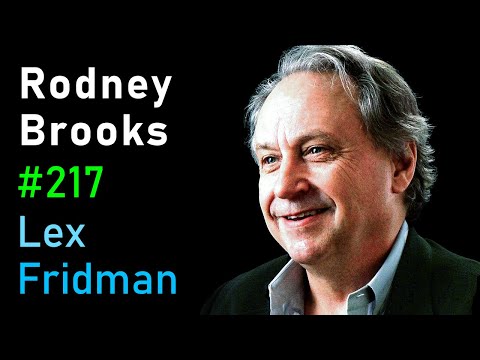
Rodney Brooks: Robotics | Lex Fridman Podcast #217
Lex Fridman (host), Rodney Brooks (guest), Narrator, Narrator, Narrator
In this episode of Lex Fridman Podcast, featuring Lex Fridman and Rodney Brooks, Rodney Brooks: Robotics | Lex Fridman Podcast #217 explores rodney Brooks challenges AI hype, defends hard-earned, real-world robotics Rodney Brooks reflects on a lifetime in robotics, from early homebrew 'brains' and MIT leadership to founding iRobot, Rethink Robotics, and Robust.AI, emphasizing how hard real-world perception and manipulation truly are. He critiques the dominance of the Turing-style computation metaphor and argues current AI—especially deep learning—solves narrow labeling and game-playing problems, not grounded, embodied intelligence. Brooks is skeptical about near-term fully autonomous driving and human-level AI, stressing our tendency to overgeneralize from demos and underestimate engineering, infrastructure, and edge cases. He also discusses the messy realities of building robotics businesses, the importance of human-robot interaction, and his hope that future thinkers will escape current conceptual traps around computation and intelligence.
Rodney Brooks challenges AI hype, defends hard-earned, real-world robotics
Rodney Brooks reflects on a lifetime in robotics, from early homebrew 'brains' and MIT leadership to founding iRobot, Rethink Robotics, and Robust.AI, emphasizing how hard real-world perception and manipulation truly are. He critiques the dominance of the Turing-style computation metaphor and argues current AI—especially deep learning—solves narrow labeling and game-playing problems, not grounded, embodied intelligence. Brooks is skeptical about near-term fully autonomous driving and human-level AI, stressing our tendency to overgeneralize from demos and underestimate engineering, infrastructure, and edge cases. He also discusses the messy realities of building robotics businesses, the importance of human-robot interaction, and his hope that future thinkers will escape current conceptual traps around computation and intelligence.
Key Takeaways
Embodied perception and manipulation are far harder than abstract reasoning tasks.
Brooks emphasizes Moravec’s paradox: evolution spent hundreds of millions of years on sensorimotor skills, so what looks ‘easy’ (vision, movement, everyday manipulation) is actually vastly harder than chess or Go. ...
Get the full analysis with uListen AI
‘Computation’ is a narrow historical construct that we overextend to minds and nature.
Tracing from Napier and Kepler to Turing and Knuth, Brooks argues that what we call computation is a human-invented model—optimized to what people with paper could do and what silicon can implement—not a fundamental property of the universe. ...
Get the full analysis with uListen AI
Deep learning successes are impressive but do not imply we’re close to general intelligence.
Brooks finds ImageNet gains, AlphaGo, and especially AlphaFold surprising and valuable, but stresses they work in tightly constrained domains with full information and short state descriptions. ...
Get the full analysis with uListen AI
Autonomous driving’s hardest problems are edge cases, infrastructure, and human expectations.
He notes autonomous cars have driven highways since the 1980s and demos are not new; what’s unsolved is robust behavior in messy urban environments, rare scenarios, and socially acceptable failure rates. ...
Get the full analysis with uListen AI
Product success in robotics depends at least as much on economics and expectations as on algorithms.
iRobot’s Roomba succeeded by hitting a $200 price point and solving a clear consumer problem; many other home robots failed despite technical sophistication. ...
Get the full analysis with uListen AI
Human-robot interaction design—signals of intent, expressivity, and not overpromising—is crucial.
Brooks insists robot appearance is a ‘promise’ about capability: a robot that looks like Einstein should be Einstein-level smart. ...
Get the full analysis with uListen AI
Ambitious optimism is vital, but hype and ungrounded timelines distort the field and public trust.
He respects ambitious entrepreneurs like Musk and applauds space efforts, yet criticizes overconfident near-term timelines for full self-driving or human-level AI. ...
Get the full analysis with uListen AI
Notable Quotes
“If your robot looks like Albert Einstein, it should be as smart as Albert Einstein.”
— Rodney Brooks
“Certainly machines can think because I believe you're a machine and I'm a machine and I believe we both think. The question is: do we have a clue how to build such machines?”
— Rodney Brooks
“We tend to think a baby seeing the world is easy and playing chess is hard. Evolution spent hundreds of millions of years on perception and movement, and hardly any time on chess.”
— Rodney Brooks
“Each of these deep learning successes is a hard‑fought battle for the next step. People see the demo and say, ‘We must be almost there.’ We’ve been saying that for 35 years.”
— Rodney Brooks
“There’s no way to make all safe decisions and actually really contribute. If you want real impact, you have to be ready to fail a lot of times.”
— Rodney Brooks
Questions Answered in This Episode
If computation as defined by Turing is an inadequate metaphor for minds, what alternative conceptual frameworks should AI researchers explore for modeling intelligence?
Rodney Brooks reflects on a lifetime in robotics, from early homebrew 'brains' and MIT leadership to founding iRobot, Rethink Robotics, and Robust. ...
Get the full analysis with uListen AI
What concrete research program would Brooks design today to tackle grounded common sense and symbol grounding in robots, beyond current deep learning approaches?
Get the full analysis with uListen AI
How should regulators and industry jointly set acceptable risk and failure thresholds for autonomous vehicles, given the stark asymmetry in how society views human versus machine error?
Get the full analysis with uListen AI
What lessons from the commercial trajectory of iRobot and Rethink Robotics should future founders internalize when deciding product scope, pricing, and target markets in robotics?
Get the full analysis with uListen AI
How might widespread social robots in homes and elder care need to behave—emotionally, ethically, and physically—to form genuine long-term relationships without deceiving users about their capabilities?
Get the full analysis with uListen AI
Transcript Preview
The following is a conversation with Rodney Brooks, one of the greatest roboticists in history. He led the Computer Science and Artificial Intelligence Laboratory at MIT, then co-founded iRobot, which is one of the most successful robotics companies ever. Then, he co-founded Rethink Robotics that created some amazing collaborative robots, like Baxter and Sawyer. Finally, he co-founded Robust.AI, whose mission is to teach robots common sense, which is a lot harder than it sounds. To support this podcast, please check out our sponsors in the description. As a side note, let me say that Rodney is someone I've looked up to for many years in my now over two decade journey in robotics because, one, he's a legit great engineer of real world systems, and two, he's not afraid to state controversial opinions that challenge the way we see the AI world. But of course, while I agree with him on some of his critical views of AI, I don't agree with some others, and he's fully supportive of such disagreement. Nobody ever built anything great by being fully agreeable. There's always respect and love behind our interactions, and when a conversation is recorded like it was for this podcast, I think a little bit of disagreement is fun. This is the Lex Fridman Podcast, and here is my conversation with Rodney Brooks. What is the most amazing or beautiful robot that you've ever had the chance to work with?
I think it was DOMO, um, which was made by one of my grad students, Aaron Edsinger. It now sits in, uh, Daniela Rus' office, uh, director of CSAIL, and it was just a beautiful robot. And Aaron was really clever. He didn't give me a budget ahead of time. He didn't tell me what he was gonna do. He just started spending money.
(laughs)
He spent a lot of money.
Yeah.
He and Jeff Weber, who, um, is a mechanical engineer, who Aaron insisted he bring with him when he became a grad student-
Mm-hmm.
... built this beautiful, gorgeous robot, DOMO, which is a to- upper torso, humanoid, two, two arms, uh, uh-
With fingers?
... three-fingered hands-
Mm.
... um, uh, and, um, a face, eyeballs, um, all, uh, not the, not the eyeballs, but everything else, series elastic actuators, uh, you can interact with it, um, cable driven, all the motors are inside, and it's just gorgeous.
The eyeballs are actuated too or no?
Oh yeah, the eyeballs are actuated with cameras, and, you know, so it had a visual attention mechanism, you know-
Wow.
... looking when people came in and looking at their face and talking with them. Yeah.
Why was it amazing?
The beauty of it. You said bea- but you said what was the most beau-
I said beauty. What is the most beautiful?
It's just mechanically gorgeous, as, as everything Aaron builds has always been mechanically gorgeous. It's just exquisite in the detail.
Install uListen to search the full transcript and get AI-powered insights
Get Full TranscriptGet more from every podcast
AI summaries, searchable transcripts, and fact-checking. Free forever.
Add to Chrome