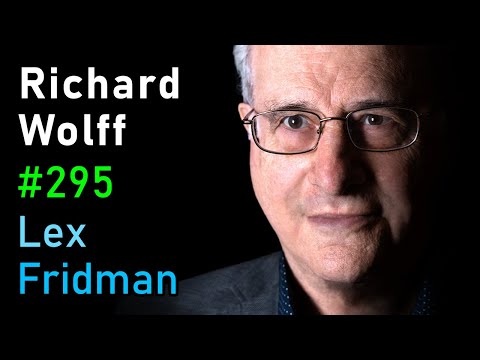
Richard Wolff: Marxism and Communism | Lex Fridman Podcast #295
Richard Wolff (guest), Lex Fridman (host), Lex Fridman (host), Narrator
In this episode of Lex Fridman Podcast, featuring Richard Wolff and Lex Fridman, Richard Wolff: Marxism and Communism | Lex Fridman Podcast #295 explores richard Wolff and Lex Fridman Debate Capitalism, Marxism, and Alternatives Lex Fridman interviews Marxist economist Richard Wolff about what Marxism actually is, separating Marx’s critique of capitalism from the 20th‑century regimes that claimed his legacy. Wolff defines exploitation as one class appropriating the surplus created by another and argues that both Soviet communism and Western capitalism preserved exploitative workplace structures, merely changing who holds power. They trace the historical evolution of Marxism, including the Russian and Chinese revolutions, social democracy, and today’s democratic socialism, while examining concepts like class struggle, central planning, markets, and human nature. Wolff advocates democratizing workplaces through worker cooperatives as the next stage beyond capitalism, and contends that current crises—inequality, political polarization, ecological destruction—show capitalism is historically exhausted but not yet replaced.
Richard Wolff and Lex Fridman Debate Capitalism, Marxism, and Alternatives
Lex Fridman interviews Marxist economist Richard Wolff about what Marxism actually is, separating Marx’s critique of capitalism from the 20th‑century regimes that claimed his legacy. Wolff defines exploitation as one class appropriating the surplus created by another and argues that both Soviet communism and Western capitalism preserved exploitative workplace structures, merely changing who holds power. They trace the historical evolution of Marxism, including the Russian and Chinese revolutions, social democracy, and today’s democratic socialism, while examining concepts like class struggle, central planning, markets, and human nature. Wolff advocates democratizing workplaces through worker cooperatives as the next stage beyond capitalism, and contends that current crises—inequality, political polarization, ecological destruction—show capitalism is historically exhausted but not yet replaced.
Key Takeaways
Marxism is primarily a systematic critique of capitalism, not a blueprint for Soviet‑style communism.
Wolff emphasizes that Marx mostly analyzed how capitalism works—especially exploitation in the workplace—and wrote very little concrete guidance about socialism or communism, so later regimes improvised their own models while claiming Marx.
Get the full analysis with uListen AI
Exploitation is defined by who controls and distributes the surplus, not by how harsh conditions look from the outside.
Across slavery, feudalism, and capitalism, one class produces more than it consumes and another class appropriates and allocates that surplus; for Marx, that structural relationship—workers vs. ...
Get the full analysis with uListen AI
Soviet and similar systems changed ownership of the state but largely preserved hierarchical, non‑democratic workplaces.
Wolff argues that replacing private capitalists with state officials without democratizing the enterprise meant exploitation persisted in a new form, undermining the emancipatory goals Marx had in mind.
Get the full analysis with uListen AI
Capitalism is technologically dynamic but morally and socially ambiguous.
While capitalism has driven massive innovation, Wolff maintains that the benefits are distributed through undemocratic decisions by owners, often costing workers jobs, security, and leisure that could have been shared if workers controlled the gains.
Get the full analysis with uListen AI
A core Marxist alternative is democratic worker control of enterprises, not just bigger government.
Wolff’s positive vision centers on worker cooperatives where employees collectively appropriate the surplus and vote on what to produce, how to use technology, and how to distribute income, aligning economic life with the democratic values societies profess.
Get the full analysis with uListen AI
Cold War taboos left most Americans with a caricatured understanding of Marxism and socialism.
Wolff notes that elite universities largely erased serious engagement with Marxist thought, so many Americans equate socialism with the post office or Soviet dogma, and use terms like ‘Marxist’ or ‘cultural Marxism’ mainly as insults rather than analytic categories.
Get the full analysis with uListen AI
Current crises suggest capitalism, like previous systems, has limits and will eventually be superseded.
Drawing on a historical perspective, Wolff sees rising inequality, political instability, and ecological breakdown as signs that capitalism, while once progressive over feudalism and slavery, is now historically “exhausted” and ripe for transition to more democratic economic forms.
Get the full analysis with uListen AI
Notable Quotes
“Slaves produce a surplus which the master gets. Serfs produce a surplus which the lord gets. Employees produce a surplus which the employer gets. It's very simple.”
— Richard Wolff
“The point was not who the exploiter is, but the exploitation per se.”
— Richard Wolff
“If you make a revolution, and all you do is remove the private exploiter and substitute a government official without changing the relationship, you can call yourself a Marxist all day long but you're not getting the point of the Marxism.”
— Richard Wolff
“The stunning contradiction [is] that there is a place in our society where democracy has never been allowed to enter: the workplace.”
— Richard Wolff
“Life is struggle… that network of struggles makes life interesting, intriguing, and satisfying.”
— Richard Wolff
Questions Answered in This Episode
If exploitation is structurally built into employer–employee relations, what concrete steps could realistically transition large corporations toward democratic worker control?
Lex Fridman interviews Marxist economist Richard Wolff about what Marxism actually is, separating Marx’s critique of capitalism from the 20th‑century regimes that claimed his legacy. ...
Get the full analysis with uListen AI
How can Marxist critiques of capitalism account for genuine human desires for hierarchy, leadership, and competition without simply dismissing them as ‘false consciousness’ or ideology?
Get the full analysis with uListen AI
To what extent did external hostility and isolation versus internal design flaws shape the failures and atrocities of the Soviet Union and other Marxist‑Leninist states?
Get the full analysis with uListen AI
Can capitalist innovation and technological dynamism be maintained—or even enhanced—within a system of worker cooperatives and democratic planning, and what evidence do we have either way?
Get the full analysis with uListen AI
Given the deep Cold War legacy in U.S. education and media, what would an honest, non‑propagandistic public conversation about Marxism and socialism look like today?
Get the full analysis with uListen AI
Transcript Preview
Slaves produce a surplus which the master gets. Serfs produce a surplus which the lord gets. Employees produce a surplus which the employer gets. It's very simple. These are exploitative class structures because one class produces a surplus appropriated, distributed by another group of people, n- not the ones who produced it, which creates hostility, enmity, envy, anger, resentment, and all of the problems you can lump under the heading class struggle.
The following is a conversation with Richard Wolff, one of the top Marxist economists and philosophers in the world. This is a heavy topic, in general, and for me personally, given my family history in the Soviet Union, in Russia, and in Ukraine. Today the words Marxism, socialism, and communism are used to attack and to divide much more than to understand and to learn. With this podcast I seek the latter. I believe we need to study the ideas of Karl Marx, as well as their various implementations throughout the 20th and the 21st centuries. And in general, we need to both steel man and to consider seriously the ideas we demonize, and to challenge the ideas we dogmatically accept as true, even when doing so is unpleasant and at times dangerous. This is the Lex Fridman Podcast. To support it please check out our sponsors in the description. And now, dear friends, here's Richard Wolff. Let's start with a basic question but maybe not so basic after all. What is Marxism? What are the defining characteristics of, uh, Marxism as an economic and political theory and ideology?
Well, the simplest way to begin a definition would be to say it's the tradition that takes its founding inspiration from the works of, uh, Karl Marx. Um, but because these ideas that he put forward spread as fast as they did and as globally as they did, literally it's, uh, 140 y- years since Marx died, and in that time his ideas have become major types of thinking in every country on the Earth. Um, if you know much about the great ideas of human history, um, that's an extraordinary spread in an extraordinarily short period of historical time. And what that has meant, that speed of spread and that geographic diversity, is that the Marxian ideas interacted with very different cultural histories, religious histories, and economic conditions. So the end result was that the ideas were interpreted differently in different places at different times. And therefore Marxism, as a kind of first flush definition, is the totality of all of these very different ways of coming to terms, uh, with it. For the first roughly 40, 50 years, um, Marxism was a tradition of thinking critically about capitalism. Marx himself, that's all he really did. He never wrote a book about communism. He never wrote a book really about socialism either. His comments were occasional, fragmentary, dispersed. What he was really interested in was a critical analysis of capitalism, and that's what Marxism was more or less in its first 40 or 50 years. Um, the only qualification of what I just said was something that happened in Paris for a few weeks. Uh, in 1871 there was a collapse of the French government, uh, consequent upon losing a war to Bismarck's Germany, and then the result was something called the Paris Commune. The working class of Paris rose up, basically took over the function of running the Parisian economy and the Parisian society. And Marx's people, people influenced by Marx, were very active, uh, in that commune, in the leadership of the commune, and Marx wasn't that far away. He was in, uh, London, uh, and these things were happening in Paris. You know, that's an easy transport even then. And for a short time, very short, Marxism had a different quality. In addition to being a critique of capitalism, it became a theory of how to organize societally differently. Before, that had only been implicit. Now it became explicit. What is the leadership of the Paris Commune going to do, and why, and in what order? And in other words, governing, organizing a society. But since it only lasted a few weeks, the French Army regrouped, uh, and under the leadership of people who were very opposed to M- Marx, they marched back into Paris, took over, killed a large number of the, of the Communards as they were called, and deported them to islands in the Pacific that the, that were part of the French Empire at the time. The really big change happens in Russia in 1917. Uh, now you have a group of Marxists, Lenin, Trotsky, all the rest, who...... are in this bizarre position to seize a moment. Once again, a war, like in France, uh, disorganizes the government, throws the government into a very bad reputation because it is the government that loses World War I, has to withdraw, as you know, uh, Brest-Litovsk and all of that, and the government collapses and the army revolts. And in that situation, a very small political party, Russian Social Democratic Workers Party, um, splits under the pressures of all of this, uh, into the Bolshevik and Menshevik divisions. Lenin, Trotsky, and the others are in the Bolshevik division. And to make a long story short, he's in exile. Uh, his position, uh, Lenin's position makes him, gets him deported because he says Russian workers should not be killing German workers. I mean, this is a war of capitalists who are dividing the world up into colonies and Russian working people have no... should not kill and should not die for such a thing. As you can expect, they arrest him and they throw him out. Interestingly, in the United States, the, the comparable leader at that time of the Socialist Party here, as you know, there was no Communist Party at this point, that comes later, um, the head of the Socialist Party, a very important American figure named Eugene Victor Debs, makes exactly the same argument to the... that Americans should not fight in the war. Uh, he's in the pa- he has nothing to do with Lenin. I don't even know if they knew each other. But, uh, he does it on his own. He gets arrested and put in jail here in the United States. By the way, he runs for president from jail and does very well. Really, very well. It's remarkable. Um, and he's the inspiration for Bernie Sanders, if you-
Install uListen to search the full transcript and get AI-powered insights
Get Full TranscriptGet more from every podcast
AI summaries, searchable transcripts, and fact-checking. Free forever.
Add to Chrome