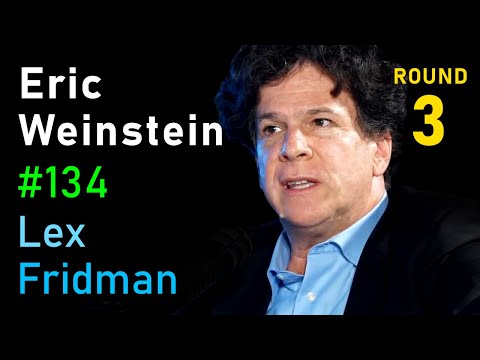
Eric Weinstein: On the Nature of Good and Evil, Genius and Madness | Lex Fridman Podcast #134
Lex Fridman (host), Eric Weinstein (guest), Guest (third voice, brief interjections) (guest)
In this episode of Lex Fridman Podcast, featuring Lex Fridman and Eric Weinstein, Eric Weinstein: On the Nature of Good and Evil, Genius and Madness | Lex Fridman Podcast #134 explores eric Weinstein and Lex Fridman Confront Genius, Despair, and Collapse Lex Fridman and Eric Weinstein range from music and mathematics to depression, suicide, and the fragility of modern civilization, using figures like Eddie Van Halen, Leonard Cohen, and Robin Williams as lenses on genius and pain.
Eric Weinstein and Lex Fridman Confront Genius, Despair, and Collapse
Lex Fridman and Eric Weinstein range from music and mathematics to depression, suicide, and the fragility of modern civilization, using figures like Eddie Van Halen, Leonard Cohen, and Robin Williams as lenses on genius and pain.
They argue that institutional decay, especially in science, politics, and media, is driving a “no-name revolution” where growth has stalled, gatekeepers suffocate innovation, and public discourse is policed by trolls, cancel culture, and corporate platforms.
Eric defends his temporary retreat from podcasting as strategic self‑preservation in an increasingly meta-violent information landscape, insisting that independent voices can be easily “garbage collected” by coordinated reputational attacks.
Throughout, they return to the tension between hope and cynicism: whether goodness, love, and authentic conversation can actually win against entrenched power, systemic cowardice, and what Eric suspects are real conspiracies exemplified by the Epstein scandal.
Key Takeaways
Genius often lives at the intersection of head, heart, and “loins.”
Eric describes artists like Eddie Van Halen and Leonard Cohen as uniquely powerful because they simultaneously grip our intellect, emotions, and sexuality; cultivating work that touches all three domains is a path to deep impact.
Get the full analysis with uListen AI
Innovation requires new orchards, not just more efficient fruit-picking.
Using his “orchard” metaphor, Eric argues the West exhausted its local ‘low-hanging fruit’ in physics, chemistry, and industry; instead of arguing about scarcity, we must explore entirely new domains (e. ...
Get the full analysis with uListen AI
Independent voices must treat reputational resilience as a strategic problem.
Eric warns that any prominent dissenter can be neutralized in a few “moves” via coordinated smears, deplatforming, or policy changes; creators should diversify platforms, anticipate attacks, and build communities that can withstand narrative manipulation.
Get the full analysis with uListen AI
Much of today’s online discourse is structurally hostile to earnestness.
They critique trolling, ironic detachment, and performative LOLs as habits that punish sincerity and reward cynicism; consciously choosing long-form, nuanced, face-to-face conversation is one way to re-normalize seriousness and depth.
Get the full analysis with uListen AI
Institutional cowardice enables systemic evil more than overt malice does.
In discussing Epstein and MIT, Eric suggests most participants weren’t masterminds but people willing to compromise for funding, prestige, or safety, highlighting that resisting corrosive systems requires a “religious-level” commitment to principles.
Get the full analysis with uListen AI
Our political options reflect gerontocratic stall, not genuine representation.
Eric points to the uncanny fact that recent U. ...
Get the full analysis with uListen AI
Hopeful, high-risk projects are rational responses to civilizational danger.
Whether it’s Elon Musk’s Mars ambitions, Bret Weinstein’s Unity 2020, or Eric’s own Geometric Unity, they argue that seemingly quixotic efforts are necessary bets against existential risks; even failed attempts map what the system will and won’t allow.
Get the full analysis with uListen AI
Notable Quotes
“When something can grab your head, heart, and your loins at the same moment and integrate them, there are very few opportunities to live like that.”
— Eric Weinstein
“There is a cluster of people that tell you that for that cluster, there is a relationship between the darkness and the beauty.”
— Eric Weinstein
“We had a machine that as long as growth was insanely good, we plowed the treasure back into the system. We did not have a plan for what happens when the growth goes below the stall speed of our society.”
— Eric Weinstein
“By the end of today, if they wanted us off the chessboard, we would be off the chessboard.”
— Eric Weinstein
“You have this idea that there's a war between good and evil, and that good has already been designated the winner. And it's not true. But your belief that it's true is so critical.”
— Eric Weinstein
Questions Answered in This Episode
If genius often comes bundled with deep psychological pain, how should societies ethically support such individuals without either romanticizing their suffering or trying to “normalize” them into mediocrity?
Lex Fridman and Eric Weinstein range from music and mathematics to depression, suicide, and the fragility of modern civilization, using figures like Eddie Van Halen, Leonard Cohen, and Robin Williams as lenses on genius and pain.
Get the full analysis with uListen AI
Are Eric’s fears about systemic ‘meta-violence’ and conspiratorial suppression of dissent overstated, or are we underestimating how fragile independent voices really are in the current media ecosystem?
They argue that institutional decay, especially in science, politics, and media, is driving a “no-name revolution” where growth has stalled, gatekeepers suffocate innovation, and public discourse is policed by trolls, cancel culture, and corporate platforms.
Get the full analysis with uListen AI
How can universities and funding bodies practically reclaim the ‘playground’ of high-risk, high-reward science without falling back into the pathologies exemplified by the Epstein saga?
Eric defends his temporary retreat from podcasting as strategic self‑preservation in an increasingly meta-violent information landscape, insisting that independent voices can be easily “garbage collected” by coordinated reputational attacks.
Get the full analysis with uListen AI
What would a realistic plan to reduce our dependence on aging political elites look like, and how could platforms like podcasts help surface and legitimize a new generation of leaders?
Throughout, they return to the tension between hope and cynicism: whether goodness, love, and authentic conversation can actually win against entrenched power, systemic cowardice, and what Eric suspects are real conspiracies exemplified by the Epstein scandal.
Get the full analysis with uListen AI
If you accept Eric’s claim that we must eventually ‘leave’ this planetary system to survive, how should that priority be balanced against urgent problems like inequality, mental health, and political instability here and now?
Get the full analysis with uListen AI
Transcript Preview
The following is a conversation with Eric Weinstein, the third time we've spoken on this podcast. He is the wise turtle, Master Oogway to my Kung Fu Panda, one of my favorite people to talk to in this world. A complicated and fascinating mind that I'm grateful to have the chance to accompany in exploring this world through conversation, on this podcast and on his, the latter called The Portal. Quick mention of each sponsor, followed by some thoughts related to the episode. First is Grammarly, a service I use in my writing to check spelling, grammar, sentence structure and readability. Second is Sunbasket, a meal delivery service I use to add healthy variety into my culinary life. Third is SEMrush, the most advanced SEO optimization tool I've ever come across. I don't like looking at numbers, but somebody should, it helps you make good decisions. And finally, ExpressVPN, the VPN I've used for many years to protect my privacy on the internet. Please check out these sponsors in the description to get a discount and to support this podcast. As a side note, let me say that wherever this life takes me, I'm drawn to the possibility of having many more conversations with Eric through the years. I think we have just the right kind of contrasting worldviews and a deep respect and appreciation of each other's life stories that creates for this magical experience in the realm of conversation that feels like we're always looking for something that we never quite find, but are always better for having tried. I'm not sure how or why the universe has connected Eric and me, but it did, and I would be a fool not to trust its judgment and enjoy the journey. If somehow you like this podcast, please subscribe on YouTube, review it with five stars on Apple Podcasts, follow on Spotify, support on Patreon, or connect with me on Twitter @lexfridman. And now, here's my conversation with Eric Weinstein. Who's the greatest musician of all time, would you say? We were just off camera talking about Eddie Van Halen. He unfortunately passed away.
Who's the greatest musician of all time?
Yeah.
Jonathan Richman.
Who's that?
It's a weird question, so I'm gonna give you a weird answer. It's not because-
Thank you.
Okay. Jonathan Richman, the reason I'm picking on him is, is that he had a quote. Uh, he was the front man of a group called The Modern Lovers, and his quote was something like, "We have to be prepared to play music when our instruments are broken, the electricity is out, and it's raining." Something like that. And I thought that that quote was very interesting, because what it said was, you have to be able to strip this thing down farther and farther back to get to something that is intrinsically musical. So, we were having a conversation just now about virtuosity, and we were talking about Eddie Van Halen and his recent passing, and that affected me emotionally. I don't know whether it affected you. I was never a Van Halen, the group, fan, but I, I revered Eddie Van Halen's, uh, capacity for innovation. Just, I saw him like, uh, you know, Rodney Mullen the skateboarder. I dreamed of having the two of them on my, the same podcast just to talk about what it's like to totally discontinuously innovate.
Install uListen to search the full transcript and get AI-powered insights
Get Full TranscriptGet more from every podcast
AI summaries, searchable transcripts, and fact-checking. Free forever.
Add to Chrome