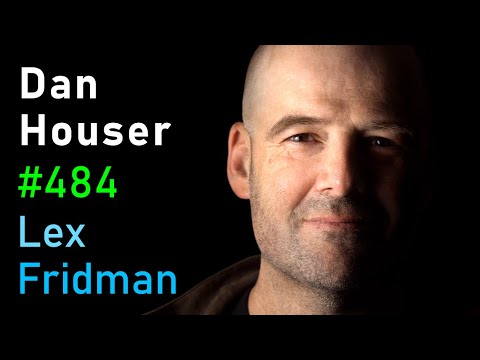
Dan Houser: GTA, Red Dead Redemption, Rockstar, Absurd & Future of Gaming | Lex Fridman Podcast #484
Lex Fridman (host), Dan Houser (guest), Narrator
In this episode of Lex Fridman Podcast, featuring Lex Fridman and Dan Houser, Dan Houser: GTA, Red Dead Redemption, Rockstar, Absurd & Future of Gaming | Lex Fridman Podcast #484 explores dan Houser on building living worlds, flawed heroes, and absurd futures Dan Houser reflects on two decades at Rockstar, detailing how Grand Theft Auto and Red Dead Redemption evolved open-world, narrative-driven games into emotionally resonant experiences comparable to great films and novels.
Dan Houser on building living worlds, flawed heroes, and absurd futures
Dan Houser reflects on two decades at Rockstar, detailing how Grand Theft Auto and Red Dead Redemption evolved open-world, narrative-driven games into emotionally resonant experiences comparable to great films and novels.
He explains his character-first writing process, the tension between player freedom and authored story, and why Red Dead Redemption 2 and GTA IV mark creative high points in combining systemic worlds with deep, 360-degree protagonists.
Houser also introduces his new company, Absurd Ventures, and its emerging universes—A Better Paradise, American Caper, and the comedic Absurdiverse—aimed at exploring AI, American satire, and sitcom-like open worlds across games, comics, and animation.
Throughout, he discusses influences from cinema and literature, the limits and uses of AI (both in fiction and real tools), the future of single‑player narrative games, and philosophical themes like mortality, utopia, and the duality of good and evil in every character and person.
Key Takeaways
Great open worlds feel alive even when the player does nothing.
Houser argues GTA III was revolutionary because its city simulation and rudimentary AI created the illusion that the world existed independently of the player, encouraging ‘digital tourism’ where just walking, listening to radio, or watching NPCs was compelling.
Get the full analysis with uListen AI
Deep characters come from fully imagining them in any situation.
He develops protagonists over a year or more, treating them as 360‑degree people whose reactions, strengths, flaws, and speech are coherent across contexts; once he finds a single authentic line of dialogue, the character ‘comes alive’ and anchors the story.
Get the full analysis with uListen AI
Story and sandbox must support each other rather than compete.
Purely systemic or purely scripted structures both fall short; Houser uses narrative to pace feature unlocks and give motivation, while preserving enough moral and behavioral latitude that the player’s free actions still feel in-character for someone like Niko or Arthur.
Get the full analysis with uListen AI
Killing a protagonist can elevate games to literary-level impact—if earned.
Red Dead Redemption’s ending, where John Marston dies and the player continues as Jack, deliberately broke an unwritten open-world rule; Houser calls it one of his proudest risks because it served the story while still keeping the game mechanically coherent.
Get the full analysis with uListen AI
Utopian thinking often hides a subtle hatred of real humanity.
In A Better Paradise, Houser explores AI builders who ‘like humans apart from the bad bits’; he sees this drive to erase messiness and imperfection as a dangerous, quasi-sociopathic impulse that recurs in real-world attempts to engineer paradises or perfect systems.
Get the full analysis with uListen AI
AI can mass-produce competence but not true originality or magic.
He’s relatively unconcerned about LLMs replacing high-level creative work, believing they excel at ‘cheap decent stuff’ and low-level tasks, while the last 5% of genuine voice, structure, and novel ideas will remain disproportionately hard and human-driven.
Get the full analysis with uListen AI
Single-player narrative games still have huge untapped potential.
Despite industry pressure toward live-service and online models, Houser sees long-form, story-led games as uniquely suited to new IP and deep worldbuilding; Absurd Ventures is explicitly doubling down on single-player open worlds with optional extensions.
Get the full analysis with uListen AI
Notable Quotes
“The games were a mathematical equation: the personality of the world multiplied or divided by the personality of the protagonist.”
— Dan Houser
“I don’t think AI is going to come up with magic. It’s going to be fantastic at coming up with really cheap, decent stuff.”
— Dan Houser
“Somebody who wants to build a utopia is saying, ‘I like humans apart from the bad bits.’ And that’s a huge side of us.”
— Dan Houser
“Arthur’s journey is not about becoming a superhero… it’s about an intellectual rollercoaster when his worldview gets taken apart.”
— Dan Houser
“We always tried to make something better and to use time and whatever money we had to always put impressive stuff on the screen, to push the medium of video games further.”
— Dan Houser
Questions Answered in This Episode
How far can games push branching narratives and persistent NPC memory before they undermine a strong authored story?
Dan Houser reflects on two decades at Rockstar, detailing how Grand Theft Auto and Red Dead Redemption evolved open-world, narrative-driven games into emotionally resonant experiences comparable to great films and novels.
Get the full analysis with uListen AI
Could an open-world ‘spy’ game ever work if it must reconcile time pressure and global stakes with player freedom and wandering?
He explains his character-first writing process, the tension between player freedom and authored story, and why Red Dead Redemption 2 and GTA IV mark creative high points in combining systemic worlds with deep, 360-degree protagonists.
Get the full analysis with uListen AI
In what specific ways will AI tools meaningfully change the pipeline for building giant narrative worlds without flattening their originality?
Houser also introduces his new company, Absurd Ventures, and its emerging universes—A Better Paradise, American Caper, and the comedic Absurdiverse—aimed at exploring AI, American satire, and sitcom-like open worlds across games, comics, and animation.
Get the full analysis with uListen AI
What philosophical responsibilities do designers have when they create worlds that many players inhabit for hundreds of hours?
Throughout, he discusses influences from cinema and literature, the limits and uses of AI (both in fiction and real tools), the future of single‑player narrative games, and philosophical themes like mortality, utopia, and the duality of good and evil in every character and person.
Get the full analysis with uListen AI
How might Absurd Ventures’ universes evolve across media—comics, audio, games—without diluting the coherence of each world’s tone and themes?
Get the full analysis with uListen AI
Transcript Preview
You said that Red Dead Redemption 2, in your opinion, is the best thing you've ever done. I think there's a strong case to be made that it's the greatest game of all time. What are the elements that make that game truly great, do you think?
People searching for meaning within amongst the violence. I think that the West and all of the themes around the West really lend itself to that. And then the, the gunplay was fantastic and the horses were incredible. I think we got to spend... A smaller group of us working on it from day one, coming up with some weird, wacky ideas that we got to embed in the game that I think was helpful. Like, we got to be very creative before it had a full team on it.
You lock yourself in a room and get anchovies and onion pizza and-
(laughs)
... crushed Diet Cokes?
Yeah. (laughs)
Is this accurate information?
Very accurate.
Why do you think there was so much excitement about GTA IV, GTA V, and now GTA 6?
I think we did a really good job of constantly innovating. The games always felt different, you know. People have very strong feelings. "I like this one. I didn't like that one as much." 'Cause they are pretty different. So you would... There would be simultaneously where you know what's gonna happen. It's a Grand Theft Auto, you know it's gonna be a game about being a criminal. But the way it's gonna be a game is gonna change quite a lot.
The number one question from the internet, it is so ridiculous but I must ask-
(laughs)
... have you seen Gavin? The following is a conversation with Dan Houser, a legendary video game creator, co-founder of Rockstar Games, and the creative force behind Grand Theft Auto and Red Dead Redemption series, which includes some of the best-selling games of all time and some of the greatest games of all time. Both Red Dead Redemption 1 and 2 has some of the deepest, most complex and heart-wrenching characters and storylines ever created in video games. Dan has started a new company, Absurd Ventures, great name, that is creating some, uh, incredible new worlds in multiple forms, including books, comic books, audio series, and yes, video games. That includes A Better Paradise, which is a dystopian near-future world with a super intelligent AI, American Caper, which is an insanely chaotic, violent, dark, satirical world, and Absurdiverse, which is a comedic action-adventure world. I'm excited to explore all three of these. I have spent hundreds of hours in worlds that Dan has helped create, so this conversation was an incredible honor for me. And on top of that, Dan and I talked a lot after and in the days since, and he has been just a wonderful human being. I'm just at a loss of words. I feel like the luckiest kid in the world. This is the Lex Fridman Podcast. To support it, please check out our sponsors in the description, where you can also find links to contact me, ask questions, give feedback, and so on. And now, dear friends, here's Dan Houser. You've helped create some of the most incredible characters, stories, and open worlds in video game history. But when you grew up in the late '70s and '80s, open world video games wasn't a thing, so you've credited, uh, literature and film as, uh, early inspiration. So let's talk about, uh, film first, if we can.
Install uListen to search the full transcript and get AI-powered insights
Get Full TranscriptGet more from every podcast
AI summaries, searchable transcripts, and fact-checking. Free forever.
Add to Chrome