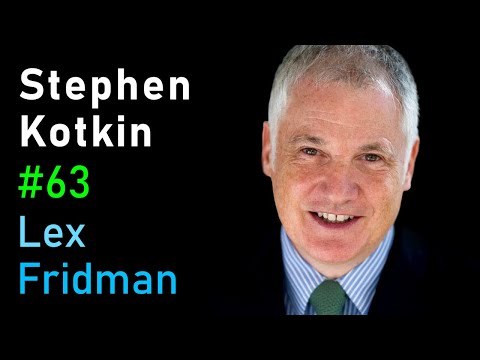
Stephen Kotkin: Stalin, Putin, and the Nature of Power | Lex Fridman Podcast #63
Lex Fridman (host), Stephen Kotkin (guest)
In this episode of Lex Fridman Podcast, featuring Lex Fridman and Stephen Kotkin, Stephen Kotkin: Stalin, Putin, and the Nature of Power | Lex Fridman Podcast #63 explores stalin, Putin, and why unchecked power corrodes leaders and nations Stephen Kotkin and Lex Fridman explore the psychology of power, contrasting constrained institutional authority with unconstrained, personalist rule. Kotkin explains how Stalin built perhaps the most powerful personal dictatorship in history, and how Putin has accumulated and maintained power in modern Russia. They examine why societies sometimes crave a “strong hand,” how communism and capitalism have fared historically, and why institutions matter more than heroic individuals. The conversation closes on whether war and evil are permanent features of human life and how historical understanding can help avoid catastrophic great‑power conflict.
Stalin, Putin, and why unchecked power corrodes leaders and nations
Stephen Kotkin and Lex Fridman explore the psychology of power, contrasting constrained institutional authority with unconstrained, personalist rule. Kotkin explains how Stalin built perhaps the most powerful personal dictatorship in history, and how Putin has accumulated and maintained power in modern Russia. They examine why societies sometimes crave a “strong hand,” how communism and capitalism have fared historically, and why institutions matter more than heroic individuals. The conversation closes on whether war and evil are permanent features of human life and how historical understanding can help avoid catastrophic great‑power conflict.
Key Takeaways
Unconstrained power increases mistakes and extremism, even for capable leaders.
Without checks and balances, leaders are not challenged, information is distorted, and decisions can escalate into catastrophe, as seen under Stalin, Mao, and various authoritarian regimes and corporations.
Get the full analysis with uListen AI
Many people crave order and results, not necessarily democracy.
In both Russia and the United States, a nontrivial minority is attracted to an authoritarian “strong hand” when frustrated by gridlock or perceived disorder, which can legitimize leaders who promise to “get things done” quickly.
Get the full analysis with uListen AI
Putin’s legitimacy rests on early growth, psychological insight, and lack of alternatives.
He benefited from liberalizing reforms, the 1998 devaluation, and China-driven demand, while skillfully appealing to both economic “losers” and urban “winners”—and from tightly restricting real political competitors and independent media.
Get the full analysis with uListen AI
Authoritarian “rescues” often solve short‑term chaos while creating deeper long‑term problems.
Putin stabilized the post‑1990s state, but reliance on repression, expropriation, and a narrow corrupt elite undermines diversification, human capital, and future growth, leaving Russia “stuck” and bleeding its most dynamic citizens.
Get the full analysis with uListen AI
Stalin was both a true-believing communist and a ruthless power accumulator.
His appeal came from genuine dedication to communism and Russian state power, combined with extreme diligence, memory, and organizational skill—but he used lies, purges, and terror to build a personal dictatorship within a party dictatorship.
Get the full analysis with uListen AI
History shows that abolishing capitalism produces tyranny and scarcity, not freedom.
Every attempt to eliminate markets, private property, and parliaments in the Marxist sense led to repression and shortages; the viable left‑wing alternative is social democracy—regulating and redistributing within a market system, not destroying it.
Get the full analysis with uListen AI
Durable progress depends on institutions, not heroic individuals.
Figures like George Washington matter because they institutionalize constraints and walk away from power; what Russia needs is coalitions that build courts, a real parliament, rule of law, and competitive markets, rather than a single “savior.”
Get the full analysis with uListen AI
Notable Quotes
“We worry about unconstrained power. We worry about executive authority that’s not limited. That’s the definition of authoritarianism, or tyranny.”
— Stephen Kotkin
“The primary victims of President Putin’s power are Russians.”
— Stephen Kotkin
“Everywhere this was tried—eliminating markets, private property, and parliaments—it produced tyranny and mass violence, death, and shortages.”
— Stephen Kotkin
“We don’t need individuals. We need institutions… a court system, a parliament that functions.”
— Stephen Kotkin
“Once you experience power at that level, it becomes almost a drug.”
— Stephen Kotkin
Questions Answered in This Episode
How can modern democracies strengthen institutional checks without paralyzing their ability to act in crises?
Stephen Kotkin and Lex Fridman explore the psychology of power, contrasting constrained institutional authority with unconstrained, personalist rule. ...
Get the full analysis with uListen AI
What concrete steps could a future Russian leadership realistically take to unwind entrenched corruption without triggering chaos or violence?
Get the full analysis with uListen AI
Is there any viable path for an authoritarian leader like Putin to voluntarily step away from power while safeguarding his personal security and legacy?
Get the full analysis with uListen AI
Given history’s verdict on revolutionary socialism, why does radical anti‑capitalist sentiment still retain appeal among segments of today’s youth?
Get the full analysis with uListen AI
Can great‑power conflicts between nuclear-armed states like the U.S. and China be durably managed, or are we merely postponing an eventual catastrophe?
Get the full analysis with uListen AI
Transcript Preview
The following is a conversation with Stephen Kotkin, a professor of history at Princeton University and one of the great historians of our time, specializing in Russian and Soviet history. He has written many books on Stalin and the Soviet Union, including the first two of a three-volume work on Stalin, and he's currently working on volume three. You may have noticed that I've been speaking with not just computer scientists, but physicists, engineers, historians, neuroscientists, and soon, much more. To me, artificial intelligence is much bigger than deep learning, bigger than computing. It is our civilization's journey into understanding the human mind and creating echoes of it in the machine. To me, that journey must include a deep historical and psychological understanding of power. Technology put some of the greatest power in the history of our civilization into the hands of engineers and computer scientists. This power must not be abused, and the best way to understand how such abuse can be avoided is to not be blind to the lessons of history. As Stephen Kotkin brilliantly articulates, Stalin was arguably one of the most powerful humans in history. I read many books on Joseph Stalin, Vladimir Putin, and the wars of the 20th century. I hope you understand the value of such knowledge to all of us, especially to engineers and scientists who build the tools of power in the 21st century. This is the Artificial Intelligence podcast. If you enjoy it, subscribe on YouTube, give us five stars on Apple Podcast, follow on Spotify, support on Patreon, or simply connect with me on Twitter @lexfridman, spelled F-R-I-D-M-A-N. I recently started doing ads at the end of the introduction. I'll do one or two minutes after introducing the episode, and never any ads in the middle that can break the flow of the conversation. I hope that works for you and doesn't hurt the listening experience. This show is presented by Cash App, the number one finance app in the App Store. I personally use Cash App to send money to friends, but you can also use it to buy, sell, and deposit Bitcoin in just seconds. Cash App also has an investing feature. You can buy fractions of a stock, say $1 worth, no matter what the stock price is. Broker services are provided by Cash App Investing, a subsidiary of Square and member SIPC. I'm excited to be working with Cash App to support one of my favorite organizations called FIRST, best known for their FIRST Robotics & Lego competitions. They educate and inspire hundreds of thousands of students in over 110 countries, and have a perfect rating on Charity Navigator, which means the donated money is used to maximum effectiveness. When you get Cash App from the App Store or Google Play and use code LEXPODCAST, you'll get $10, and Cash App will also donate $10 to FIRST, which again is an organization that I've personally seen inspire girls and boys to dream of engineering a better world. And now, here's my conversation with Stephen Kotkin. Do all human beings crave power?
Install uListen to search the full transcript and get AI-powered insights
Get Full TranscriptGet more from every podcast
AI summaries, searchable transcripts, and fact-checking. Free forever.
Add to Chrome