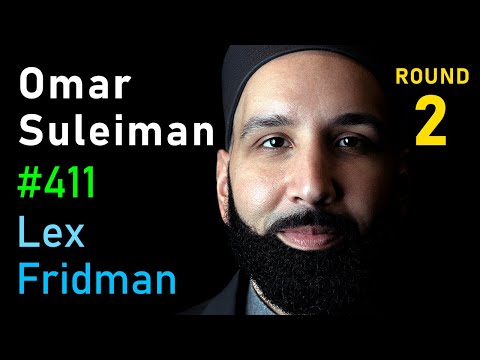
Omar Suleiman: Palestine, Gaza, Oct 7, Israel, Resistance, Faith & Islam | Lex Fridman Podcast #411
Omar Suleiman (guest), Lex Fridman (host), Lex Fridman (host)
In this episode of Lex Fridman Podcast, featuring Omar Suleiman and Lex Fridman, Omar Suleiman: Palestine, Gaza, Oct 7, Israel, Resistance, Faith & Islam | Lex Fridman Podcast #411 explores omar Suleiman on Gaza: Occupation, Dehumanization, Faith and Resistance Imam Dr. Omar Suleiman, a Palestinian-American scholar, argues that the events of October 7 cannot be understood without recognizing decades of Israeli occupation, apartheid, and systematic dehumanization of Palestinians, especially in Gaza. He describes Gaza as a besieged, bombed population with no real escape, where people’s primary hope is simply to survive another year. Suleiman sharply criticizes U.S. policy, media coverage, and political leadership—especially Joe Biden—for enabling what he repeatedly calls genocide, while suppressing Palestinian voices and nonviolent resistance. Throughout, he grounds his moral framework in Islam, emphasizes the sanctity of every human life, and calls for an immediate ceasefire, an end to occupation and apartheid, and genuine accountability under international law.
Omar Suleiman on Gaza: Occupation, Dehumanization, Faith and Resistance
Imam Dr. Omar Suleiman, a Palestinian-American scholar, argues that the events of October 7 cannot be understood without recognizing decades of Israeli occupation, apartheid, and systematic dehumanization of Palestinians, especially in Gaza. He describes Gaza as a besieged, bombed population with no real escape, where people’s primary hope is simply to survive another year. Suleiman sharply criticizes U.S. policy, media coverage, and political leadership—especially Joe Biden—for enabling what he repeatedly calls genocide, while suppressing Palestinian voices and nonviolent resistance. Throughout, he grounds his moral framework in Islam, emphasizes the sanctity of every human life, and calls for an immediate ceasefire, an end to occupation and apartheid, and genuine accountability under international law.
Key Takeaways
Gaza’s reality predates October 7 and is shaped by long-term siege and occupation.
Suleiman stresses that Gaza has functioned as an ‘open-air prison’ for years—blockaded by land, air, and sea, subjected to repeated bombardments, settlement expansion, and restrictions on basic life, making the latest explosion of violence both predictable and rooted in structural injustice.
Get the full analysis with uListen AI
Western media and U.S. policy systematically erase Palestinian suffering.
He argues that American audiences mainly see Israeli deaths and hostages while Palestinian casualties and context—decades of killings, apartheid reports, and daily humiliations—are minimized or framed through Israeli and U. ...
Get the full analysis with uListen AI
Occupation and apartheid are inherently violent; resistance is morally and legally justified, but not unlimited.
Drawing on Islamic ethics and international law, Suleiman says any occupied people have the right to resist, yet targeting civilians—women, children, noncombatants—is always immoral and should be prosecuted, whether done by state or non-state actors.
Get the full analysis with uListen AI
U.S. political leaders bear direct responsibility for the current scale of destruction.
He contends that decades of U. ...
Get the full analysis with uListen AI
Anti-Palestinian racism and Islamophobia fuel both foreign policy and domestic hate crimes.
From dehumanizing language to the murder of six‑year‑old Palestinian-American Wadea al-Fayoume, Suleiman links media and political rhetoric to real-world attacks, arguing that Palestinians’ lives are valued less than others’ whether in Gaza or the U.S.
Get the full analysis with uListen AI
Nonviolent Palestinian resistance has been repressed or delegitimized alongside armed resistance.
He highlights examples like the Great Return March, boycotts, and massive peaceful protests, noting that they were met with sniper fire, legal crackdowns, and accusations of antisemitism—leaving Palestinians condemned regardless of how they resist.
Get the full analysis with uListen AI
Faith and spiritual hope sustain Palestinians and are drawing outsiders to Islam.
Suleiman says Gazans’ visible reliance on faith amid ‘hell on Earth’—their patience, dignity, and references to God—has prompted many non-Muslims to explore the Qur’an and visit mosques, seeking the source of that resilience and hope.
Get the full analysis with uListen AI
Notable Quotes
“You don’t pass out candy in a concentration camp. You end the occupation.”
— Omar Suleiman
“If they’ve made them faceless, they can’t make us voiceless.”
— Omar Suleiman
“The trauma of the past does not justify the murder of the present, and the fear of the future does not justify the murder of the present.”
— Omar Suleiman
“An occupied people have the right to defend themselves. The occupier is obligated to those that they occupy.”
— Omar Suleiman
“You can’t survive hell on Earth unless you believe in paradise outside of it.”
— Omar Suleiman
Questions Answered in This Episode
How should international law be reformed or enforced so that both state and non-state actors are genuinely held accountable for killing civilians, regardless of alliances?
Imam Dr. ...
Get the full analysis with uListen AI
What concrete steps could U.S. citizens take—beyond protesting—to influence American foreign policy on Israel-Palestine in a meaningful way?
Get the full analysis with uListen AI
If both violent and nonviolent Palestinian resistance are delegitimized or punished, what realistic avenues for change remain for Palestinians under occupation?
Get the full analysis with uListen AI
How can societies distinguish between legitimate criticism of Israeli government policies and antisemitism, while also recognizing and confronting anti-Palestinian racism?
Get the full analysis with uListen AI
What would a just and sustainable post-occupation future look like for both Palestinians and Israelis, and who should be trusted to broker that transition?
Get the full analysis with uListen AI
Transcript Preview
You always know when you live in Gaza that it's only a matter of time before the next bombs drop. You know if you're in Gaza that you are waiting for your death. People dream about going out in the world and pursuing education. People dream about going out in the world and pursuing economic opportunity. In Gaza, your idea of opportunity is an opportunity to see the next year. That has been the case. And so when we talk about, you know, this not existing in a vacuum, if people only hear about Gaza on October 7th, that is, that is a major part of the problem, and that is, again, part of the problem of our ignorance and our apathy. Right? Why is it that the plight of the people of Gaza is not brought up until an attack happens on Israel?
The following is a conversation with Imam Dr. Omar Suleiman, his second time on the podcast. He is a Palestinian-American, a Muslim scholar, a civil rights leader, president of the Yaqeen Institute for Islamic Research, and is one of the most influential Muslims in the world. Our previous conversation was focused on Islam. This time, the focus was on Gaza and Palestine. This is the Lex Fridman Podcast. To support it, please check out our sponsors in the description. And now, dear friends, here's Omar Suleiman. What did you think, feel, and pray for in the days that followed October 7th?
I think the first feeling was that, uh, there's going to be a lot of death and destruction in Gaza as a result, right? We always kind of see this, where one Israeli casualty leads to hundreds of Palestinian casualties, right? So it, it's a pretty familiar cycle in some ways, where there are daily transgressions against Palestinians in the West Bank and in Gaza. The checkpoints, the aggression on Masjid al-Aqsa, the settlements expanding, the stories of Palestinian death, and then you have rockets fired from Gaza, and that's when the Western press catches up and starts to cover it. Israel responds with hellfire missiles, white phosphorus bombs, and the casualties are wildly disproportionate. And so I think that, you know, I wasn't surprised. I prayed for the people that I knew were going to bear the brunt of this outbreak, but the outbreak was predictable.
You wrote a statement on October 9th. I was hoping, uh, to read it, if it's okay.
Yeah, go ahead.
"Our Palestinian casualties are always your footnotes, the daily humiliation of occupation ignored, the aggression by settlers and soldiers alike on holy sites and souls, the annihilation of entire families that follows, the devastation of whatever scraps remain in the open-air prison of Gaza. Unsustainable and inhumane. So if you're waking up to a sudden interest in the region and want to know what's been happening, dig a bit deeper than two weeks and try to read beyond the headlines of a media that has been dehumanizing us for decades."
Install uListen to search the full transcript and get AI-powered insights
Get Full TranscriptGet more from every podcast
AI summaries, searchable transcripts, and fact-checking. Free forever.
Add to Chrome