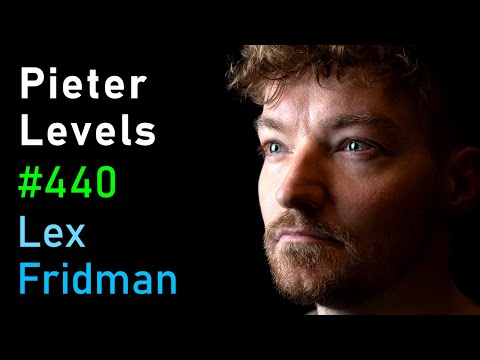
Pieter Levels: Programming, Viral AI Startups, and Digital Nomad Life | Lex Fridman Podcast #440
Pieter Levels (guest), Lex Fridman (host), Narrator, Narrator, Narrator, Narrator, Narrator, Narrator, Narrator, Narrator
In this episode of Lex Fridman Podcast, featuring Pieter Levels and Lex Fridman, Pieter Levels: Programming, Viral AI Startups, and Digital Nomad Life | Lex Fridman Podcast #440 explores pieter Levels on solo building, AI photos, and nomad freedom Lex Fridman talks with indie hacker Pieter Levels about how he’s built dozens of profitable, one‑person internet businesses using ultra‑simple tech stacks and relentless iteration.
Pieter Levels on solo building, AI photos, and nomad freedom
Lex Fridman talks with indie hacker Pieter Levels about how he’s built dozens of profitable, one‑person internet businesses using ultra‑simple tech stacks and relentless iteration.
They dig into his philosophy of shipping fast, validating with real payments, automating everything, and avoiding VC funding so he can optimize for freedom and fun, not headcount and stress.
Pieter explains how he created viral AI products like PhotoAI and InteriorAI on top of Stable Diffusion, including the messy realities of porn‑tainted models, parameter tuning, and user‑driven A/B tests.
They also explore digital‑nomad life, depression, the value of hard physical work, minimalism, and why Europe is lagging the US in entrepreneurial culture and risk‑taking.
Key Takeaways
Validate ideas with speed and payment, not signups or hype.
Levels builds a minimal working product in about two weeks, launches publicly, and only considers an idea validated if strangers pull out their credit card—email signups or traffic alone don’t count.
Get the full analysis with uListen AI
Use the simplest tools you know so you can ship faster.
He deliberately sticks to vanilla HTML, jQuery, PHP, and SQLite; avoiding fashionable frameworks lets him iterate quickly, debug easily, and deploy straight to production dozens of times a day.
Get the full analysis with uListen AI
Automate everything so one person can run “big” products.
Cron jobs, health‑check pages, error notifications, and now GPT‑4 moderation let him operate sites like Nomad List and PhotoAI with high uptime and almost no manual ops or community management.
Get the full analysis with uListen AI
Let users help you tune AI systems in the real world.
For PhotoAI, he A/B tests model parameters on a subset of users and tracks which outputs they favorite or download; those implicit votes drive systematic improvements beyond his own intuition.
Get the full analysis with uListen AI
Constraints—time, money, possessions—can make you more creative.
Doing “12 startups in 12 months,” living out of a backpack, and refusing VC funding forced him to cut scope, ship scrappy versions, and focus on what actually creates value for users.
Get the full analysis with uListen AI
Work itself can be therapy if it’s meaningful and self‑directed.
Coming out of depression and digital‑nomad loneliness, he treated building startups like his dad’s endless house renovations: pick a hard, concrete task and move the metaphorical pile of sand every day.
Get the full analysis with uListen AI
Culture and regulation heavily shape who builds what, and where.
He argues that Europe’s economy is dominated by pre‑1950 “dinosaur” firms and heavy regulation, making it hard for new tech companies to emerge, while the US still rewards aggressive building and risk‑taking.
Get the full analysis with uListen AI
Notable Quotes
“I build a micro, mini startup in about two weeks, launch it, and if nobody pays, I kill it.”
— Pieter Levels
“Being alone on my laptop in my underwear in a hotel room, I can ship very fast.”
— Pieter Levels
“Most people look way too far ahead. I only look at the next problem to solve, then the next. At the end, you have a whole app.”
— Pieter Levels
“Freedom is no constraints, and everyone thinks that makes you happy. For me, it was the opposite. Constraints probably make you happy.”
— Pieter Levels
“The web is mostly PHP and jQuery. I’m just one of the few people still admitting it in public.”
— Pieter Levels
Questions Answered in This Episode
If you were starting from zero today, what exact 90‑day plan would you follow to go from no product to your first paying users?
Lex Fridman talks with indie hacker Pieter Levels about how he’s built dozens of profitable, one‑person internet businesses using ultra‑simple tech stacks and relentless iteration.
Get the full analysis with uListen AI
How far do you think solo builders can really scale AI products before they hit hard limits of compute, regulation, or support?
They dig into his philosophy of shipping fast, validating with real payments, automating everything, and avoiding VC funding so he can optimize for freedom and fun, not headcount and stress.
Get the full analysis with uListen AI
Where do you draw the ethical line when training and deploying AI image models, given their roots in web‑scraped and often NSFW data?
Pieter explains how he created viral AI products like PhotoAI and InteriorAI on top of Stable Diffusion, including the messy realities of porn‑tainted models, parameter tuning, and user‑driven A/B tests.
Get the full analysis with uListen AI
How has your experience with depression and digital‑nomad loneliness changed the way you design communities like Nomad List?
They also explore digital‑nomad life, depression, the value of hard physical work, minimalism, and why Europe is lagging the US in entrepreneurial culture and risk‑taking.
Get the full analysis with uListen AI
What would have to change—personally or structurally—for Europe to produce the next NVIDIA or Stripe instead of another old‑line conglomerate?
Get the full analysis with uListen AI
Transcript Preview
So I was trying to figure out how to do photo-realistic AI photos, and it was... Stable diffusion by itself is not doing that well. Like, the faces look all mangled.
Yep.
Um, and it doesn't have enough resolution or something to, to, to do that well. So... But I started seeing these, these, m- um, base models, these fine-tuning models, and people would train on porn. And I would try them, and they would be very photo-realistic. They would have bodies that actually made sense, like body o- uh, a- a- anatomy. Um, but if you look at the photo-realistic models that people use now, still, there's still a core of porn there, like, of naked people.
Yeah.
So I need to prompt out the nak-... And everyone needs to do this with AI startups with imaging. You need to prompt out the naked stuff.
Do you have to keep reminding the model you need to put-
It's not-
... clothes on the thing?
Yeah, "Don't put naked 'cause it's very risky." I have Google Vision-
Yeah.
... that checks every photo before it's shown to the user to, like, check for-
Like a nipple detector?
... NSFW. Yes.
Oh (laughs) NSFW de-, detector.
Because you get the journalists get very angry.
The following is a conversation with Pieter Levels, also known on X as LevelsIO. He is a self-taught developer and entrepreneur who designed, programmed, shipped, and ran over 40 startups, many of which are hugely successful. In most cases, he did it all by himself while living the digital nomad life in over 40 countries and over 150 cities, programming on a laptop while chilling on a couch, using vanilla HTML, jQuery, PHP, and SQLite. He builds and ships quickly and improves on the fly, all in the open, documenting his work, both his successes and failures, with a raw honesty of a true indie hacker. Pieter is an inspiration to a huge number of developers and entrepreneurs who love creating cool things in the world that are hopefully useful for people. This was an honor and a pleasure for me. This is the Lex Fridman Podcast. To support it, please check out our sponsors in the description. And now, dear friends, here's Pieter Levels. You've launched a lot of companies and built a lot of products. As you say, most failed, but some succeeded. What's your philosophy behind building the startups that you did?
I think my philosophy is very different than most people in startups, 'cause most people in startups, they, they build a company, and they raise money, right? And they hire people, and then they build a product, and they find something that makes money. And I don't really raise money. I don't use VC funding. I do everything myself. I'm a designer. I'm the developer. I, I make everything. I make the logo. So for me, I'm much more scrappy. And-
Install uListen to search the full transcript and get AI-powered insights
Get Full TranscriptGet more from every podcast
AI summaries, searchable transcripts, and fact-checking. Free forever.
Add to Chrome