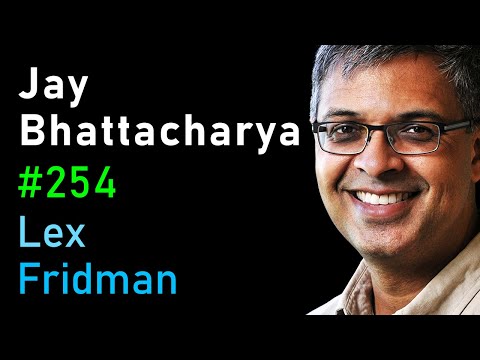
Jay Bhattacharya: The Case Against Lockdowns | Lex Fridman Podcast #254
Lex Fridman (host), Jay Bhattacharya (guest)
In this episode of Lex Fridman Podcast, featuring Lex Fridman and Jay Bhattacharya, Jay Bhattacharya: The Case Against Lockdowns | Lex Fridman Podcast #254 explores jay Bhattacharya argues lockdowns backfired, urging humane COVID policy Jay Bhattacharya, Stanford professor and co-author of the Great Barrington Declaration, argues that COVID lockdowns caused vast, underappreciated harm while failing to stop the virus’s spread. He emphasizes the steep age-based risk of COVID and advocates “focused protection” of the vulnerable instead of broad societal shutdowns. Bhattacharya and Lex Fridman also dissect institutional failures, including an NIH email calling for a “devastating takedown” of the Declaration, as emblematic of arrogance, politicization, and the suppression of scientific dissent. The conversation closes with reflections on vaccines, public trust, fear, humility in science, and the moral imperative to center empathy and love in policy.
Jay Bhattacharya argues lockdowns backfired, urging humane COVID policy
Jay Bhattacharya, Stanford professor and co-author of the Great Barrington Declaration, argues that COVID lockdowns caused vast, underappreciated harm while failing to stop the virus’s spread. He emphasizes the steep age-based risk of COVID and advocates “focused protection” of the vulnerable instead of broad societal shutdowns. Bhattacharya and Lex Fridman also dissect institutional failures, including an NIH email calling for a “devastating takedown” of the Declaration, as emblematic of arrogance, politicization, and the suppression of scientific dissent. The conversation closes with reflections on vaccines, public trust, fear, humility in science, and the moral imperative to center empathy and love in policy.
Key Takeaways
COVID’s lethality is highly age-stratified, which should shape policy.
Seroprevalence data suggest a low overall infection fatality rate (around 0. ...
Get the full analysis with uListen AI
Lockdowns imposed massive collateral damage, especially on the poor and young.
Bhattacharya details harms such as global hunger, missed vaccinations and medical care, learning loss from school closures, mental health crises, and job loss-induced ‘deaths of despair,’ arguing these were insufficiently weighed against COVID benefits.
Get the full analysis with uListen AI
Focused protection is a targeted alternative to blanket lockdowns.
The Great Barrington Declaration proposes concentrating resources on shielding the vulnerable (e. ...
Get the full analysis with uListen AI
Institutional arrogance and politicization undermined scientific debate.
The NIH email labeling the Declaration’s authors ‘fringe’ and calling for a ‘devastating takedown’ exemplifies, in Bhattacharya’s view, how leaders conflated their policy preferences with ‘science’ itself, chilling open discussion and encouraging groupthink.
Get the full analysis with uListen AI
Vaccines are powerful against severe disease but not a silver bullet against spread.
Trials and real‑world data show COVID vaccines dramatically cut hospitalization and death, especially in older adults, but their protection against infection and transmission wanes over months, making eradication unrealistic and reinforcing the need to focus on reducing harm, not eliminating cases.
Get the full analysis with uListen AI
Public health messaging must be transparent, humble, and non-coercive.
Downplaying natural immunity, overselling vaccines as transmission blockers, mocking repurposed drug research, and using fear as a tool all fuel distrust; Bhattacharya argues authorities should openly communicate uncertainties and risks, and treat citizens as adults.
Get the full analysis with uListen AI
Fear-driven policies fracture social bonds and degrade common humanity.
Fridman and Bhattacharya describe how COVID fear turned neighbors into perceived biohazards, eroded in‑person education and connection, and polarized discourse, and they urge a return to empathy, forgiveness, and love as guiding principles in crisis response.
Get the full analysis with uListen AI
Notable Quotes
“The ideology of lockdown is to make people live apart, alone, isolated, so that we don't spread diseases to each other. But we're not actually designed as a species to live that way.”
— Jay Bhattacharya
“Those latter three—money, fame, and power—are all ephemeral. They slip through the fingers of anyone who tries to hold on, and leave behind an empty shell of a human being.”
— Lex Fridman
“It’s the same kind of arrogance that you see when Tony Fauci gets on TV and says that if you criticize me, you're not simply criticizing a man, you're criticizing science itself.”
— Jay Bhattacharya
“Fear should never be used as a tactic to manipulate human behavior by public health.”
— Jay Bhattacharya
“The meaning of life is very simple: love one another. Treat your neighbor as yourself.”
— Jay Bhattacharya
Questions Answered in This Episode
How could governments have operationalized ‘focused protection’ in real time, and what specific metrics would have signaled success or failure?
Jay Bhattacharya, Stanford professor and co-author of the Great Barrington Declaration, argues that COVID lockdowns caused vast, underappreciated harm while failing to stop the virus’s spread. ...
Get the full analysis with uListen AI
Given what we now know about vaccines and natural immunity, what would a rational, freedom-respecting long‑term COVID policy look like?
Get the full analysis with uListen AI
How should scientific institutions be restructured to prevent leaders from weaponizing funding and prestige against dissenting views?
Get the full analysis with uListen AI
What mechanisms can rebuild public trust in public health after fear-based messaging and politicization of expertise?
Get the full analysis with uListen AI
In future pandemics, how can societies better incorporate the ‘quiet suffering’—economic, educational, and psychological—into real-time policy decisions?
Get the full analysis with uListen AI
Transcript Preview
The following is a conversation with Jay Bhattacharya, professor of medicine, health policy, and economics at Stanford University. Please allow me to say a few words about lockdowns and the blinding, destructive effects of arrogance on leadership, especially in the space of policy and politics. Jay Bhattacharya is the co-author of the now famous Great Barrington Declaration, a one-page document that, in October 2020, made a case against the effectiveness of lockdowns. Most of this podcast conversation is about the ideas related to this document. And so, let me say a few things here about what troubles me. Those who advocate for lockdowns as a policy often ignore the quiet suffering of millions that it results in, which includes economic pain, loss of jobs that give meaning and pride in the face of uncertainty, the increase in suicide and suicidal ideation, and, in general, the fear and anger that arises from the powerlessness forced onto the populous by the self-proclaimed elites and experts. Many folks whose job is unaffected by the lockdowns talk down to the masses about which path forward is right and which is wrong. What troubles me most is this very lack of empathy among the policymakers for the common man, and, in general, for people unlike themselves. The landscape of suffering is vast and must be fully considered in calculating the response to the pandemic with humility and with rigorous, open-minded scientific debate. Jay and I talked about the email from Francis Collins to Anthony Fauci that called Jay and his two co-authors fringe epidemiologists, and also called for devastating published takedown of their ideas. These words from Francis broke my heart. I understand them. I can even steel man them. But nevertheless, on balance, they show to me a failure of leadership. Leadership in a pandemic is hard, which is why great leaders are remembered by history. They are rare, they stand out, and they give me hope. Also, this whole mess inspires me on my small individual level to do the right thing in the face of conformity, despite the long odds. I talked to Francis Collins, I talked to Albert Bourla, Pfizer CEO. I also talked, and will continue to talk, with people like Jay and other dissenting voices that challenge the mainstream narratives and those in the seats of power. I hope to highlight both the strengths and weaknesses in their ideas, with respect and empathy, but also with guts and skill. The skill part, I hope to improve on over time, and I do believe that conversation and an open mind is the way out of this. And finally, as I've said in the past, I value love and integrity far, far above money, fame, and power. Those latter three are all ephemeral. They slip through the fingers of anyone who tries to hold on, and leave behind an empty shell of a human being. I prefer to die a man who lived by principles that nobody could shake, and a man who added a bit of love to the world. This is the Lex Fridman podcast. To support it, please check out our sponsors in the description. And now, here's my conversation with Jay Bhattacharya. To our best understanding today, how deadly is COVID? Do we have a good measure for- for this very question?
Install uListen to search the full transcript and get AI-powered insights
Get Full TranscriptGet more from every podcast
AI summaries, searchable transcripts, and fact-checking. Free forever.
Add to Chrome