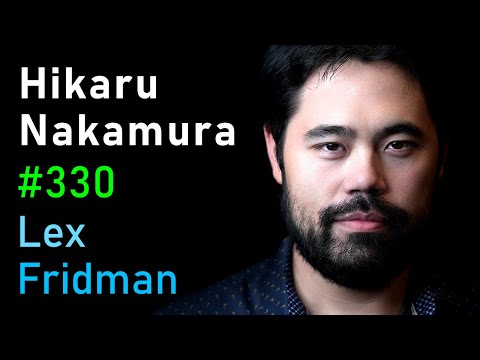
Hikaru Nakamura: Chess, Magnus, Kasparov, and the Psychology of Greatness | Lex Fridman Podcast #330
Lex Fridman (host), Hikaru Nakamura (guest), Narrator
In this episode of Lex Fridman Podcast, featuring Lex Fridman and Hikaru Nakamura, Hikaru Nakamura: Chess, Magnus, Kasparov, and the Psychology of Greatness | Lex Fridman Podcast #330 explores hikaru on Magnus, mastery, mistakes, and modern chess’s evolution Hikaru Nakamura and Lex Fridman explore what makes Magnus Carlsen great, how one legendary 40‑game blitz session in 2010 reshaped Hikaru’s career, and how psychology and confidence define elite chess. They dig into openings like the Berlin and the Najdorf to show how engines changed modern preparation and risk-taking. Hikaru reflects on streaming, financial insecurity as a pro, cheating controversies, and why he now plays with far less pressure. Throughout, he frames chess as both a brutal mental sport and a global community that taught him about resilience, ego, and joy.
Hikaru on Magnus, mastery, mistakes, and modern chess’s evolution
Hikaru Nakamura and Lex Fridman explore what makes Magnus Carlsen great, how one legendary 40‑game blitz session in 2010 reshaped Hikaru’s career, and how psychology and confidence define elite chess. They dig into openings like the Berlin and the Najdorf to show how engines changed modern preparation and risk-taking. Hikaru reflects on streaming, financial insecurity as a pro, cheating controversies, and why he now plays with far less pressure. Throughout, he frames chess as both a brutal mental sport and a global community that taught him about resilience, ego, and joy.
Key Takeaways
A single training match can reshape an elite rivalry for years.
Hikaru sees the secret 40-game blitz match with Magnus in 2010 as one of his biggest competitive mistakes because it gave Magnus deep insight into his weaknesses—especially in openings and technical defenses—which Magnus then exploited for a long time.
Get the full analysis with uListen
At the top, psychology is often more decisive than pure chess skill.
Repeatedly failing to convert winning positions against Magnus made Hikaru—and many others—start to view Magnus as “superhuman,” which eroded confidence and changed how they played him; only playing Magnus very frequently during online events helped Hikaru normalize him again.
Get the full analysis with uListen
Engines have radically changed what ‘good chess’ looks like.
Openings like the Berlin and Najdorf are now navigated with deep engine prep, reducing risk for Black and increasing draw rates; computers also endorse moves (like early flank pawn pushes) that feel nonsensical to humans but objectively hold, forcing players to trust results they can barely explain.
Get the full analysis with uListen
Blitz excellence relies more on intuition and low-blunder rate than deep calculation.
Hikaru attributes his #1 blitz status to an almost subconscious feel for positions, allowing him to find non-blundering, strong moves in seconds; under 10 seconds, he isn’t calculating long lines, just trusting patterns refined by hundreds of thousands of games.
Get the full analysis with uListen
Financial insecurity shapes how top pros think and play.
Only about 20–30 players can truly make a living from chess, so invitation-dependent income and volatile results create pressure that Hikaru believes hurt his over-the-board performance before streaming freed him from needing chess prize money to survive.
Get the full analysis with uListen
Cheating is a serious, systemic threat that tech makes easier and cheaper.
Hikaru stresses that subtle device-based cheating (e. ...
Get the full analysis with uListen
Long-term greatness builds on obsession with improvement, not innate talent.
Hikaru insists he wasn’t naturally gifted like his brother; instead, he obsessively attacked his weaknesses—whether in chess, phone games, or openings—by repeatedly asking what he was doing wrong and grinding until patterns clicked.
Get the full analysis with uListen
Notable Quotes
“After that match, it wasn’t even so much that I lost—what scared me was realizing how hard it was to beat Magnus even when I got an advantage.”
— Hikaru Nakamura
“We’re all capable of beating Magnus, but we all have very bad scores against him—and people underestimate how much of that is psychological.”
— Hikaru Nakamura
“Computers are so good now that with Black, if you take risks, you have to play almost perfectly just to make a draw—and you still almost never get winning chances.”
— Hikaru Nakamura
“When I say ‘I literally don’t care,’ it doesn’t mean I’m not competitive. It means if I lose a game, it’s not the end of the world in the way it used to be.”
— Hikaru Nakamura
“You might pursue your passion and fail, but it’s better to have tried and failed than to have never tried at all.”
— Hikaru Nakamura
Questions Answered in This Episode
How much transparency and statistical evidence would the chess world need to truly move past the Hans Niemann controversy?
Hikaru Nakamura and Lex Fridman explore what makes Magnus Carlsen great, how one legendary 40‑game blitz session in 2010 reshaped Hikaru’s career, and how psychology and confidence define elite chess. ...
Get the full analysis with uListen AI
If engines keep advancing, what concrete changes to formats or rules could preserve human creativity and reduce drawishness at the top?
Get the full analysis with uListen AI
In hindsight, would Hikaru still choose to play that 2010 blitz marathon with Magnus if he could go back, knowing how much it revealed?
Get the full analysis with uListen AI
How can younger players balance using engines for improvement without losing the ‘human element’ and basic logical thinking Hikaru values?
Get the full analysis with uListen AI
What would a world championship format look like that Magnus Carlsen would actually find fun, challenging, and worthy of his time?
Get the full analysis with uListen AI
Transcript Preview
You and Magnus played a private game, 40 games of blitz in 2010 in Moscow at a hotel. This sounds and just feels legendary.
The reason that I probably should not have agreed to play this match and why I very oftentimes reference it as one of the biggest mistakes in terms of competitive chess that I made, is specifically because it gave Magnus a chance to understand my style of chess.
Are you and Magnus, uh, friends, enemies, frenemies? Um, what, what's the status of, of the relationship?
Yeah, I think with all the rivalries in chess, everybody tries to hype it up like everyone hates each other, but the thing is, at the end of the day, yes, we're very competitive. We want to beat each other, whether it's myself or Magnus or, or other, other top players, but we also realize that it's a very small world, like a lot of us are able to make a living playing the game as professionals, and as I alluded to earlier, the top 20 to 30 players can make a living. So even though we're competitive against each other, we want to beat each other, there is a certain level of respect that we have and there is a sort of brotherhood, I would say. Um, so all of us are, I would say, frenemies.
The following is a conversation with Hikaru Nakamura, a chess super grand master. He's one of the greatest chess players in the world, including currently being ranked world number one in blitz chess. He's also one of the most popular chess streamers on Twitch and YouTube, which you should definitely check out. His channel's name on both is GM Hikaru. This is the Lex Fridman Podcast. To support it, please check out our sponsors in the description, and now, dear friends, here's to Hikaru Nakamura. You and Magnus played a private game, 40 games of blitz in 2010 in Moscow at a hotel. This sounds and just feels legendary. Final score was 24 and a half to 15 and a half for Magnus.
Where'd you find out the score? I'm actually curious. I don't think it was publicly said or it was very briefly said, but it wasn't ever, like, mentioned in a, in a serious way, so...
I think it's a deep dive based on a few links that started as... in, at a subreddit, which is how all great journeys start.
Right. Yeah, so this is kind of a crazy story. There... This was not preplanned at all. I remember this quite well. Um, I went out to dinner that final night with someone who was actually very high up within the International Chess Club at that time. We... I went out for a nice dinner. I think I had, like, a couple of drinks. Maybe it was wine, beer, I don't know what it was. And I think towards the end of the dinner, somehow they got word of this and they, they relayed the information to me that Magnus wanted to play a private match. Now, I agreed to play this match, probably I should not have, and actually it has nothing to do with, like, the state of having been out, had a few drinks, anything of that nature. But the reason that I probably should not have agreed to play this match and why I very oftentimes reference it as one of the biggest mistakes i- in terms of competitive chess that I made is specifically because it gave Magnus a chance to understand my style of chess, and at the time, I actually had pretty good results against Magnus. I think maybe he was up one or two games, but there were many games where I'd been pressing close to winning against him prior to that match. And so when I went and played that match, there were a few things that happened. First of all, Magnus really started to understand my style because we played all sorts of different openings, um, and so I think he understood that at times I wasn't so great in the opening and there were many openings where I would play slightly dubious variations as opposed to the main lines, um, and then secondly, from my standpoint, the problem that I realized is since we were playing with an increment, there were many games where I was close to winning and he would defend endgames amazingly well. He would defend what are technical- technically drawn endgames, but where I would have like an extra pawn, it would be like rook and bishop versus rook and knight. Say I have four pawns, he has three pawns. Endgames of this nature. Now, if you aren't super into chess, you might not understand, uh, what I'm referring to. If you are, you will, but there are endgames where one side might have extra material, an extra pawn, say, extra two pawns, but theoretically it's a draw. So perfect play-
Install uListen to search the full transcript and get AI-powered insights
Get Full TranscriptGet more from every podcast
AI summaries, searchable transcripts, and fact-checking. Free forever.
Add to Chrome