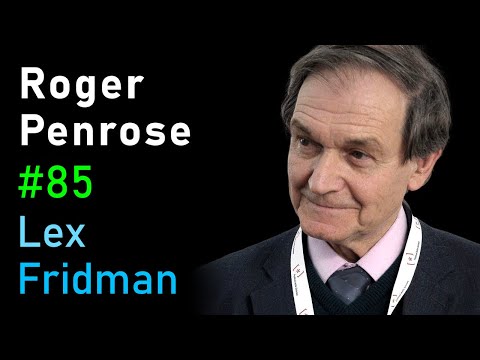
Roger Penrose: Physics of Consciousness and the Infinite Universe | Lex Fridman Podcast #85
Lex Fridman (host), Roger Penrose (guest)
In this episode of Lex Fridman Podcast, featuring Lex Fridman and Roger Penrose, Roger Penrose: Physics of Consciousness and the Infinite Universe | Lex Fridman Podcast #85 explores roger Penrose challenges computable mind, reimagines cosmos before Big Bang Roger Penrose and Lex Fridman explore why consciousness, understanding, and intelligence may not be reducible to computation, drawing on Gödel’s incompleteness theorem, brain anatomy, and quantum mechanics. Penrose argues that key aspects of mind involve non-computable physics, possibly linked to quantum state reduction orchestrated in neuronal microtubules. They also discuss the limits of current quantum theory, Penrose’s proposal that gravity modifies quantum mechanics, and his conformal cyclic cosmology, where our Big Bang follows a prior cosmic “eon.” The conversation closes on the deep connection between mathematical beauty, physical law, and enduring questions about meaning, awareness, and why anything exists at all.
Roger Penrose challenges computable mind, reimagines cosmos before Big Bang
Roger Penrose and Lex Fridman explore why consciousness, understanding, and intelligence may not be reducible to computation, drawing on Gödel’s incompleteness theorem, brain anatomy, and quantum mechanics. Penrose argues that key aspects of mind involve non-computable physics, possibly linked to quantum state reduction orchestrated in neuronal microtubules. They also discuss the limits of current quantum theory, Penrose’s proposal that gravity modifies quantum mechanics, and his conformal cyclic cosmology, where our Big Bang follows a prior cosmic “eon.” The conversation closes on the deep connection between mathematical beauty, physical law, and enduring questions about meaning, awareness, and why anything exists at all.
Key Takeaways
Consciousness and understanding likely exceed pure computation.
Using Gödel’s incompleteness theorem, Penrose argues that human mathematical understanding can see truths no fixed formal, algorithmic system can prove, suggesting that at least some aspects of mind are non-computable.
Get the full analysis with uListen AI
Not all complex brain computation is conscious, challenging simple AI analogies.
The cerebellum contains more neurons and performs highly precise, unconscious motor computations, while conscious experience is associated with the cerebrum’s seemingly less efficient, oddly wired structure, undermining the idea that “more computation = more consciousness.”
Get the full analysis with uListen AI
Quantum mechanics as currently formulated is incomplete for describing reality.
Penrose maintains that standard quantum theory (Schrödinger evolution plus ad hoc collapse) cannot be the final word; he and a minority of physicists think state reduction is a real physical process not yet captured by existing equations.
Get the full analysis with uListen AI
Gravity may play a crucial role in objective wavefunction collapse and mind.
He proposes that when quantum superpositions involve sufficiently different spacetime geometries (via gravity), they become unstable and undergo an objective, non-computable “collapse,” potentially providing the physical substrate for conscious events.
Get the full analysis with uListen AI
Microtubules in neurons are a candidate site for quantum-level consciousness.
In the Orch OR model with Stuart Hameroff, Penrose suggests that highly ordered microtubule structures might maintain quantum coherence long enough for gravity-induced state reductions to be orchestrated into unified conscious moments; anesthetic action on microtubules is a key experimental clue.
Get the full analysis with uListen AI
Our Big Bang may follow a previous cosmic “eon” in a cyclic universe.
Conformal cyclic cosmology (CCC) posits that the infinitely expanded, cold, massless future of a prior universe can be conformally rescaled to become the hot, dense Big Bang of the next, with possible observable imprints from black hole events in the prior eon.
Get the full analysis with uListen AI
Mathematics appears discovered, not invented, and is deeply woven into physics.
Penrose highlights complex numbers and their centrality to quantum mechanics as evidence that mathematical structures pre-exist our notation, hinting at an objective mathematical reality that underlies both physical law and our capacity to understand it.
Get the full analysis with uListen AI
Notable Quotes
“Whatever consciousness is, it's not a computation.”
— Roger Penrose
“Understanding, whatever it is, is not governed by rules. It's not a computational procedure.”
— Roger Penrose
“The cerebellum has more neurons than the cerebrum, and as far as we know it's entirely unconscious.”
— Roger Penrose
“You don’t just quantize gravity; you have to gravitize quantum mechanics.”
— Roger Penrose
“It’s not a stupid question to ask what the meaning of life is.”
— Roger Penrose
Questions Answered in This Episode
If some aspects of understanding are non-computable, how far can artificial intelligence ever truly go in replicating human cognition?
Roger Penrose and Lex Fridman explore why consciousness, understanding, and intelligence may not be reducible to computation, drawing on Gödel’s incompleteness theorem, brain anatomy, and quantum mechanics. ...
Get the full analysis with uListen AI
What specific experimental results would most strongly support or falsify the Orch OR model connecting microtubules and consciousness?
Get the full analysis with uListen AI
How could a future theory that “gravitizes” quantum mechanics be mathematically formulated, and what new predictions would distinguish it from standard quantum theory?
Get the full analysis with uListen AI
What observable signatures in the cosmic microwave background would convincingly indicate interactions from a prior eon, as predicted by conformal cyclic cosmology?
Get the full analysis with uListen AI
Does Penrose’s view that mathematics is discovered imply that our minds are somehow tuned to a pre-existing mathematical reality, and how might that relate to consciousness itself?
Get the full analysis with uListen AI
Transcript Preview
The following is a conversation with Roger Penrose, physicist, mathematician, and philosopher at University of Oxford. He has made fundamental contributions in many disciplines from the mathematical physics of general relativity and cosmology to the limitations of a computational view of consciousness. In his book, The Emperor's New Mind, Roger writes that, quote, "Children are not afraid to pose basic questions that may embarrass us as adults to ask." In many ways, my goal with this podcast is to embrace the inner child that is not constrained by how one should behave, speak, and think in the adult world. Roger is one of the most important minds of our time, so it's truly a pleasure and an honor to talk with him. This conversation was recorded before the outbreak of the pandemic. For everyone feeling the medical, psychological, and financial burden of the crisis, I'm sending love your way. Stay strong. We're in this together. We'll beat this thing. This is the Artificial Intelligence Podcast. If you enjoy it, subscribe on YouTube, review it with five stars on Apple Podcast, support it on Patreon, or simply connect with me on Twitter, @lexfridman, spelled F-R-I-D-M-A-N. As usual, I'll do a few minutes of ads now and never any ads in the middle that can break the flow of the conversation. I hope that works for you and doesn't hurt the listening experience. Quick summary of the ads. Two sponsors: ExpressVPN and Cash App. Please consider supporting the podcast by getting ExpressVPN at expressvpn.com/lexpod and downloading Cash App and using code LEXPODCAST. This show is presented by Cash App, the number one finance app in the App Store. When you get it, use code LEXPODCAST. Cash App lets you send money to friends, buy Bitcoin, and invest in the stock market with as little as $1. Since Cash App does fractional share trading, let me mention that the order execution algorithm that works behind the scenes to create the abstraction of the fractional orders is an algorithmic marvel, so big props to the Cash App engineers for solving a hard problem that, in the end, provides an easy interface that takes a step up to the next layer of abstraction over the stock market, making trading more accessible for new investors and diversification much easier. So again, if you get Cash App from the App Store or Google Play and use the code LEXPODCAST, you get $10 and Cash App will also donate $10 to FIRST, an organization that is helping to advance robotics and STEM education for young people around the world. This show is sponsored by ExpressVPN. Get it at expressvpn.com/lexpod to get a discount and to support this podcast. I've been using ExpressVPN for many years. I love it. It's easy to use. Press the big power on button and your privacy is protected. And, if you like, you can make it look like your location's anywhere else in the world. I might be in Boston now, but I can make it look like I'm in New York, London, Paris, or anywhere else. This has a large number of obvious benefits. Certainly, it allows you to access international versions of streaming websites like the Japanese Netflix or the UK Hulu. ExpressVPN works on any device you can imagine. I use it on Linux, shout out to Ubuntu, Windows, Android. But it's available everywhere else too. Once again, get it at expressvpn.com/lexpod to get a discount and to support this podcast. And now here's my conversation with Roger Penrose. You mentioned in conversation with Eric Weinstein on the Portal podcast that 2001: Space Odyssey is your favorite movie.
Install uListen to search the full transcript and get AI-powered insights
Get Full TranscriptGet more from every podcast
AI summaries, searchable transcripts, and fact-checking. Free forever.
Add to Chrome