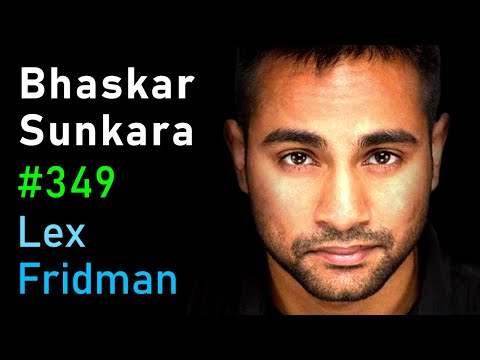
Bhaskar Sunkara: Socialism and Communism | Lex Fridman Podcast #349
Lex Fridman (host), Bhaskar Sunkara (guest)
In this episode of Lex Fridman Podcast, featuring Lex Fridman and Bhaskar Sunkara, Bhaskar Sunkara: Socialism and Communism | Lex Fridman Podcast #349 explores bhaskar Sunkara Defends Democratic Socialism Without Authoritarian or Woke Dogma Lex Fridman and Bhaskar Sunkara explore what democratic socialism means today, distinguishing it sharply from 20th‑century authoritarian communism while defending markets, democracy, and civil liberties. Sunkara argues socialism is about guaranteeing basic needs, expanding democracy into the workplace, and reducing extreme inequality of wealth and power—without abolishing markets or free speech. They examine historical experiences from the USSR, China, and Scandinavia, debating why some socialist projects failed, why social democracy partly succeeded, and how corruption, incentives, and human nature fit into any system. The conversation closes with practical priorities like universal healthcare and shorter work weeks, internal critiques of the contemporary left, and Sunkara’s vision of a more egalitarian but still democratic and conflict-filled future.
Bhaskar Sunkara Defends Democratic Socialism Without Authoritarian or Woke Dogma
Lex Fridman and Bhaskar Sunkara explore what democratic socialism means today, distinguishing it sharply from 20th‑century authoritarian communism while defending markets, democracy, and civil liberties. Sunkara argues socialism is about guaranteeing basic needs, expanding democracy into the workplace, and reducing extreme inequality of wealth and power—without abolishing markets or free speech. They examine historical experiences from the USSR, China, and Scandinavia, debating why some socialist projects failed, why social democracy partly succeeded, and how corruption, incentives, and human nature fit into any system. The conversation closes with practical priorities like universal healthcare and shorter work weeks, internal critiques of the contemporary left, and Sunkara’s vision of a more egalitarian but still democratic and conflict-filled future.
Key Takeaways
Democratic socialism aims to expand democracy into the economy, not abolish markets.
Sunkara envisions firms owned and governed by workers, competing in regulated markets with public banks providing investment—retaining price signals and competition while eliminating a separate capitalist owner class.
Get the full analysis with uListen AI
The real trade-off is often ‘freedom vs freedom’, not ‘freedom vs equality’.
Regulations like minimum wages and maximum work weeks constrain an employer’s contractual freedom but expand workers’ real freedom—time, security, and autonomy—so politics is about whose freedom is prioritized.
Get the full analysis with uListen AI
Authoritarian communism was shaped more by conditions than by socialism’s core ideals.
Sunkara argues that revolutions in backward, war-torn, non-democratic societies (Russia, China) produced small parties clinging to power amid civil war and invasion; their one-party states then fused political and economic control, enabling mass repression and corruption.
Get the full analysis with uListen AI
Social democracy showed that strong unions and welfare states can increase productivity.
He cites Scandinavian “pattern bargaining,” where high, sector-wide wages forced inefficient firms out, pushed efficient firms to innovate, and combined with active labor-market policies to maintain employment and growth.
Get the full analysis with uListen AI
Corruption and abuse are systemic risks in any system, not unique to socialism.
Centralized planning can magnify corruption by giving bureaucrats control over production and allocation, but Sunkara notes that capitalism’s lobbying, regulatory capture, and private collusion are parallel distortions of democratic will.
Get the full analysis with uListen AI
Free speech and civil liberties are non‑negotiable for any legitimate socialist project.
Sunkara calls himself almost a free-speech absolutist, rejects ‘woke’ speech policing, and insists that democracy, independent courts, and basic rights must constrain any attempt to pursue egalitarian goals.
Get the full analysis with uListen AI
Practical reforms are essential stepping stones—and tests—for bigger socialist ambitions.
He emphasizes winning broadly popular, concrete policies like universal healthcare, stronger unions, and reduced working hours to both improve lives now and demonstrate that collective political action can deliver.
Get the full analysis with uListen AI
Notable Quotes
““At the minimum, socialism is about making sure that the core necessities of life…are guaranteed to everyone just by virtue of being born.””
— Bhaskar Sunkara
““Socialists are proposing a trade-off, but it’s really a trade-off between freedom and freedom.””
— Bhaskar Sunkara
““I’m basically a free speech absolutist… It’s very condescending to assume that people can’t take debate.””
— Bhaskar Sunkara
““I’m a socialist on normative grounds… but I’m a Marxist only as long as Marxism helps me understand pertinent facts about the world.””
— Bhaskar Sunkara
““We marvel at the pyramids, but we don’t often think about the suffering that went into making them.””
— Bhaskar Sunkara
Questions Answered in This Episode
If worker-owned, market-driven firms can function efficiently, what concrete transition path from our current system to that model is politically and economically realistic?
Lex Fridman and Bhaskar Sunkara explore what democratic socialism means today, distinguishing it sharply from 20th‑century authoritarian communism while defending markets, democracy, and civil liberties. ...
Get the full analysis with uListen AI
How can democratic socialists design institutions that prevent the emergence of a new ruling bureaucracy while still allowing effective coordination and planning?
Get the full analysis with uListen AI
What empirical evidence would convince Sunkara that more radical moves beyond social democracy (toward full worker ownership) are either necessary—or too risky?
Get the full analysis with uListen AI
How should the left balance its focus between material class issues (wages, healthcare, housing) and cultural or identity-based injustices without alienating potential allies?
Get the full analysis with uListen AI
In a world of AI and automation, does Sunkara’s market‑socialist framework still hold, or would superabundance require fundamentally new economic assumptions and institutions?
Get the full analysis with uListen AI
Transcript Preview
The following is a conversation with Bhaskar Sunkara. He's a democratic socialist, a political writer, founding editor of Jacobin, president of The Nation, former vice chair of the Democratic Socialists of America, and the author of The Socialist Manifesto: The Case for Radical Politics in an Era of Extreme Inequality. As a side note, let me say that this conversation with Bhaskar Sunkara, who is a brilliant socialist writer and philosopher, represents what I hope to do with this podcast. I hope to talk to the left and the right, to the far left and the far right, always with the goal of presenting and understanding both the strongest interpretation of their ideas and valuable thought-provoking arguments against those ideas. Also, I hope to understand the human being behind the ideas. I trust in your intelligence as the listener to use the ideas you hear to help you learn, to think, to empathize, and to make up your own mind. I will often fall short in pushing back too hard or not pushing back enough, of, uh, not bringing up topics I should have, of talking too much, of interrupting too much, or- or maybe sometimes, in the rare cases, not enough, of being too silly on a serious topic or being too serious on a silly topic. I'm trying to do my best and I will keep working my ass off to improve. In this way, I hope to talk to prominent figures in the political space, even controversial ones, on both the left and the right. For example, I hope to talk to Donald Trump and Alexandria Ocasio-Cortez, to Ron DeSantis and Barack Obama, and of course, many others across the political spectrum. I sometimes hear accusations about me being controlled in some way by a government or an intelligence agency like CIA, FSB, Mossad, or perhaps that I'm controlled in some way by the very human desire for money, fame, power, access. All I have is my silly little words, but let me give them to you. I'm not and will never be controlled by anyone. There's nothing in this world that can break me and force me to sacrifice my integrity. People call me naive. I'm not naive. I'm optimistic, and optimism isn't a passive state of being. It's a constant battle against a world that wants to pull you into a downward spiral of cynicism. To me, optimism is freedom, freedom to think, to act, to build, to help, at times, in the face of impossible odds. As I often do, please allow me to read a few lines from the poem If by Rudyard Kipling. "If you can keep your head when all about you are losing theirs and blaming it on you, if you can trust yourself when all men doubt you, but make allowance for their doubting too; if you can wait and not be tired by waiting, or being lied about, don't deal in lies, or being hated, don't give way to hating, and yet don't look too good nor talk too wise." Even this very poem is mocking my over-romantic ridiculousness as I read it. The meta-irony is not lost on me, my friends. I'm a silly little kid trying to do a bit of good in this world. Thank you for having my back through all of it, all of my mistakes. Thank you for the love. This is the Lex Fridman podcast. Um, to support it, please check out our sponsors in the description. And now, dear friends, here's Bhaskar Sunkara. Let's start with a big, broad question. What is socialism? How do you like to define it? How do you like to think about it?
Install uListen to search the full transcript and get AI-powered insights
Get Full TranscriptGet more from every podcast
AI summaries, searchable transcripts, and fact-checking. Free forever.
Add to Chrome