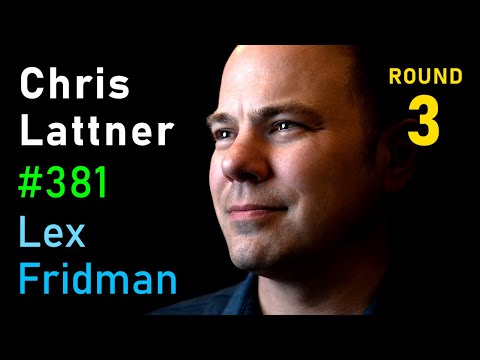
Chris Lattner: Future of Programming and AI | Lex Fridman Podcast #381
Chris Lattner (guest), Lex Fridman (host)
In this episode of Lex Fridman Podcast, featuring Chris Lattner and Lex Fridman, Chris Lattner: Future of Programming and AI | Lex Fridman Podcast #381 explores chris Lattner outlines Mojo and Modular to tame AI complexity Chris Lattner discusses Mojo, a new programming language that is a strict superset of Python designed to deliver Python’s ergonomics with C/C++-class performance and low-level control. Built on MLIR and a novel compiler architecture, Mojo supports interpreters, JIT, and ahead‑of‑time compilation, plus features like ownership, value semantics, traits, and compile‑time metaprogramming. Mojo is one pillar of Modular, a full‑stack AI platform meant to unify today’s fragmented ecosystem of frameworks, hardware accelerators, and deployment runtimes. Lattner’s overarching goal is to reduce the massive complexity in AI software so researchers and engineers can target any hardware, scale to huge models, and deploy reliably—without constantly rewriting code.
Chris Lattner outlines Mojo and Modular to tame AI complexity
Chris Lattner discusses Mojo, a new programming language that is a strict superset of Python designed to deliver Python’s ergonomics with C/C++-class performance and low-level control. Built on MLIR and a novel compiler architecture, Mojo supports interpreters, JIT, and ahead‑of‑time compilation, plus features like ownership, value semantics, traits, and compile‑time metaprogramming. Mojo is one pillar of Modular, a full‑stack AI platform meant to unify today’s fragmented ecosystem of frameworks, hardware accelerators, and deployment runtimes. Lattner’s overarching goal is to reduce the massive complexity in AI software so researchers and engineers can target any hardware, scale to huge models, and deploy reliably—without constantly rewriting code.
Key Takeaways
Target Python ergonomics with near‑metal performance.
Mojo is designed as a strict superset of Python so existing Python syntax and idioms work, but it adds static types, ownership, and low‑level features to unlock 10–35,000x speedups over CPython on computational kernels while still feeling like Python to most users.
Get the full analysis with uListen AI
Use one language instead of Python + C/C++ hybrids.
Many Python libraries, especially in ML and scientific computing, are thin Python wrappers over C/C++ for speed. ...
Get the full analysis with uListen AI
Exploit ownership and value semantics to reduce bugs and copies.
Mojo adopts ownership and a Swift‑style copy‑on‑write model so arrays, tensors, and other aggregates behave like values: you get logical copies without unnecessary physical copies, eliminating many aliasing bugs while still achieving high performance.
Get the full analysis with uListen AI
Leverage compile‑time meta‑programming and auto‑tuning.
By embedding an interpreter inside the compiler, Mojo can run Pythonic meta‑programming at compile time, generate specialized kernels, and perform auto‑tuning (trying parameter variants on real hardware, caching the best), allowing domain experts to encode optimization knowledge without hand‑coding every variant.
Get the full analysis with uListen AI
Unify heterogeneous hardware under a common compute runtime.
Modular’s engine abstracts CPUs, GPUs, TPUs, NPUs, edge accelerators, and multi‑node clusters into a single heterogeneous runtime that can schedule and partition compute graphs across devices, so model code doesn’t need to be rewritten for each new chip or deployment topology.
Get the full analysis with uListen AI
Incremental migration and strict superset status are strategic.
To avoid another Python 2→3‑style fracture, Mojo interoperates with the CPython runtime and can import existing Python packages as‑is; over time, critical packages can be ported to Mojo for performance while still exposing Python APIs back to the broader ecosystem.
Get the full analysis with uListen AI
Attack complexity, not just raw speed, to unlock AI.
Lattner frames the real enemy as systemic complexity—fragmented frameworks, hardware‑specific stacks, and brittle tooling that make deploying AI models costly and slow. ...
Get the full analysis with uListen AI
Notable Quotes
“My bitter enemy in the industry is complexity.”
— Chris Lattner
“We’re not working forwards from making Python a little bit better, we’re working backwards from what is the limit of physics.”
— Chris Lattner
“Python won. It owns machine learning. Our view is that Python is just not done yet.”
— Chris Lattner
“If you have to rewrite all your code for every new device, that doesn’t scale. The world’s not going to get simpler—physics is only going to get weirder.”
— Chris Lattner
“AI is this weird different thing right now. It shouldn’t be that way. It should just be another programming paradigm integrated into normal tools and languages.”
— Chris Lattner
Questions Answered in This Episode
How realistic is Mojo’s ambition to remain a strict superset of Python while still adding advanced static features like ownership, traits, and lifetimes without breaking compatibility?
Chris Lattner discusses Mojo, a new programming language that is a strict superset of Python designed to deliver Python’s ergonomics with C/C++-class performance and low-level control. ...
Get the full analysis with uListen AI
In practice, how much of the typical ML stack (NumPy, PyTorch, TensorFlow, custom CUDA kernels) could be consolidated into Mojo over the next five to ten years?
Get the full analysis with uListen AI
What are the biggest technical risks in Modular’s heterogeneous runtime—particularly around automatic partitioning and scheduling models across many devices and machines?
Get the full analysis with uListen AI
How might large language models be integrated into future compilers or IDEs for Mojo to assist with optimization, refactoring, and API design without sacrificing correctness?
Get the full analysis with uListen AI
If Modular succeeds in abstracting away most hardware details, what new kinds of AI applications or research directions become feasible that are currently too complex or expensive?
Get the full analysis with uListen AI
Transcript Preview
... on one axis, you have more hardware coming in. On the other hand, you have an explosion of innovation in AI.
Mm-hmm.
And so what happened with both Tensorflow and Pytorch is that the explosion of innovation in AI has led to... It's not just about matrix multiplication and convolution. These things have now, like, 2,000 different operators.
Mm-hmm.
And on the other hand, you have I don't know how many pieces of hardware there are out there. It's a lot. Part of my thesis, part of my belief of where computing goes if you look out 10 years from now is it's not gonna get simpler. Physics isn't going back to where we came from.
Mm-hmm.
It's only gonna get weirder from here on out, right? And so to me, the exciting part about what we're building is it's about building that universal platform, which world can continue to get weird, 'cause again, I don't think it's avoidable. It's physics. But we can help lift people, scale, do things with it, and they don't have to rewrite their code every time a new device comes out. And I think that's pretty cool.
The following is a conversation with Chris Lattner, his third time on this podcast. As I've said many times before, he's one of the most brilliant engineers in modern computing, having created LLM Compiler Infrastructure Project, the Clang compiler, the Swift programming language, a lot of key contributions to Tensorflow and TPUs as part of Google. He served as vice president of Autopilot software at Tesla, was a software innovator and leader at Apple, and now he co-created a new full stack AI infrastructure for distributed training, inference, and deployment on all kinds of hardware called Modular, and a new programming language called Mojo that is a superset of Python, giving you all the usability of Python, but with the performance of C, C++. In many cases, Mojo Code has demonstrated over 30,000X speedup over Python. If you love machine learning, if you love Python, you should definitely give Mojo a try. This programming language, this new AI framework and infrastructure, and this conversation with Chris is mind-blowing. I love it. It gets pretty technical at times, so I hope you hang on for the ride. This is the Lex Fridman Podcast. To support it, please check out our sponsors in the description. And now, dear friends, here's Chris Lattner. It's been, I think, two years since we last talked, and then in that time, you somehow went and co-created a new programming language called Mojo. Uh, so it's optimized for AI. It's a superset of Python. Let's look at the big picture. What is the vision, uh, for Mojo?
For Mojo? Well, so I mean, I think you have to zoom out. So I've been working on a lot of related technologies for many, many years. So I've worked on LLVM and a lot of things in mobile and servers and things like this. But the world's changing, and what's happened with AI is we have new GPUs and new machine learning accelerators and other ASICs and things like that that make AI go real fast. At Google, I worked on TPUs. That's one of the biggest larger-scale deployed systems that exist for AI.
Install uListen to search the full transcript and get AI-powered insights
Get Full TranscriptGet more from every podcast
AI summaries, searchable transcripts, and fact-checking. Free forever.
Add to Chrome