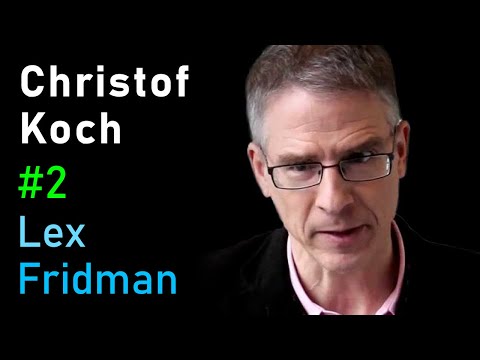
Christof Koch: Consciousness | Lex Fridman Podcast #2
Lex Fridman (host), Christof Koch (guest), Guest (guest), Narrator
In this episode of Lex Fridman Podcast, featuring Lex Fridman and Christof Koch, Christof Koch: Consciousness | Lex Fridman Podcast #2 explores christof Koch Dissects Consciousness, AI, Free Will, and Spirituality Christof Koch and Lex Fridman explore what consciousness is, how it differs from intelligence, and whether machines or simple organisms can be conscious. Koch explains integrated information theory (IIT) as a candidate scientific framework and uses clinical cases, dreams, and sensory deprivation to separate experience from function. They discuss panpsychism, the ethics and risks of advanced AI, free will in a largely deterministic universe, and the influence of religion, Buddhism, and literature on Koch’s thinking. The conversation ends with current neuroscience work on brain structures like the claustrum that may help unify conscious experience.
Christof Koch Dissects Consciousness, AI, Free Will, and Spirituality
Christof Koch and Lex Fridman explore what consciousness is, how it differs from intelligence, and whether machines or simple organisms can be conscious. Koch explains integrated information theory (IIT) as a candidate scientific framework and uses clinical cases, dreams, and sensory deprivation to separate experience from function. They discuss panpsychism, the ethics and risks of advanced AI, free will in a largely deterministic universe, and the influence of religion, Buddhism, and literature on Koch’s thinking. The conversation ends with current neuroscience work on brain structures like the claustrum that may help unify conscious experience.
Key Takeaways
Consciousness is about experience, not performance or problem‑solving.
Koch defines consciousness as “what it feels like” to be a system—subjective experience—distinct from intelligence, which is about learning, adapting, and functioning effectively.
Get the full analysis with uListen AI
Intelligent behavior does not guarantee consciousness, especially in machines.
Future systems like Alexa or simulated brains may convincingly pass Turing tests and claim to be conscious, yet, in Koch’s view, could still lack experience if they only simulate behavior without the right causal physical structure.
Get the full analysis with uListen AI
Brains reveal clear dissociations between function and experience.
Cases like locked‑in syndrome, vegetative patients with residual awareness, dreaming, and sensory‑deprivation “pure experience” show people can have rich consciousness with minimal or no outward behavior or task‑oriented intelligence.
Get the full analysis with uListen AI
A scientific theory of consciousness must be physical and testable.
Koch argues we need a principled theory—such as IIT—that specifies what physical properties of a system (e. ...
Get the full analysis with uListen AI
Advanced AI might not be conscious but may need empathy to be safe.
Koch believes human‑level or superhuman AI can be built without consciousness, yet argues that giving powerful systems an empathic, feeling‑with capacity could be crucial to aligning them with human survival and values.
Get the full analysis with uListen AI
Free will is constrained but meaningful in deliberative decisions.
Even in a mostly deterministic or probabilistic universe, Koch thinks we exhibit our greatest freedom in high‑stakes, reflective choices where we bring our full conscious understanding, history, and values to bear.
Get the full analysis with uListen AI
Broader human experiences and literature enrich scientific insight about mind.
Koch sees value in rock climbing, meditation, sports ‘flow’, and reading diverse fiction as ways to access and appreciate varied conscious states and perspectives that lab tasks and technical texts alone cannot reveal.
Get the full analysis with uListen AI
Notable Quotes
“Consciousness is about being, intelligence is about function.”
— Christof Koch
“We need a theory of consciousness that tells us what is it about a piece of matter that gives rise to conscious experience.”
— Christof Koch
“Simulating intelligence is not the same as having conscious experiences.”
— Christof Koch
“In biology, consciousness and intelligence go hand in hand; in digital machines, they do not.”
— Christof Koch
“When you are in the zone, you touch the root of being.”
— Christof Koch
Questions Answered in This Episode
If a future AI convincingly insists it is conscious, what empirical criteria—beyond behavior—should we demand before believing it?
Christof Koch and Lex Fridman explore what consciousness is, how it differs from intelligence, and whether machines or simple organisms can be conscious. ...
Get the full analysis with uListen AI
How should ethics and law change if we accept that many nonhuman animals, organoids, or even simple organisms have some degree of experience?
Get the full analysis with uListen AI
What concrete experiments could decisively support or falsify integrated information theory compared with rival theories of consciousness?
Get the full analysis with uListen AI
How might giving AGI systems genuine empathic capacities alter their architecture, training, and potential risks?
Get the full analysis with uListen AI
Does redefining free will as constrained but deliberative change how we think about moral responsibility and criminal justice?
Get the full analysis with uListen AI
Transcript Preview
As part of MIT course 6.099 on artificial general intelligence, I got a chance to sit down with Christof Koch, who is one of the seminal figures in, uh, neurobiology and neuroscience, and generally in the study of consciousness. He is the president, the chief scientific officer of the Allen Institute for Brain Science in Seattle. From 1986 to 2013 he was a professor at Caltech. Before that, he was at MIT. He is extremely well-cited, over 100,000 citations. His research, his writing, his ideas have had big impact on the scientific community and the general public in the way we think about consciousness and the way see ourselves as human beings. He's the author of several books, The Quest for Consciousness: A Neurobiological Approach, and a more recent book, Consciousness: Confessions of a Romantic Reductionist. If you enjoy this conversation, this course, subscribe, click the little bell icon to make sure you never miss a video. And in the comments, leave suggestions for any people you'd like to see be part of the course or any ideas that you would like us to explore. Thanks very much and I hope you enjoy. Okay, before we delve into the beautiful mysteries of consciousness, let's zoom out a little bit and let me ask, do you think there's intelligent life out there in the universe?
Uh, yes, I do believe so. We have no evidence of it, but I think the probabilities are overwhelming in favor of it, given a universe, uh, where we have 10 to the 11th galaxies and each galaxy has between 10 to the 11th, 10 to the 12th stars and we know most stars have one or more planets.
So how does that make you feel?
It still makes me feel special because I have experiences. I feel the world, I experience the world. And, uh, independent of whether there are other creatures o- out there, I still feel the world and I have access to this world in this very strange compelling way, and that's the core of, uh, human existence.
Now, you said human. Do you think... If those intelligent creatures are out there, do you think they experience their world that's shared?
Yes, if they are evolved, if they are a product of natural evolution as they would have to be, they will also experience their own world. So consciousness isn't just, uh, human, you're right, it's, it's much wider. It's probably... it may be spread across all of biology. We have... The only thing that we have special is we can talk about it.
(laughs)
Of course, not all people can talk about it. Babies and little children can't talk about it, patients who have, um, who have a stroke in the, let's say the left inferior frontal gyrus can't talk about it, but most normal adult people can talk about it and so we think that makes us special compared to, let's say, monkeys or dogs or cats or mice or all the other creatures that we share the planet with. But all the evidence seems to suggest that they too experience the world and so it's, like, overwhelmingly likely that other alien- that aliens would also experience their world. Of course differently because they have a different sensorium, they have different sensors, they have a very different environment. But the fact that... I, I would s- uh, strongly suppose that they also have experiences, they feel pain and pleasure and see in some sort of spectrum and hear and have all the other senses.
Install uListen to search the full transcript and get AI-powered insights
Get Full TranscriptGet more from every podcast
AI summaries, searchable transcripts, and fact-checking. Free forever.
Add to Chrome