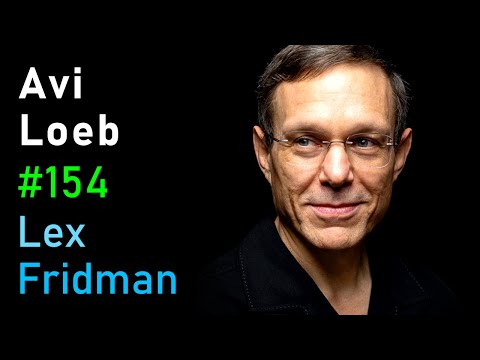
Avi Loeb: Aliens, Black Holes, and the Mystery of the Oumuamua | Lex Fridman Podcast #154
Lex Fridman (host), Avi Loeb (guest), Narrator, Lex Fridman (host)
In this episode of Lex Fridman Podcast, featuring Lex Fridman and Avi Loeb, Avi Loeb: Aliens, Black Holes, and the Mystery of the Oumuamua | Lex Fridman Podcast #154 explores avi Loeb challenges science to confront anomalies, aliens, and humility Avi Loeb argues that it is scientifically conservative—not speculative—to take seriously the possibility of intelligent extraterrestrial life, given billions of Earth-like planets and our own technological trajectory. Using the anomalous interstellar object ‘Oumuamua as a case study, he criticizes the scientific community’s reluctance to entertain artificial origins while freely embracing far less testable ideas like string theory or multiverses.
Avi Loeb challenges science to confront anomalies, aliens, and humility
Avi Loeb argues that it is scientifically conservative—not speculative—to take seriously the possibility of intelligent extraterrestrial life, given billions of Earth-like planets and our own technological trajectory. Using the anomalous interstellar object ‘Oumuamua as a case study, he criticizes the scientific community’s reluctance to entertain artificial origins while freely embracing far less testable ideas like string theory or multiverses.
Loeb and Lex Fridman discuss black holes, dark matter, interstellar travel, and projects like Breakthrough Starshot as concrete paths to becoming an interstellar species and securing humanity’s long‑term survival. Throughout, Loeb emphasizes epistemic humility, evidence‑driven inquiry, and the danger of prize‑chasing, groupthink, and social-media-style tribalism in both science and society.
He advocates treating anomalies as precious clues rather than inconveniences, urges funding for the search for technosignatures (industrial pollution, artifacts, probes), and suggests that studying alien civilizations—living or dead—could teach us how not to self‑destruct.
The conversation blends astrophysics, philosophy, and personal biography to argue that science should serve human curiosity and public interest, keeping its “eyes on the ball, not on the audience.”
Key Takeaways
Adopt cosmic modesty: assume we are not special or alone.
With roughly half of Sun-like stars hosting Earth-sized planets in habitable zones, it is statistically arrogant to presume we are unique; we should instead treat humanity as a typical, early-stage technological civilization in a vast universe.
Get the full analysis with uListen AI
Treat anomalies like ‘Oumuamua as high‑value scientific clues, not nuisances.
‘Oumuamua’s extreme shape, lack of cometary tail, unusual acceleration, and rest frame suggest it does not fit known natural categories, so dismissing artificial explanations a priori is unscientific; the correct response is to gather better data on future objects.
Get the full analysis with uListen AI
Expand the search for life to technosignatures, not just biosignatures.
Looking only for oxygen or simple life markers may remain ambiguous, whereas industrial pollutants, artificial light, or alien space junk could provide much clearer evidence of advanced civilizations—including dead ones—if we deliberately search for such signals.
Get the full analysis with uListen AI
Reform scientific culture to prioritize evidence over ego and consensus.
Loeb argues that obsession with prizes, careers, and social approval makes scientists avoid risky ideas and taboo topics, leading to decades of delayed or missed discoveries; embracing childlike curiosity and tolerance for mistakes is essential for breakthroughs.
Get the full analysis with uListen AI
Use interstellar projects like Starshot to both explore and safeguard humanity.
Developing light-sail probes to nearby stars and AI‑driven “Noah’s arks” that can seed life elsewhere are realistic long‑term strategies to avoid single‑point failure of life on Earth from self‑inflicted catastrophes or cosmic events.
Get the full analysis with uListen AI
Pursue quantum gravity and dark matter with experimental guidance, not pure math.
Despite sophisticated theories (e. ...
Get the full analysis with uListen AI
Recognize that humility about our lifespan should shape our values.
Awareness of our brief existence in cosmic time should foster modesty, daily gratitude, and a focus on learning and exploration, rather than dominance, nationalism, or social-media vanity that can drive civilizations toward self‑destruction.
Get the full analysis with uListen AI
Notable Quotes
“It would be extremely arrogant to think that we are special. We are probably not the sharpest cookie in the jar.”
— Avi Loeb
“Reality doesn’t care whether you ignore it or not. We can all agree that ‘Oumuamua was just a rock, but it might still be an alien artifact.”
— Avi Loeb
“Science is not about glorifying our image. It’s about a dialogue with nature. Many of my colleagues prefer to have a monologue.”
— Avi Loeb
“If you step on the grass, it will never grow. If you never fund the search for extraterrestrial intelligence, of course you won’t find anything.”
— Avi Loeb
“All of us are in the gutters, but some of us are looking at the stars.”
— Oscar Wilde (quoted by Avi Loeb)
Questions Answered in This Episode
If ‘Oumuamua or similar objects are artificial, what kinds of follow‑up missions or instruments should we build specifically to characterize them next time?
Avi Loeb argues that it is scientifically conservative—not speculative—to take seriously the possibility of intelligent extraterrestrial life, given billions of Earth-like planets and our own technological trajectory. ...
Get the full analysis with uListen AI
What institutional or funding changes would most effectively reduce taboo and groupthink in astronomy and physics, especially around topics like technosignatures?
Loeb and Lex Fridman discuss black holes, dark matter, interstellar travel, and projects like Breakthrough Starshot as concrete paths to becoming an interstellar species and securing humanity’s long‑term survival. ...
Get the full analysis with uListen AI
How might discovering clear evidence of a dead alien civilization—say, industrial pollution on an exoplanet—change humanity’s priorities and political structures on Earth?
He advocates treating anomalies as precious clues rather than inconveniences, urges funding for the search for technosignatures (industrial pollution, artifacts, probes), and suggests that studying alien civilizations—living or dead—could teach us how not to self‑destruct.
Get the full analysis with uListen AI
Given our short technological lifespan so far, what concrete steps can we take in the next century to meaningfully reduce the risk of human self‑destruction?
The conversation blends astrophysics, philosophy, and personal biography to argue that science should serve human curiosity and public interest, keeping its “eyes on the ball, not on the audience.”
Get the full analysis with uListen AI
Where is the line between bold scientific speculation and unfalsifiable theory, and who should decide which ideas deserve large-scale funding and attention?
Get the full analysis with uListen AI
Transcript Preview
The following is a conversation with Avi Loeb, an astrophysicist, astronomer, and cosmologist at Harvard. He has authored over 800 papers and written eight books, including his latest called Extraterrestrial: The First Sign of Intelligent Life Beyond Earth. It'll be released in a couple of weeks, so go pre-order it now to show support for what I think is truly an important book in that it serves as a strong example of a scientist being both rigorous and open-minded about the question of intelligent alien civilizations in our universe. Quick mention of our sponsors: Zero Fasting app for intermittent fasting, LMNT electrolyte drink, Sunbasket meal delivery service, and Pessimists Archive history podcast. So the choice is a fasting app, fasting fuel, fast-breaking delicious meals, and a history podcast that has very little (laughs) to do with fasting. Choose wisely, my friends. And if you wish, click the sponsor links below to get a discount and to support this podcast. As a side note, let me say a bit more about why Avi's work is so exciting to me and I think to a lot of people. In 2017, a strange interstellar object, now named Oumuamua, (laughs) it's fun to say, was detected traveling through our solar system. Based on the evidence we have, it has strange characteristics which made it not like any asteroid or comet that we've seen before. Avi was one of the only world-class scientists who fearlessly suggested that we should be open-minded about whether it is naturally made or, in fact, is an artifact of an intelligent alien civilization. In fact, he suggested that the more likely explanation, given the evidence, is the latter hypothesis. But we also talk about a lot of fascinating mysteries in our universe, including black holes, dark matter, the Big Bang, and close-to-speed-of-light space travel. The theme throughout is that in scientific pursuits, the weird things, the anomalies, the ideas that right now are considered taboo should not be ignored if we're to have a chance at finding the next big breakthrough, the next big paradigm shift, and also if we are to inspire the world with the power and beauty of science. If you enjoy this thing, subscribe on YouTube, review it on Apple Podcasts, follow on Spotify, support on Patreon, or connect with me on Twitter @lexfriedman. And now, here's my conversation with Avi Loeb. In the introduction to your new book, Extraterrestrial, you write, "This book confronts one of the universe's most profound questions: Are we alone?" Over time, this question has been framed in different ways. Is life here on Earth the only life in the universe? Are humans the only sentient intelligence in the vastness of space and time? A better, more precise framing of this question would be this. Throughout the expanse of space and over the lifetime of the universe, are there now or have ever been other sentient civilizations that, like ours, explored the stars and left evidence of their efforts? So let me ask, are we alone?
Install uListen to search the full transcript and get AI-powered insights
Get Full TranscriptGet more from every podcast
AI summaries, searchable transcripts, and fact-checking. Free forever.
Add to Chrome