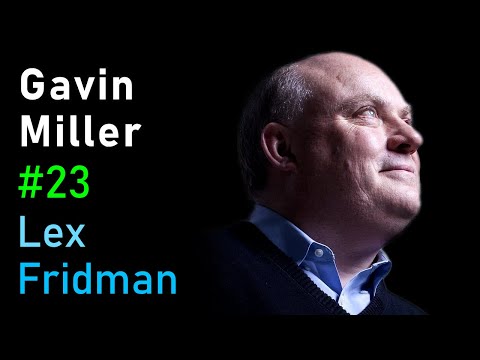
Gavin Miller: Adobe Research | Lex Fridman Podcast #23
Lex Fridman (host), Gavin Miller (guest), Narrator
In this episode of Lex Fridman Podcast, featuring Lex Fridman and Gavin Miller, Gavin Miller: Adobe Research | Lex Fridman Podcast #23 explores adobe Research Chief Explores AI’s Future in Creativity and Robots Gavin Miller, head of Adobe Research, discusses how AI is transforming creative tools to automate tedious tasks while preserving and expanding human creativity. He explains concrete projects in image editing, search, and style transfer, and how Adobe balances power-user control with new, assistive interfaces. Miller also talks about data, privacy, and learning from user workflows, plus his parallel life as a poet and roboticist using biomimetic robots to explore intelligence and personality. The conversation ranges from deep technical ideas like GANs and 3D understanding to philosophical questions about altered reality, authenticity, and the future of human–machine collaboration.
Adobe Research Chief Explores AI’s Future in Creativity and Robots
Gavin Miller, head of Adobe Research, discusses how AI is transforming creative tools to automate tedious tasks while preserving and expanding human creativity. He explains concrete projects in image editing, search, and style transfer, and how Adobe balances power-user control with new, assistive interfaces. Miller also talks about data, privacy, and learning from user workflows, plus his parallel life as a poet and roboticist using biomimetic robots to explore intelligence and personality. The conversation ranges from deep technical ideas like GANs and 3D understanding to philosophical questions about altered reality, authenticity, and the future of human–machine collaboration.
Key Takeaways
AI will increasingly handle tedious production work so humans can focus on ideas.
Adobe’s goal is to automate low-level tasks like selections, background removal, aspect-ratio variants, and layout adjustments, freeing creatives to spend more time on story, style, and concept rather than manual pixel work.
Get the full analysis with uListen AI
Smart defaults and assistive tools can make complex software more accessible without sacrificing expert control.
Features like AI-driven ‘auto’ settings, one-click object selection, and suggestion systems based on similar user workflows aim to speed up beginners while still allowing professionals to refine results to 100% quality.
Get the full analysis with uListen AI
Understanding real workflows and online tutorials is key to building better creative assistants.
Adobe Research analyzes sequences of user actions and thousands of tutorial videos to infer common next steps, with the ambition to surface context-aware suggestions or mini-lessons directly inside tools instead of relying on manual search.
Get the full analysis with uListen AI
Modern image tools are evolving from single operations to full workflow macros powered by AI.
Examples like Sky Replace and Concept Canvas bundle selection, search, compositing, color matching, and layout into near-instant compound actions, enabling rapid exploration of multiple high-quality design alternatives.
Get the full analysis with uListen AI
Generative models bring ‘visual common sense’ but are limited by data, resolution, and domain.
GAN-based fills can plausibly hallucinate missing structure, but today work best at lower resolutions and on familiar categories; robust product features will likely require ensembles of specialized models and self-assessment of confidence.
Get the full analysis with uListen AI
Privacy-respecting learning from user behavior will be crucial to the next generation of tools.
Miller stresses that Adobe must earn explicit permission and provide clear user benefit when leveraging workflow data, possibly using techniques that learn on-device or without storing detailed records to preserve trust.
Get the full analysis with uListen AI
Physical robots and virtual agents are converging around personality, explanation, and interaction.
Miller’s snake and spider robots, combined with advances in onboard compute and neural nets, serve as a personal testbed for AI that moves, perceives, and can explain its reasoning—informing how future digital and embodied assistants might feel ‘alive’ without needing full human-level intelligence.
Get the full analysis with uListen AI
Notable Quotes
“We want to free the artist to focus on inspiration and less on perspiration.”
— Gavin Miller
“Shipping is a different type of peer review.”
— Gavin Miller
“If you add a feature to a GUI, you add visual complexity; if you add a skill to an assistant, you don’t have to make the interface more intimidating.”
— Gavin Miller
“Being in research is a license to be curious.”
— Gavin Miller
“I like creating the illusion of life—if you coordinate enough degrees of freedom, it starts to feel like a creature rather than a thing.”
— Gavin Miller
Questions Answered in This Episode
How far can AI go in ‘understanding’ visual concepts before users start to treat it as genuinely sentient or creative, and does that matter?
Gavin Miller, head of Adobe Research, discusses how AI is transforming creative tools to automate tedious tasks while preserving and expanding human creativity. ...
Get the full analysis with uListen AI
Where should companies like Adobe draw the line between powerful image manipulation and enabling harmful deepfakes or misinformation?
Get the full analysis with uListen AI
How can creative tools give beginners strong AI assistance without discouraging them from developing deeper craft and manual skill?
Get the full analysis with uListen AI
What new ethical or aesthetic standards will we need when AR objects can adapt dynamically to our physical spaces and behavior?
Get the full analysis with uListen AI
In what ways might living with rich virtual personalities in AR/VR change how we later accept or reject those same personalities in physical robots?
Get the full analysis with uListen AI
Transcript Preview
The following is a conversation with Gavin Miller. He's the head of Adobe Research. Adobe has empowered artists, designers, and creative minds from all professions, working in the digital medium for over 30 years with software such as Photoshop, Illustrator, Premiere, After Effects, InDesign, Audition, software that work with images, video, and audio. Adobe Research is working to define the future evolution of these products in a way that makes the life of creatives easier, automates the tedious tasks, and gives more and more time to operate in the idea space instead of pixel space. This is where the cutting edge, deep learning methods of the past decade can really shine more than perhaps any other application. Gavin is the embodiment of combining tech and creativity. Outside of Adobe Research, he writes poetry and builds robots, both things that are near and dear to my heart as well. This conversation is part of the Artificial Intelligence podcast. If you enjoy it, subscribe on YouTube, iTunes, or simply connect with me on Twitter at Lex Fridman, spelled F-R-I-D. And now, here's my conversation with Gavin Miller. You're head of Adobe Research, leading a lot of innovative efforts in applications of AI, creating images, video, audio, language, but you're also yourself an artist, a poet, a writer, and even a roboticist. So while I promise to everyone listening that I will not spend the entire time we have together reading your poetry, which I love-
Oh. (laughs)
... I have to sprinkle it in at least a little bit. So some of them are pretty deep and profound, and some are light and silly. Let's start with a few lines from the, uh, the silly variety. You write, uh, in, uh, Je ne regrette rien, a poem that beautifully parodies both, uh, Edith Piaf's Je Ne Regrette Rien and My Way by Frank Sinatra. So it opens with, "And now dessert is near. It's time to pay the final total. I've tried to slim all year, but my diets have been anecdotal." So where does that love for poetry come from for you? And if we dissect your mind-
Mm-hmm.
... how does it all fit together in the bigger puzzle of Dr. Gavin Miller?
Oh. Well, interesting you chose that one. That was a poem I wrote when I'd been to my doctor and he said, "You really need to lose some weight" and, "Go on a diet."
(laughs)
And whilst the rational part of my brain wanted to do that, uh, the irrational part of my brain was protesting and sort of embraced the opposite idea.
I regret nothing, hence...
Yes, exactly. Taken to an extreme, I thought it would be funny. Obviously, it's a serious topic for so- some people, but, um, uh... I think for me, I've always been interested in writing since I was in high school, as well as doing technology and invention. And sometimes the parallel strands in your life that carry on and, you know, one is more about your private life and one's more about your technological, um, career, and then at sort of happy moments along the way, sometimes the two things touch, one idea informs the other, and, um, we can talk about that, uh, as we go.
Install uListen to search the full transcript and get AI-powered insights
Get Full TranscriptGet more from every podcast
AI summaries, searchable transcripts, and fact-checking. Free forever.
Add to Chrome