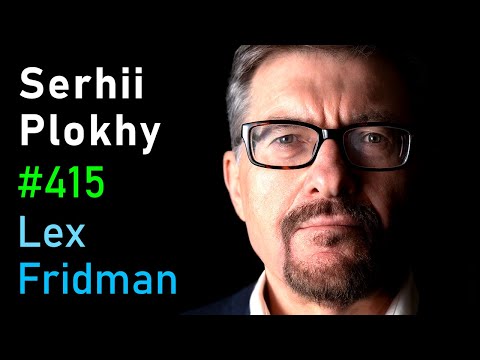
Serhii Plokhy: History of Ukraine, Russia, Soviet Union, KGB, Nazis & War | Lex Fridman Podcast #415
Serhii Plokhy (guest), Lex Fridman (host)
In this episode of Lex Fridman Podcast, featuring Serhii Plokhy and Lex Fridman, Serhii Plokhy: History of Ukraine, Russia, Soviet Union, KGB, Nazis & War | Lex Fridman Podcast #415 explores historian Serhii Plokhy Dissects Empire, Ukraine, Putin, and War Myths Lex Fridman speaks with historian Serhii Plokhy about the long arc of Russian and Ukrainian history, from Kievan Rus and the rise of Moscow to the Soviet Union’s collapse and today’s war. Plokhy frames the USSR’s end as the final phase of a centuries‑long imperial breakup, with Ukraine’s 1991 independence as a decisive turning point. They unpack nationalist myths, Nazi and neo‑Nazi narratives, the role of Bandera, KGB operations, and how propaganda around “denazification” functions inside Russia. The conversation ends by linking Chernobyl, nuclear risk, and the new Cold War dynamic between the U.S. and China, asking what history can teach about avoiding global catastrophe.
Historian Serhii Plokhy Dissects Empire, Ukraine, Putin, and War Myths
Lex Fridman speaks with historian Serhii Plokhy about the long arc of Russian and Ukrainian history, from Kievan Rus and the rise of Moscow to the Soviet Union’s collapse and today’s war. Plokhy frames the USSR’s end as the final phase of a centuries‑long imperial breakup, with Ukraine’s 1991 independence as a decisive turning point. They unpack nationalist myths, Nazi and neo‑Nazi narratives, the role of Bandera, KGB operations, and how propaganda around “denazification” functions inside Russia. The conversation ends by linking Chernobyl, nuclear risk, and the new Cold War dynamic between the U.S. and China, asking what history can teach about avoiding global catastrophe.
Key Takeaways
View the Soviet collapse as the final stage of Russian imperial disintegration, not just an ideological failure.
Plokhy argues that 1991 was a continuation of an imperial breakup that began in 1917, driven by rising nationalisms (including Russian nationalism), economic crisis, and center–periphery tensions—similar to other empires, not a unique ideological event.
Get the full analysis with uListen AI
Ukraine’s independence decision in 1991 made the USSR unsustainable and remains central to Russian power ambitions.
Ukraine’s referendum and exit deprived Moscow of its second‑largest republic, key industry, and cultural ‘near twin’; Yeltsin abandoned the Soviet project once Ukraine left, and Plokhy stresses that any future Russian bid to control the post‑Soviet space again hinges on Ukraine.
Get the full analysis with uListen AI
The ‘denazification’ justification relies on propaganda, historical trauma, and selective facts rather than current realities.
Plokhy notes Ukraine’s far right is electorally marginal (no far‑right party in parliament, ~2% pre‑war), and stresses that focusing narrowly on Bandera or SS units while ignoring millions who fought in the Red Army is a classic propaganda tactic that exploits WWII memory in Russia.
Get the full analysis with uListen AI
Imperial and ecclesiastical narratives still shape Putin’s policy and worldview toward Ukraine.
Putin’s essay on the ‘historical unity’ of Russians and Ukrainians echoes 19th‑century imperial ideology and the Russian Orthodox Church’s notion of one ‘Russian people’ (Great, Little, and White Russians), delegitimizing Ukrainian statehood and justifying intervention.
Get the full analysis with uListen AI
Ukraine’s political culture is fundamentally more pluralistic and anti‑authoritarian than Russia’s, affecting how both wage and experience war.
Plokhy contrasts Russia’s state‑centric, imperial tradition with Ukraine’s history of rebellions, regional diversity, and negotiated politics; he argues this underpins Ukraine’s democratic resilience, mass mobilization, and the shock Ukrainians felt at large‑scale Russian bombardment.
Get the full analysis with uListen AI
Nuclear technology is technically safe per unit of energy but politically fragile and highly vulnerable to rare, high‑impact failures.
Looking across Chernobyl, Fukushima, and war‑time threats to plants like Zaporizhzhia, Plokhy emphasizes that accidents arise from secrecy, authoritarian management, first‑generation operators, and now warfare; each big incident triggers global political backlash, making nuclear unreliable as a long‑term climate solution.
Get the full analysis with uListen AI
The world is sliding back into a Cold War–like structure, now centered on Washington and Beijing, not Washington and Moscow.
The Ukraine war has weakened Russia as a potential separate ‘pole’ while revitalizing Western alliances and pushing Russia toward China; Plokhy argues the key historical lesson from the original Cold War is not how it began, but how leaders kept it from turning into a hot global war.
Get the full analysis with uListen AI
Notable Quotes
““The Soviet collapse is continuation of the disintegration of the Russian Empire that started back in 1917.””
— Serhii Plokhy
““If Ukraine is gone, Russia is not interested in this Soviet project.””
— Serhii Plokhy (paraphrasing Boris Yeltsin to George H. W. Bush)
““If that’s the real goal of the war, probably the war would have to start not against Ukraine, but probably against France.””
— Serhii Plokhy (on Russia’s ‘denazification’ claim)
““Ukraine is the only country in the world outside of Israel who has a Jewish president… and there is no far right in the parliament.””
— Serhii Plokhy
““We are not done yet with nuclear accidents… next accident would actually expose a new vulnerability.””
— Serhii Plokhy
Questions Answered in This Episode
How should we weigh nationalist mythmaking on both the Russian and Ukrainian sides when trying to understand the roots of this war?
Lex Fridman speaks with historian Serhii Plokhy about the long arc of Russian and Ukrainian history, from Kievan Rus and the rise of Moscow to the Soviet Union’s collapse and today’s war. ...
Get the full analysis with uListen AI
If the Soviet Union’s collapse was an imperial breakup rather than an ideological failure, what does that imply for the future stability of the Russian Federation itself?
Get the full analysis with uListen AI
What practical methods can democracies use to counter propaganda like ‘denazification’ without being trapped on its terms?
Get the full analysis with uListen AI
Given Ukraine’s war‑time centralization of power, what concrete safeguards are needed to ensure it remains a democracy after the war?
Get the full analysis with uListen AI
In a world of renewed great‑power rivalry, how can we realistically reduce nuclear risk when new nuclear states and active wars near reactors are emerging?
Get the full analysis with uListen AI
Transcript Preview
What happened during World War II was that once the Germans started to run out of, uh, of manpower, they created foreign legion groups. But because those people were not Aryans, they couldn't be trusted, so they were put under the command of Heinrich Himmler, uh, under command of SS, and became known as SS Waffen units. And, uh, one of such units was created in Ukraine.
The following is a conversation with Serhii Plokhy, a historian at Harvard University, and the director of the Ukrainian Research Institute, also at Harvard. As a historian, he specializes in the history of Eastern Europe, with an emphasis on Ukraine. He wrote a lot of great books on Ukraine and Russia, the Soviet Union, on Slavic peoples in general across centuries, on Chernobyl and nuclear disasters, and on the current war in Ukraine. A book titled the Ruso-Ukrainian War: The Return of History. This is the Lex Fridman Podcast. To support it, please check out our sponsors in the description. And now, dear friends, here's Serhii Plokhy. What are the major explanations for the collapse of the Soviet Union? Maybe ones you agree with and ones you disagree with.
Very often, people confuse three different processes that were taking place in the late '80s early '90s, and the one was the collapse of communism as ideology, another was the end of the Cold War, and the third one was the end of the Soviet Union. Uh, all of these processes were inter-related, interconnected, but when people provide ideology as the explanation for all of these processes, that's where I disagree, because ideological collapse, uh, happened on the territory of the Soviet Union in general. The Soviet Union lost the Cold War, whether we are talking about Moscow, Leningrad, or Saint Petersburg now, or Vladivostok. But the fall of the Soviet Union is about a story in which Vladivostok and Saint Petersburg ended up in one country, and Kiev, Minsk, and Əməkdaşı ended in different countries. So, the theories and explanations about how did that happen, for me, these are really very helpful theories for understanding the Soviet collapse. So, the mobilization from below, the collapse of the center, against the background of economic collapse, against the background of ideological, uh, ideological implosion, that's, that's how I look at the, at the fall of the Soviet Union, and that's how I look at the theories that explain that collapse.
So, it's a story of geography, ideology, economics. Which are the most important to understand of what made the collapse of the Soviet Union happen?
The Soviet collapse was unique, but not more unique than collapse of any other empire. So, what we really witnessed, uh, or the, the, the world witnessed back in 1991, and we continue to witness today with the Russian aggression against Ukraine, is a collapse of one of the largest world empires. We talk about, or talked about the Soviet Union, and now talk about Russia as possessing plus/minus one-sixth of the surface of the Earth. You don't get in possession of one-sixth of the Earth by being a nation-state. You get that sort of size as an empire. And, uh, the Soviet collapse is continuation of the disintegration of the Russian Empire that, uh, started back in 1917, that was arrested for some period of time by the Bolsheviks, by the communist ideology, which w- which was internationalist ideology, and then came back in full force in the late '80s and early '90s. So, the most important story for me, this is the story of the continuing collapse of the Russian Empire and the rise of, uh, not just local nationalism, but also rise of Russian nationalism that turned out to be as destructive force for the imperial or multi, multiethnic, multinational state as was, mm, Ukrainian nationalism, or Georgian, or, or, mm, Estonian for that matter.
Install uListen to search the full transcript and get AI-powered insights
Get Full TranscriptGet more from every podcast
AI summaries, searchable transcripts, and fact-checking. Free forever.
Add to Chrome